

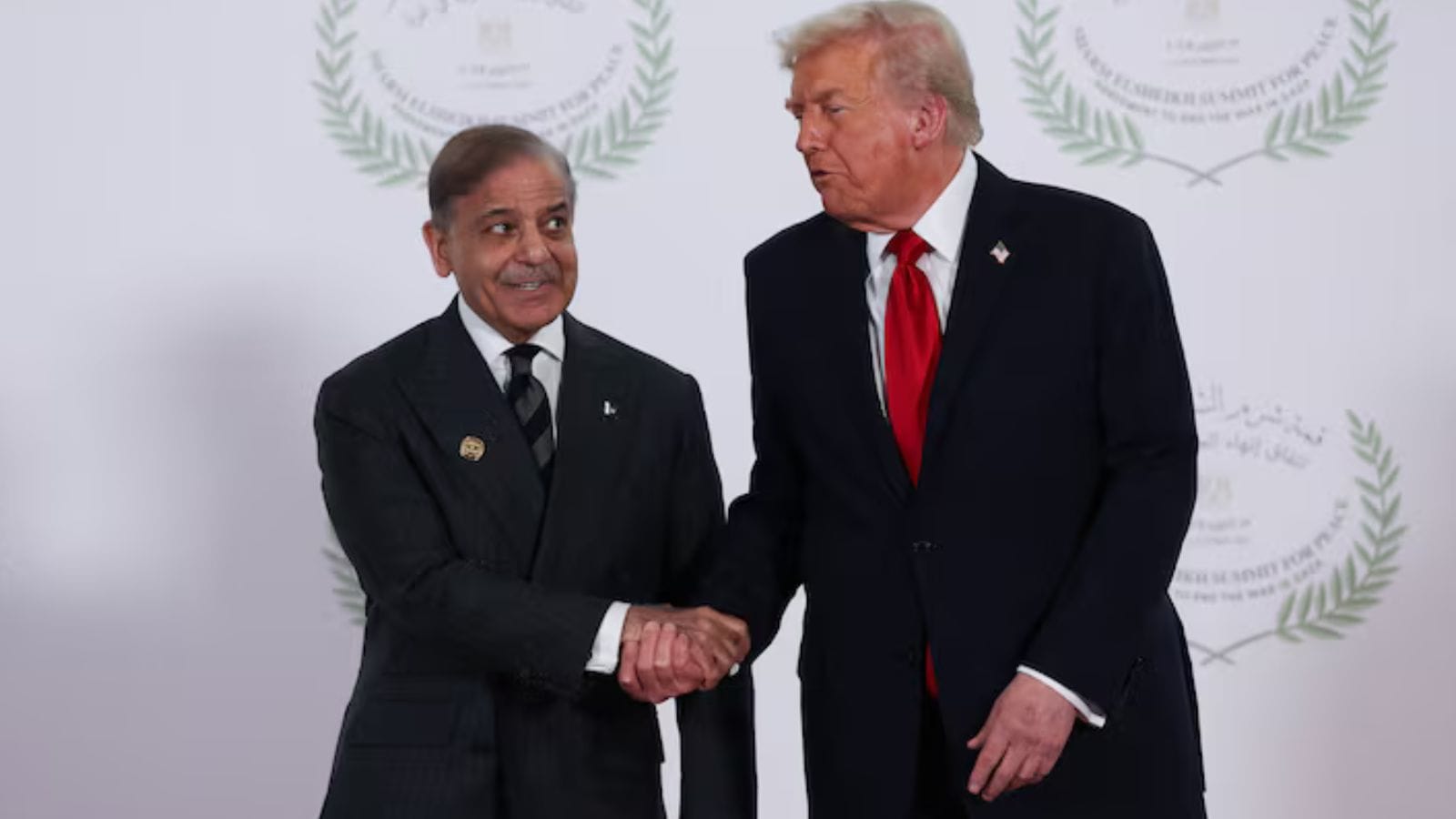
Iran-US war 2026: Tehran has received a 15-point proposal from America to reach a ceasefire in the Iran-US-Israel war 2026, news agency Associated Press quoted two Pakistani officials as saying on Wednesday. The Pakistani officials described the proposal broadly as touching on sanctions relief, civilian nuclear cooperation, a rollback of Iran’s nuclear programme, monitoring by the International Atomic Energy Agency, missile limits and access for shipping through the Strait of Hormuz, the narrow mouth of the Persian Gulf.
The plan was submitted to Iran by intermediaries from the government of Pakistan, which has offered to host renewed negotiations between Washington and Tehran, a person briefed on the plan’s contours but who was not authorised to speak publicly told AP on Tuesday.

Now the big question: Why has Pakistan offered mediation?
On the morning of February 28, 2026, as the first damage assessments from ‘Operation Epic Fury’, named by the US, were still coming in, Pakistan’s worst nightmare was yet to come. Supreme Leader Ayatollah Ali Khamenei was dead. Iranian missile sites were burning. And the Strait of Hormuz, the narrow waterway through which nearly a fifth of the world’s oil and gas moves every day, was effectively closed.
Also Read | Iran rejects US’ 15-point plan to end West Asia war, lays out own conditions. What are Tehran’s 5 demands?
In the days that followed, fuel prices climbed sharply across Pakistani cities. Pakistani Prime Minister Shehbaz Sharif ordered sweeping austerity measures as the Iran war triggered an oil crisis, and Islamabad’s military leadership, already fighting Afghan Taliban forces, was confronting what a destabilised Iran on its western border would actually mean.
In the next few weeks, Pakistan emerged as the most active diplomatic player in the conflict, passing messages between Washington and Tehran, offering Islamabad as a neutral venue for talks, and positioning Field Marshal Asim Munir as the back-channel bridge between Trump and a fractured Iranian leadership.
According to a report by TRT World, Pakistan has emerged as a key mediator to end the US-Israel war on Iran, with a summit said to be on the cards.
Story continues below this ad
📋 The Proposal
A 15-Point Ceasefire Plan, Delivered Via Pakistan
The US has submitted a comprehensive deal to Iran through Pakistani intermediaries. Pakistani and Egyptian officials described the plan broadly — it covers five major areas aimed at halting the Middle East conflict.
🔑 Key Provisions in the Plan
🏦
Sanctions Relief
The plan offers to roll back economic sanctions that have long crippled Iran’s economy.
☢
Nuclear Rollback
Demands a pullback of Iran’s nuclear programme — a longstanding Western demand.
🚀
Missile Limits
Requires limits on Iran’s ballistic missile programme — historically a non-starter for Tehran.
🚢
Reopen Strait of Hormuz
Iran to restore full passage through the strait — through which a fifth of the world’s oil flows.
⚔
Militia Support Restrictions
Iran to limit backing for armed regional groups — added to the plan by Egyptian mediators.
🚫 Flat Rejection
Iran’s Military Dismisses Any Possibility of Talks
Iran’s Khatam Al-Anbiya Central Headquarters — which commands both the regular military and the Revolutionary Guard — publicly dismissed the ceasefire effort. Iranian leaders have repeatedly denied talks are happening, even as the foreign minister maintains contact with third-party nations.
“Our first and last word has been the same from day one, and it will stay that way: Someone like us will never come to terms with someone like you. Not now, not ever.”
— Lt. Col. Ebrahim Zolfaghari, Spokesman, Khatam Al-Anbiya HQ · State TV, March 2026
⚠ Why Iran Distrusts US Diplomacy
💣
Feb 28 Strikes Started the War
Iran says US launched strikes during high-level diplomatic talks — twice under the Trump administration, including the attack that triggered this conflict.
🎯
Israel Is Targeting Iran’s Leaders
Israel has vowed to continue killing Iran’s leadership, making any negotiating authority within Tehran deeply uncertain.
🚀
Missiles & Militia Are Non-Starters
Iran views its ballistic missiles and support for regional proxies as core security architecture — not negotiable items.
“We have a very catastrophic experience with US diplomacy.”
— Esmail Baghaei, Iranian Foreign Ministry Spokesperson · India Today interview, March 2026
🤝 Back-Channel Diplomacy
Pakistan Plays Crucial Go-Between Role
Pakistan physically delivered the US proposal to Iran and is now pushing for in-person talks — possibly as soon as Friday in Islamabad. Egypt is also involved, having added militia restriction clauses to the plan during mediation.
👥 Who Is Negotiating?
🇵🇰
Pakistan — The Courier
Delivered the 15-point plan to Tehran. Now pushing for direct US-Iran in-person talks in Islamabad, possibly Friday.
🇪🇬
Egypt — The Shaper
Egyptian officials added the militia restriction clause and described the proposal as “a comprehensive deal” to reach ceasefire.
🇺🇸
US Team — Witkoff, Kushner, Rubio, Vance
Trump confirmed the US is “in negotiations right now” — his diplomatic team includes envoy Steve Witkoff, Jared Kushner, Sec. of State Marco Rubio, and VP JD Vance.
🇮🇱
Israel — Surprised & Resistant
Israeli officials were caught off guard by the ceasefire submission and have been pushing Washington to continue military action against Iran.
🛢 Energy Markets
Oil Touched $120 — Now Below $100 on Ceasefire News
Brent crude has been the sharpest barometer of the conflict. Prices spiked nearly 35% since the war began, driven by Iran’s stranglehold on the Strait of Hormuz. Wednesday’s ceasefire news pulled prices below $100 — but they remain well above pre-war levels.
📊 Brent Crude Price Tracker
📈
+35%
Price rise since war began
🚢
1/5
Of world’s oil via Strait of Hormuz
⚠ Ripple Effects
High Energy Costs Threaten Global Economy
Economists warn sustained high oil prices will push up food costs, basic goods, mortgage rates and auto loans. Iran has also confirmed it is charging ships for Strait of Hormuz passage — adding a direct toll to the energy chokehold.
💀 The Toll
A Spreading Conflict — Lives Lost Across the Region
The war has drawn in multiple countries. Iran bears the highest confirmed death toll, while Lebanon, Israel, the US military and civilian populations across Gulf states have all suffered casualties.
🌍 Deaths by Country / Group
🇮🇷
1,500+
Deaths in Iran
🇱🇧
1,000+
Deaths in Lebanon
🇮🇱
16
Deaths in Israel
🪖
13
US Military killed
🏘
12+
Civilians: West Bank & Gulf states
📅 Regional Attacks — Mar 25, 2026
Saudi Arabia — Wednesday
Saudi Defense Ministry destroys at least 8 Iranian drones over the oil-rich Eastern Province.
Kuwait — Wednesday
Drone hits fuel tank at Kuwait International Airport. Firefighters contain major blaze. Multiple other drones shot down.
Bahrain — Wednesday
Missile alert sirens sounded across Bahrain as Iran keeps up Gulf pressure.
Israel & Iran — Ongoing
Israel launches wide-scale strikes on Iranian government infrastructure. Witnesses report hits near Qazvin. Missile sirens sound multiple times in Israel as Iran retaliates.
Sources: Associated Press · Jon Gambrell, David Rising, Munir Ahmed, Aamer Madhani · Samy Magdy (Cairo) · Natalie Melzer (Tel Aviv) · E. Eduardo Castillo (Beijing)
What is happening in the Iran-US war?
The US-Israeli campaign, launched on February 28, targeted Iran’s nuclear infrastructure, IRGC command centres, and political leadership simultaneously. Israel and the US carried out extensive attacks across Iran in the conflict’s opening phase. Khamenei was killed in the opening hours, according to multiple reports.
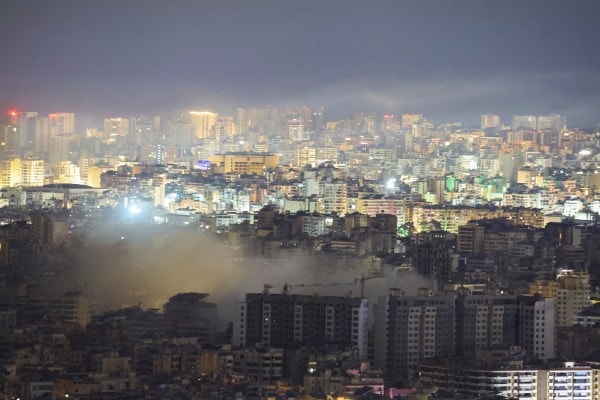 Smoke rises from Beirut’s southern suburbs following an Israeli strike on March 25, 2026. (REUTERS)
Iran hit back hard. Retaliatory strikes have hit Gulf infrastructure and threatened shipping lanes. Al Jazeera documented immense damage in Iran’s streets after continued airstrikes, with the conflict entering its 26th day as of March 25.
Iranian missiles have triggered alerts across central and southern Israel, including near Dimona, home to Israel’s long-suspected atomic weapons programme, though no casualties were reported in the latest volleys, according to the Associated Press.
For Pakistan, which shares a 900-kilometre border with Iran, none of this is abstract.
Story continues below this ad
Pakistan’s three-front tensions
Pakistan’s military was already stretched before this war began. In May 2025, India launched Operation Sindoor, a punitive air and missile campaign targeting what New Delhi described as terror camps in Pakistani-occupied Kashmir and other parts of Pakistan.
Then, in February 2026, Pakistan’s ties with the Afghan Taliban collapsed entirely. The Pakistan Air Force launched strikes on Taliban military positions in Kabul and Kandahar in retaliation for alleged persistent cross-border terrorism by the Tehreek-e-Taliban Pakistan.
Analysts caution that if Iran destabilises further, refugees and militants could flood across Balochistan’s already volatile border, something Pakistan’s overstretched army is ill-equipped to handle. From this perspective, Pakistan’s mediation is motivated less by diplomatic ambition than by urgent security imperatives.
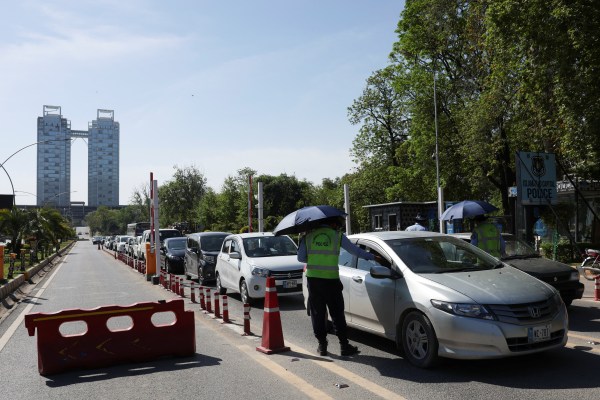 Police officers check identification of drivers at a security check post along a road, as Pakistan offers to help mediate talks between the US and Iran, in Islamabad on March 25, 2026. (REUTERS)
Pakistan, which maintains direct contact with both Washington and Tehran at a time when such channels are frozen for most other countries, would also benefit directly from an end to the war, news agency Reuters reported.
Story continues below this ad
The South Asian nation is home to the world’s second-largest Shia Muslim population after Iran, and faced nationwide protests the day after US and Israeli strikes killed Ayatollah Ali Khamenei at the start of the conflict on February 28.
“Pakistan has unusual credibility as a mediator, maintaining workable ties with both Washington and Tehran, while a history of strained relations with each gives it just enough distance to be seen as a credible go-between,” Adam Weinstein, deputy director of the Middle East programme at the Quincy Institute, told Reuters.
Pakistan has been involved in diplomacy to end the Iran conflict since it started, including shuttling at least half a dozen messages between the US and Iran, Reuters reported, citing five official Pakistani sources.
Before Pakistani Prime Minister Shehbaz Sharif confirmed the offer of talks on Tuesday, one of the Pakistani sources and a foreign source said that officials from both countries could hold talks in Islamabad as soon as the end of this week. The Pakistani source said US Vice President JD Vance, Witkoff and Trump’s son-in-law Jared Kushner were expected to take part.
Story continues below this ad
According to official press releases, over the past month, Sharif and Pakistan’s foreign minister have held over 30 conversations with counterparts in the Middle East, including half a dozen with Iranian officials. Two took place on Monday, the same day the US said mediation efforts were underway, and came alongside a phone conversation between Munir and Trump that was confirmed by the White House.
“Pakistan hosting US-Iran talks represents a major upgrade in Islamabad’s strategic standing,” Kamran Bokhari, senior resident fellow with the Middle East Policy Council in Washington, told Reuters.
“After decades of being a troubled state, Pakistan appears to be re-emerging as a major American ally in West Asia,” he said.
Pakistan’s ties with Iran
Bokhari said Pakistan was Iran’s least adversarial neighbour while maintaining “the closest ties with its historic regional adversary Saudi Arabia and (being) trusted by Washington”.
Story continues below this ad
Iran may perceive it as more neutral than other possible mediators. “Unlike Gulf states like Qatar, Pakistan does not host US military bases and is a military power in its own right,” said Weinstein.
Islamabad’s mutual defence agreement with Riyadh, signed in September, requires both countries to come to the other’s aid and has therefore weighed on calculations.
As the US war in Iran entered its second week and Tehran struck Saudi Arabia, Pakistan’s foreign minister Ishaq Dar said he had reminded Iran of the pact and was attempting to mediate with Iran. Security sources in Pakistan said Islamabad was bound by the pact but was working to avoid entering the conflict through its backchannel talks with Tehran, the Reuters report added.
Energy crisis forcing Pakistan to get involved
When Operation Epic Fury killed Supreme Leader Khamenei on February 28 and effectively closed the Strait of Hormuz, Pakistan’s economy went into immediate crisis. More than 85 per cent of Pakistan’s energy transits the Strait. The government imposed a four-day work week and emergency school closures almost immediately. Oil hit $104 a barrel. LNG stocks are running out.
Story continues below this ad
At the same time, Pakistan’s military is already stretched across two active border conflicts, a volatile standoff with India to the east, and an ongoing fight against Afghan Taliban forces to the west. A destabilised Iran on a third border, Islamabad cannot afford now.
Pakistani Prime Minister Shehbaz Sharif said Tuesday on X that “Pakistan welcomes and fully supports ongoing efforts to pursue dialogue to end the WAR in Middle East, in the interest of peace and stability in region and beyond.”
He continued, “Subject to concurrence by the US and Iran, Pakistan stands ready and honoured to be the host to facilitate meaningful and conclusive talks for a comprehensive settlement of the ongoing conflict. Sharif spoke Monday with Iranian President Masoud Pezeshkian and “underscored the urgent need to work collectively for de-escalation and a return to dialogue and diplomacy,” according to a readout from the Pakistani Foreign Affairs Ministry, the NBC reported.
That access exists because of Field Marshal Asim Munir’s personal rapport with Trump, built during the 2025 India-Pakistan crisis. On the Iranian side, Pakistan has hosted Iran’s diplomatic interests section inside its Washington embassy since 1992, making it Tehran’s only institutional back-channel to the US, according to Iran International.
Story continues below this ad
By Wednesday, the AP confirmed Pakistan had delivered a 15-point US ceasefire proposal to Iran. The 15-point plan now in Iranian hands is “a comprehensive deal” to reach a ceasefire, according to the Egyptian official. Mediators are pushing for possible in-person talks between the Iranians and the Americans, perhaps as soon as Friday in Pakistan, the Egyptian and Pakistani officials said, the AP added.
Speaking Tuesday at the White House, Trump said the US is “in negotiations right now” and that the participants included special envoy Steve Witkoff, his son-in-law Jared Kushner, Secretary of State Marco Rubio and Vice President JD Vance. He has not said who from Iran they are in contact with.
“We have a number of people doing it,” Trump said. “And the other side, I can tell you, they’d like to make a deal.”
Iran’s Khatam Al-Anbiya Central Headquarters, which commands both the regular military and the paramilitary Revolutionary Guard, dismissed the idea of talks. Iranian leaders have repeatedly denied they are happening, while acknowledging that the foreign minister is in contact with various countries but not the US or Israel.
(With inputs from agencies)
