

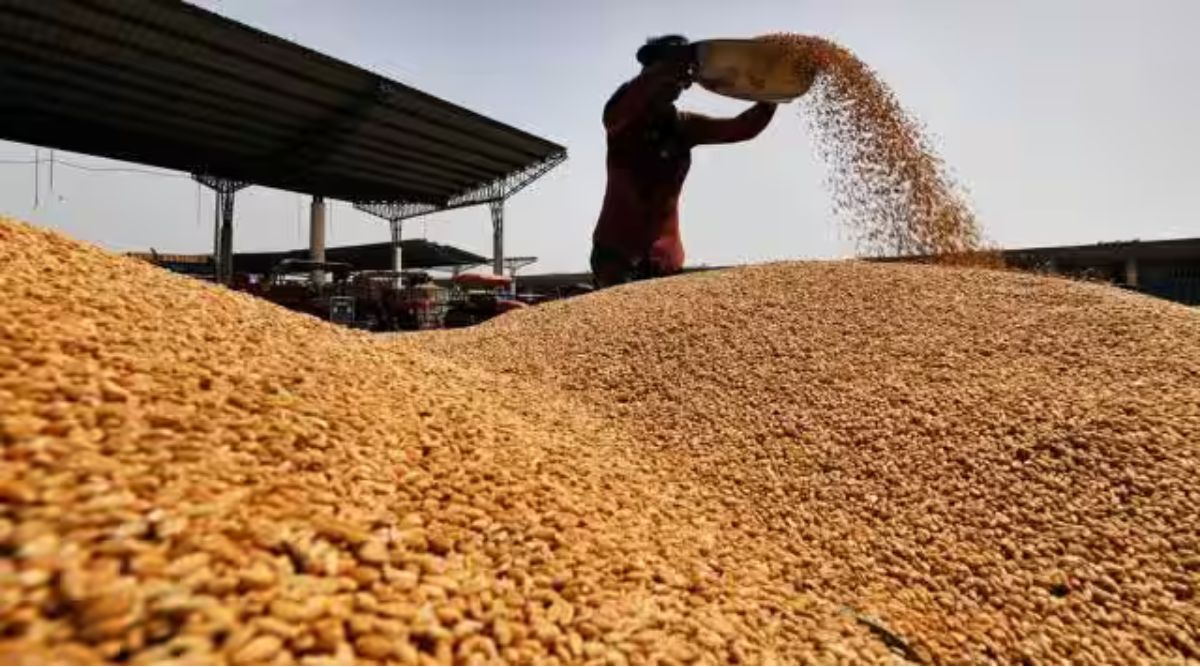
Battling a severe storage crunch ahead of the upcoming wheat procurement season, the Punjab government has come up with a plan to deploy 860 special trains in April, May and June to transport freshly procured wheat directly from mandis to consuming states.
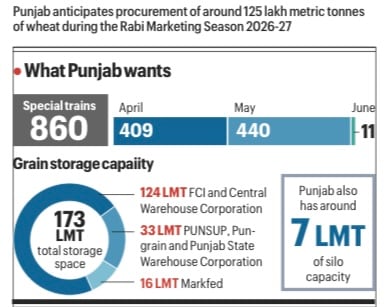
The state anticipates procurement of around 125 lakh metric tonnes (12.5 million tonnes) of wheat during the Rabi Marketing Season (RMS) 2026–27, which begins on April 1, according to an official communication dated March 20, 2026, from the Department of Food, Civil Supplies and Consumer Affairs to the Food Corporation of India (FCI).
However, higher procurement in previous years coupled with slower movement of grain has led to an acute shortage of storage space. Despite efforts to create additional storage, a significant gap remains, particularly Amritsar and Tarn Taran districts.
To address the issue, the state plans to bypass traditional storage routes and move wheat directly via railways. In total, 22.06 lakh metric tonnes of wheat will be transported through 860 special trains, with 409 trains scheduled for April, 440 for May, and 11 for June.
The distribution of rakes reflects the intensity of storage pressure across districts. Tarn Taran will see the highest allocation with 97 trains (2,54,012 MT), followed by Patiala with 90 trains (2,22,863 MT) and Amritsar with 80 trains (2,08,000 MT). Other districts including Muktsar, Ferozepur, Sangrur, Gurdaspur, Ludhiana, Bathinda, Kapurthala, and Moga will also contribute to the movement.
Officials acknowledged that while the situation remains challenging, the plan could provide partial relief. “It may not fully solve the crisis, but it will certainly ease the pressure on storage and ensure smoother procurement during peak arrivals,” said a senior officer.
A senior official, speaking on condition of anonymity, said that Punjab consistently procures more grain than it consumes, making timely transportation to deficit states critical. Delays, he added, have a cascading effect on storage, milling, and procurement operations.
 Screenshot
An FCI official added: “Every year we face delayed movement, storage shortage, and last-minute firefighting to manage surplus stock”.
Punjab currently has a covered storage capacity of about 173 lakh metric tonnes, including 48 lakh metric tonnes managed by FCI, with the remainder handled by state agencies such as warehouses, Markfed, and PUNSUP. The state also has around 7 lakh metric tonnes of silo capacity. While Punjab procures nearly 300 lakh tonnes annually for the central pool, officials estimate that 190–200 lakh metric tonnes of capacity is sufficient if grain evacuation is carried out efficiently.
Story continues below this ad
Meanwhile, the plan has drawn sharp criticism from arhtiyas (commission agents), who have questioned the strategy of prioritizing movement of freshly procured wheat over the existing stock, which may loss the nutritional value if stored for long
Prem Goel, president of the Arhtiyas Association Punjab, raised concerns about both timing and grain quality. “If old stock is not cleared in time, its nutritional value will deteriorate, leading to losses,” he said, adding that there is no justification for delaying its movement when it can be transported at any time.
He also questioned the scheduling of trains. “Wheat arrivals begin in early April, peak by mid-April, and largely end by April itself, with only limited arrivals in early May. However, the government has scheduled 440 out of 860 trains in May, raising logistical questions,” he said.
“Who will manage the wheat lying in mandis during May?” he asked. “Once farmers sell their produce, the responsibility lies with agencies, and trains will move grain out the grain in the entire month, freshly procured stocks may remain exposed in mandis”.
Goel further warned about the impact of extreme summer heat on grain quality. Wheat procured at 12–14% moisture content could dry further in May, leading to weight loss. “In such cases, the financial burden is often shifted onto arhtiyas,” he said.
Calling the plan flawed, arhtiyas called for immediate clearance of old stock. “Instead of prioritizing new wheat, the government must begin lifting old stock immediately,” they said, emphasizing that such a move would free up storage space, preserve grain quality, and streamline procurement operations.
Ravinder Singh Cheema, president of Punjab Arhtiya Association, said trains will move at their own pace and who will look after procured wheat in mandis?. He suggested that instead of delaying the process, the stock should first be lifted from the mandis and then transported via trains.
Story continues below this ad
He further added that priority should have been given to clearing old stock earlier, so that freshly procured produce could be stored properly in the godowns without any inconvenience..
Vijay Kalra, president of the Federation of Arhtiya Association of Punjab, Khalra, said that this issue was discussed in a meeting held in Chandigarh today.
He further said that the federation had earlier organised a massive protest on March 16 in the Firozpur area, raising concerns over the reduction of the 2.5% commission and the low commission being paid on stocks stored in silos.
Khalra also stated that payments amounting to around ₹55 crore are still pending towards the arhtiyas.
