

Spanish Defence Minister Margarita Robles announced Monday (March 30) that the Spanish government would allow neither its airspace nor jointly operated military bases to be utilised by American military aircraft for any operations linked to the ongoing war in Iran.
Framing this decision as a follow-up to freezing the USA out of their bases situated in Rota and Moron, she went on to classify the war in Iran as a “profoundly illegal and unjust” action. Her statements were complemented by Economy Minister Carlos Cuerpo’s affirmation that this step was part of a larger decision not to participate in a war initiated unilaterally in flagrant violation of international law.

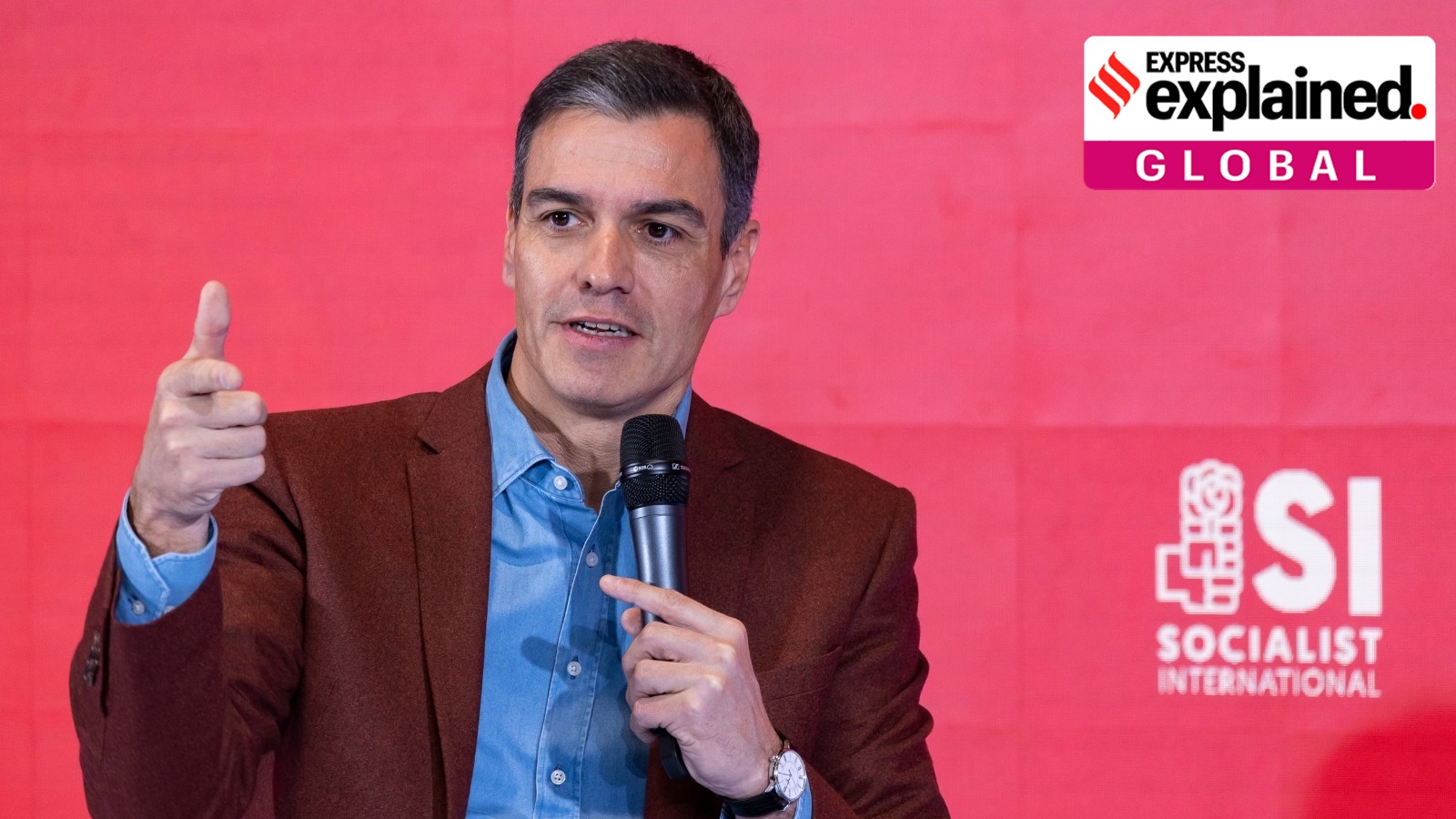
This is the latest in a series of disagreements between Madrid and Washington in recent months, with Spanish Prime Minister Pedro Sanchez and his party having painted themselves as the vocal lead of the ‘Anti-Trump’ coalition. Famously rejecting US President Donald Trump’s bid for all NATO member states to pledge 5% of their budgets for defence and security, he also publicly questioned the validity of the American operation in Venezuela earlier this year.
Threatened with a full trade embargo by Trump alongside heightened tariffs, what does Pedro Sanchez possibly hope to gain by antagonising the US? What complications arise with the imposition of the airspace ban and how would the ban work? We explain.
Airspace ban
Strongly reiterating that this ban was only targeted at aircraft operating under the banner of US military operation ‘Epic Fury’, Spain has made it clear that the latest order does not restrict any other aviation assets per their bilateral agreement with Washington.
With the US forced to relocate multiple aircraft and at least 15 KC-135 refuel tankers in recent days, the Spanish ban restricts in-flight or mid-air refuelling of aircraft in its airspace as well. This has prompted tankers positioned in the region to sail towards France and Germany.
Story continues below this ad
Circling in on the Fairford air base in Gloucestershire, UK, Trump managed to secure the necessary permissions from Prime Minister Keir Starmer to set up shop there alongside their pre-existing base in Diego Garcia in the Indian Ocean. The caveat attached, however, was that Fairford be used only for “defensive missions”. This restricts their use to countering Iranian missiles targeting Gulf neighbours and British bases.
Furthermore, it complicates movement since bombers departing Fairford must cross most of France and immediately refuel upon reaching the Mediterranean which is a significant weakness. Should they choose to not fly through France, these bombers must enter via the Strait of Gibraltar and refuel through the KC-46 Pegasus tanker situated at Laiges air base, Azores.
Possible motivations
While intentionally damaging the logistical capabilities of the United States military appears to be a highly risky geopolitical gamble, Sánchez’s motivations are deeply rooted in domestic political survival.
Presiding over one of the most fragile mandates in modern Spanish history, his minority coalition is paralysed within their domestic parliament. Composed of centre-left PSOE and far-left Sumar, they are heavily dependent on the transactional support of regional separatist parties to pass routine legislation like the national budget. Additionally, his administration is engulfed in the sprawling “Koldo case” corruption probe, which has severely damaged his approval ratings.
Story continues below this ad
With the inability to successfully execute domestic agendas, Sánchez has strategically pivoted to the international stage, where executive action bypasses parliamentary gridlock.
His narrative framing their opposition to Washington as a principled defence of Spanish sovereignty against American economic and military coercion resounds on two separate forks. First, he pacifies his anti-war, anti-imperialist left-wing coalition partners, who cannot afford to collapse a government actively championing their core ideological causes globally.
Simultaneously, he springs a trap on his conservative rivals, the People’s Party and Vox. Trump’s aggressive trade policies and pro-military interventionism are deeply unpopular among the Spanish electorate. Sanchez’s very public vocalisations have seemingly forced the right-wing opposition into a sharp corner; either align with a hostile foreign administration threatening Spanish exports, or quietly validate Sánchez’s leadership.
