

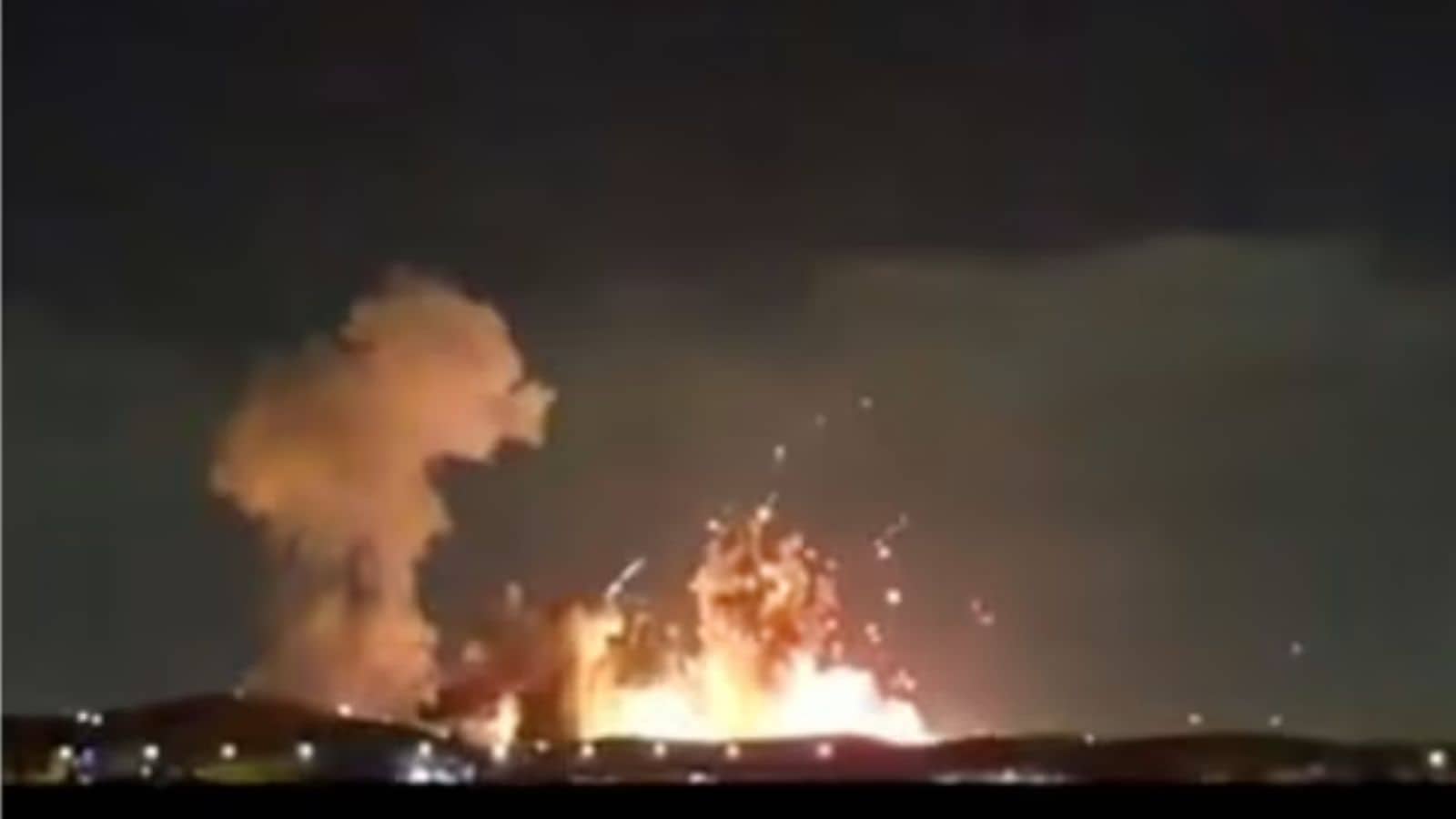
The US and Israeli forces struck an ammunition depot in Iran’s Isfahan early Tuesday, reported the Wall Street Journal.
Footage posted by Trump on Truth Social shows multiple blasts followed by fires lighting up the night sky. The video, which was posted without any context, could not be independently verified.

According to US officials, cited by The Wall Street Journal, the strike involved 2,000-pound (about 907-kg) bunker-buster bombs targeting a military-linked site in Isfahan, a central Iranian city that hosts key defence facilities, including the Badr airbase. Reports said the initial strike triggered secondary explosions across the area.
The development comes as the war entered its second month, with regional powers including Pakistan, Egypt, Saudi Arabia and Turkey holding talks to explore a diplomatic way out.
Trump has warned Iran that if talks with the “new, and more reasonable regime” don’t lead to a deal and the reopening of the Strait of Hormuz, the US will destroy Iranian energy sites, including power plants, oil wells, and Kharg Island
Story continues below this ad
What are bunker-buster bombs?
US Arsenal
Four bombs, one mission: defeat what’s buried
The US fields a tiered family of penetrating munitions — from tactical strikes on reinforced bunkers to the GBU-57 MOP, the largest conventional bomb in the US arsenal at 30,000 lbs, designed for the most heavily fortified underground sites.
GBU-28
GBU-28 “Deep Throat” — ~5,000 lbs
Tactical strikes on reinforced concrete and deep earth. Delivered by F-15E and B-2. Original casing machined from surplus 8-inch howitzer barrels.
GBU-72
GBU-72 A5K — ~5,000 lbs
Modern successor to the GBU-28 with advanced “smart” fuzing. Delivered by F-15E.
MOP
GBU-57 MOP — ~30,000 lbs
“Massive Ordnance Penetrator.” Reserved for the most heavily fortified sites. Only deliverable by B-2 Spirit and B-21 Raider stealth bombers.
B61
B61-11 — Variable yield (nuclear)
Nuclear earth-penetrator for destroying entire underground complexes. Delivered by B-2.
4
Primary variants in US inventory
30K
lbs — weight of GBU-57 MOP
B-21
Raider — newest MOP platform
The Science
Not an explosion on impact — a massive nail driven into a wall
Bunker busters don’t detonate on contact. They rely on kinetic energy and a hardened body to physically drill through soil, rock, and reinforced concrete before the explosive fires.
Stage 1 — Casing & Material
Material
Eglin Steel alloy or depleted uranium — body that won’t shatter on impact
Shape
Long and thin (high sectional density) — all weight focused onto a tiny tip area
Stage 2 — Guidance & Velocity
90°
Near-perfect impact angle required
GPS and laser guidance (JDAM/Paveway) direct the bomb to a soft spot — ventilation shaft or entrance — at close to 90 degrees. A hit at angle fails to penetrate.
▴
Supersonic terminal velocity
Gravity-fed from high altitude to reach supersonic speed. Some variants use rocket boosters to add extra velocity just before impact.
The Brain
If the bomb explodes the moment it hits the roof, it fails
The Hard Target Smart Fuze (HTSF) uses accelerometers and a microprocessor to count layers as the bomb penetrates — detecting the difference between soil, concrete, and empty space — firing only when it senses the target room.
1
Accelerometer reads deceleration signature
Soil, rock, and concrete each produce a distinct deceleration profile. The microprocessor logs each material transition as the bomb bores through.
2
Programmed to skip floors
The fuze can be set to ignore the first three floors of a building and only detonate on a specified layer — for instance, the fourth void below ground level.
◯
Void sensing — the trigger
The fuze detects the abrupt absence of deceleration — the moment the bomb enters empty air inside the bunker room. That void is the detonation signal.
HTSF
Hard Target Smart Fuze — standard on modern variants
3+
Distinct material layers the fuze can count and skip
Detonation
The camouflet: why underground explosions are far more lethal
When a bunker buster detonates deep underground, energy that would escape upward into the atmosphere has nowhere to go. It bounces off surrounding rock repeatedly, crushing the structure from within. This underground cavity effect is called a camouflet.
Standard vs Thermobaric Variant
Standard HE
Contained shockwave collapses walls and ceiling onto occupants
Thermobaric
Fuel cloud fills tunnels, ignites — pressure wave travels around corners, removes all oxygen
Why Depth Multiplies Lethality
↑
Surface burst: energy escapes upward
A surface explosion dissipates most of its energy into the atmosphere. Structural damage is concentrated near the impact point only.
●
Underground burst: energy is trapped and amplified
The same yield underground creates a camouflet — the shockwave reflects off surrounding rock repeatedly. Bunker walls and ceiling are crushed inward.
Sources: US Air Force · Federation of American Scientists · GlobalSecurity.org
The B-2 Spirit is one of the most sophisticated and secretive aircraft ever built. Developed by Northrop Grumman during the Cold War, the bomber was designed for deep-penetration missions in contested airspace. Only 21 were produced after the collapse of the Soviet Union, with each unit costing an estimated $2.1 billion, according to news agencyReuters.
The aircraft’s bat-like design and radar-absorbing materials make it nearly invisible to radar, giving it a radar cross-section said to be comparable to that of a small bird. Operated by a two-pilot crew, the B-2 uses extensive automation to reduce human workload and risk.
Range and flight capabilities
The B-2 Spirit has a range of approximately 7,000 miles (11,000 kilometres) without refuelling and up to 11,500 miles (18,500 kilometres) with one refuelling, allowing it to reach any point in the world within hours.
Payload Capacity
The B-2 can carry a massive payload of 40,000 pounds (20 tons), which includes:
Story continues below this ad
- Other Munitions: Various combinations of guided and unguided bombs, depending on the mission requirements.
- Bunker Busters: Up to two GBU-57 Massive Ordnance Penetrator (MOP) bombs, each weighing 30,000 pounds.
- Precision-Guided Munitions: 80 500-pound Mk 82 bombs, 16 2,000-pound JDAMs, or 16 nuclear B61/B83 bombs
The B-2 is a versatile and powerful aircraft, capable of delivering a wide range of munitions to targets around the world.
