

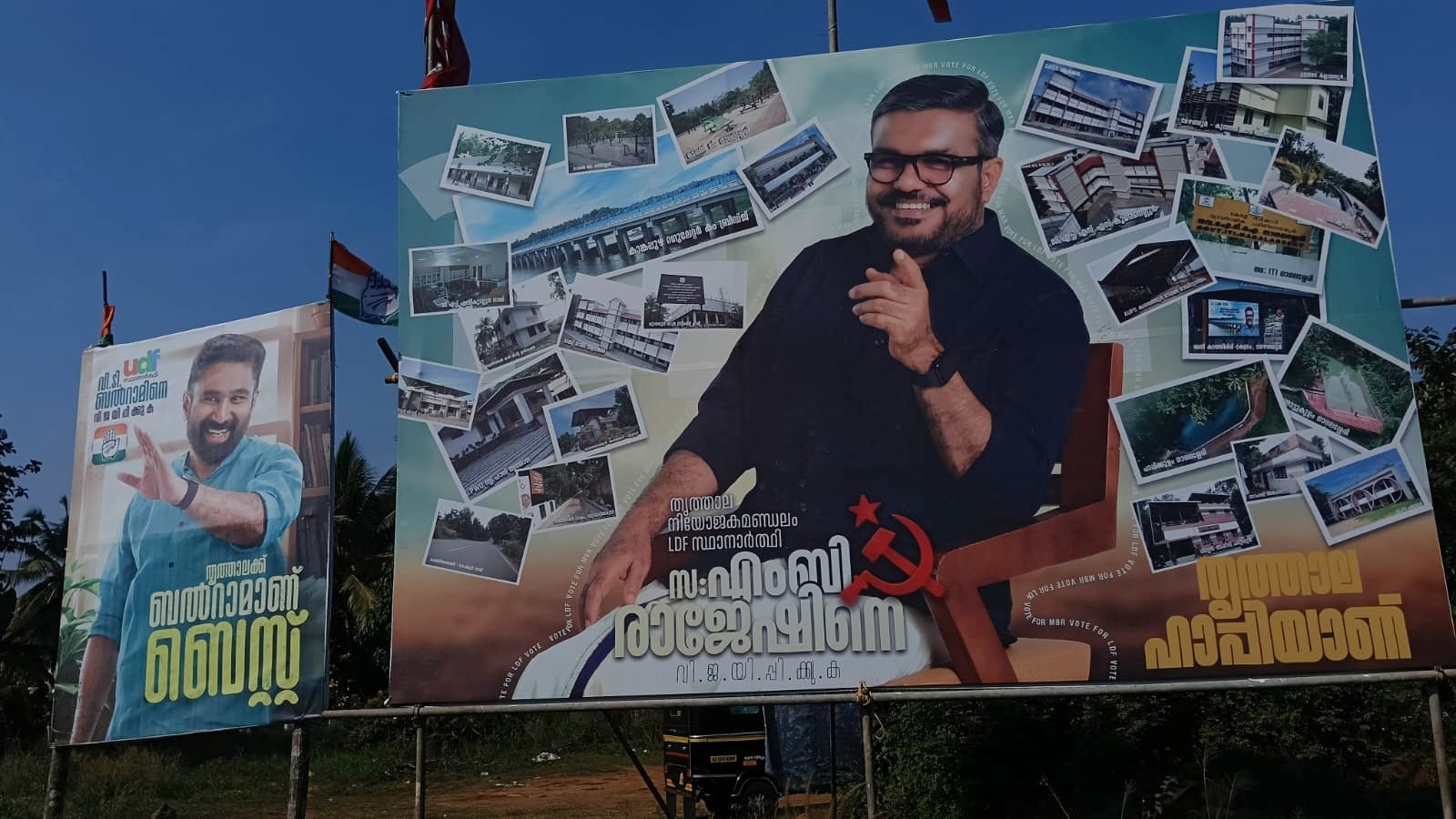
In every village under the Thrithala Assembly constituency in Kerala’s Palakkad district, sitting MLA M B Rajesh has put up massive display boards touting the results of the ruling CPI(M)’s development efforts, tied together with the tagline “Thrithala is happy”. But his Congress rival V T Balram, who won the seat in 2011 and 2016, has his own counter – “Balram is best for Thrithala”.
Much of the discourse in Thrithala, which is scheduled to vote on April 9 and is home to 2.04 lakh voters, is centred on the development of the constituency under the Pinarayi Vijayan-led Left Democratic Front (LDF) government and CPI(M) MLA Rajesh, who is also the state minister of the local self-government department. The headline figure for Thrithala voters is Rs 1,152 crore – the value of various infrastructure projects completed or under progress in the constituency, including roads, bridges, schools and hospitals, over the last five years.

But despite the Left’s prominently publicised development track record, the Opposition Congress-led United Democratic Front (UDF) gained considerable ground in Thrithala during the local body elections held in December 2025. Of the eight panchayats that fall within the constituency, the UDF seized power in five panchayats. The CPI(M) had held the Thrithala panchayat for the last three terms before ceding power to the UDF in the December elections. The BJP challenger in Thrithala is V Unnikrishnan, a retired teacher.
Both Rajesh and Balram, prominent young leaders in their parties, have been running active social media campaigns. In the run-up to voting, Rajesh had challenged Balram to a debate on development, but the Congress leader refused, instead offering a counter through a Facebook post saying, “Let there be a comparison between my 10-year term as MLA (from 2011 to 2021) and his (Rajesh) five-year term as MLA and minister. Let people evaluate who is the best for Thrithala.”
But the high-decibel campaign has shadowed the ground reality in Thrithala. At Kappur village, paddy farmer K Krishnan stands as a stark embodiment of the farm sector crisis. “The government had procured 5,000 kg of paddy from me around two months ago, but not a single rupee has reached me. Hundreds of farmers in the constituency have been betrayed. Many of us have agriculture loans at interest of 4%. If we are not able to repay the farm loans on time, we will have to pay higher interest,” he said.
While villagers in Kappur do not contest the constituency’s development, many feel that the “real issues of unemployment, inflation and farmers’ distress remain unaddressed”. Though Rajesh had implemented the Susthira Thrithala project for sustainable rural development aimed at reviving paddy and vegetable cultivation, around 2,500-odd paddy farmers in the constituency are yet to be paid for the produce procured by the government two months ago.
“Nobody will deny the development in the last 10 years. But youths have no jobs, a few are surviving because of money from the Middle East (as remittances). Many are agricultural and construction workers. Farmers do not get basic prices for their products. The government boosted horticulture crop cultivation, but did go for market intervention. A banana farmer gets only Rs 22 per kg. Traders are selling it for Rs 40 per kg. Many farmers are on distress sale. I cannot point out a single venture that has come in the region to provide jobs,” said Dinesh, a resident of Kozhikkottiri village.
While major roads gleam under scorching sun, several village roads are still dilapidated with many difficult stretches for motorists in the constituency. Construction is still underway on minor roads, with many of them closed now.
Drinking water scarcity still persists in the highlands, and though a few ponds have been renovated, farmers say there is no system to tap the water for agriculture. Large tracts of paddy fields are remaining idle after harvest as for want of irrigation.
On Thursday, CPI(M)’s Rajesh released a manifesto for his constituency, with a focus on agriculture and tourism. It promised comprehensive drinking water projects, vegetable-selling kiosks, a rice mill, and three new bridges to be converted into night tourism destinations.
Hareesh, from the Thirumittacode village, feels change is a must. “People feel there should be a change in the government. They (Left) ruled for a decade. Now change is a must. We get welfare pensions and other benefits. But are they from the pockets of politicians? People see benefits as their rights, not as a largesse,” he said.
Chalissery village resident Aravindan, an auto driver, says, “There have been big construction projects, but does that help ordinary people and their lives? The government has not addressed price rise and things to improve ordinary people’s lives. If you go to any government hospital, we have to buy medicine from outside. So will a new building alone help us?”
In this Hindu-majority constituency with scores of temples, a section of voters also say the alleged gold theft scandal at the Sabarimala shrine has had an impact on the ground. “The MLA will get good marks for his performance. But voting will not be on that alone. People will see a lot of factors, including the temple issue,” said Bindui, a homemaker in Panampatta village.
