

Mains Examination:General Studies II: Indian Economy and issues relating to planning, mobilization, of resources, growth, development and employment.
What’s the ongoing story: Ceramics manufacturers inGujarat’s Morbihave extended their industry shutdown till May 1 — two weeks beyond the earlier deadline of April 15 — after Gujarat Gas Limited announced new piped natural gas prices that tile makers say make restarting production financially unviable.
Key Points to Ponder:
• What is the historical importance of ceramic?
• What is ceramic made of?
• What is Central Glass and Ceramic Research Institute (CGCRI)?
• Why Morbi matters?
• What are the modern applications of ceramic?
• Critical Minerals and Ceramics-connect the dots
Key Takeaways:
• The shutdown, which began on March 17, was triggered by a fuel supply crisis amid the war in Iran. Most of Morbi’s tile-making units run on propane-LPG, all of which is imported from the Persian Gulf.
• The blockade of the Strait of Hormuz has disrupted this supply, pushing tile makers to seek piped natural gas (PNG) as an alternative. It is the new PNG prices quoted to these “returning” users that have now deepened the crisis.
• To be sure, the industry is bearing the brunt of the global energy shock — when The Indian Express visited Morbi on March 19, most tile units had shut down because their propane-LPG stocks were depleted.
Do You Know:
Story continues below this ad
• Morbi accounts for 90% of India’s Rs 75,000-crore ceramic industry. Of the roughly 800 units in the cluster — 650 major and 150 minor — around 500 are tile makers running on propane-LPG, consuming about 55 lakh cubic metres per day.
• India is the world’s second-largest manufacturer and consumer of ceramic tiles, with a robust industry centered in Morbi, Gujarat, which accounts for ~90% of national production. Valued at ₹62,000 crore in FY24, the sector thrives on booming construction, exporting to the USA, Europe, and the Middle East.
• The remaining 150-odd sanitaryware units use PNG, consuming about 25 lakh cubic metres per day. The new pricing stems from a central government notification of March 9, which set a unit’s Daily Contract Quantity (DCQ) at 80% of its average consumption over the previous six months. Since tile makers had little or no PNG usage in that period — having switched to propane-LPG, which was cheaper — they are now classified as non-regular users and charged the higher rate.
Other Important Articles Covering the same topic:
📍Ceramic Exporters fear‘War Risk Surcharge’addingto losses
Previous year UPSC Prelims Question Covering similar theme:
1) The famous female figurine known as ‘Dancing Girl’, found at Mohenjo-daro, is made of (UPSC CSE, 2025)
(a) carnelian
(b) clay
(c) bronze
(d) gold
The Editorial Page
Story continues below this ad
How to fast-track reservation for women in Parliament — a roadmap
Preliminary Examination:Indian Polity and Governance-Constitution, Political System, Panchayati Raj, Public Policy, Rights Issues, etc
Mains Examination:General Studies II: Parliament and State legislatures—structure, functioning, conduct of business, powers & privileges and issues arising out of these.
What’s the ongoing story: S Y Quraishi Writes-The government’s decision, reported in the media, to convene additional sittings of Parliament to debate amendments to the Women’s Reservation Act, 2023, is a welcome and significant step. It signals that a historic reform has now entered the difficult phase of implementation.
Key Points to Ponder:
Story continues below this ad
• Women’s Reservation in the parliament-How will it be implemented?
• Women’s Reservation in the parliament and in the legislative assembly-what are the key highlights?
• The Women’s Reservation Act also Constitution (106th Amendment) Act, 2023-know in detail
• Why Women’s Reservation Act is likely to face various legal and constitutional challenges?
Story continues below this ad
• What can be the possible legal and constitutional challenges in Women’s Reservation Act?
• What is Article 81 of the Constitution?
• Why delimitation is required for the implementation of women reservation?
• Why is women’s participation in politics important?
Key Takeaways:
S Y Quraishi Writes-
• Prime Minister Narendra Modi deserves full credit for accomplishing what had eluded Parliament for nearly three decades. The passage of the Constitution (106th Amendment) Act, 2023, providing one-third reservation for women in the Lok Sabha and state assemblies, was a landmark step. For 26 years, the proposal remained stalled. Its enactment demonstrated political will.
• Current discussions suggest that the strength of the Lok Sabha may be increased from 543 to about 816 seats — an addition of 273 seats. If this entire block of additional seats is reserved for women, it would immediately ensure that one-third of the enlarged House is composed of women, without displacing existing members.
Story continues below this ad
• New seats require constituencies. Constituencies can only be created through delimitation. And delimitation, by law, can only follow a
Census. The next Census is expected after 2026. Even if everything moves quickly, the publication of data, the constitution of a Delimitation Commission, and the completion of its work will take several years. Past experience suggests that delimitation cannot be completed before 2032 or 2033.
• There is also another constitutional issue. The Constitution itself freezes the allocation of seats among states until after the first Census conducted after 2026. Any attempt to change this arrangement earlier would require another constitutional amendment and may reopen the sensitive question of representation between the northern and southern states.
Do You Know:
• According to The Constitution (One Hundred and Twenty-eighth Amendment) Bill 2023, “as nearly as maybe, one-third (including the seats reserved for women belonging to the Scheduled Castes and Scheduled Tribes) of the total number of seats to be filled by direct election to the House of People shall be reserved for women”.
• The 42nd Amendment froze the delimitation exercise until the results of the first Census after 2000 was published. In 2001, this was further extended for 25 years. And now, delimitation would happen after the results of the first Census after 2026 is published.
Story continues below this ad
• The Bill states that one-third of the seats in Parliament and state Assemblies will be reserved for women. However, it doesn’t specify how these seats will be identified.
• The Delimitation Act, 2002 lays down broad principles for reserving seats. The Delimitation Commission appointed under the Act is responsible for deciding the number of Parliamentary and Assembly constituencies to be reserved based on the population.
“Constituencies in which seats are reserved for the Scheduled Castes shall be distributed in different parts of the State and located, as far as practicable, in those areas where the proportion of their population to the total is comparatively large,” Section 9 (1)(c) of the Act says.
• For delimitation — which is a precondition for the implementation of reservation — Articles 82 and 170(3) of the Constitution would have to be amended. Article 82 provides for the readjustment of constituencies (number and boundaries) of Lok Sabha after every Census. Article 170(3) deals with composition of the Legislative Assemblies.
• Article 243D of the Constitution provides for reservation of seats for Scheduled Castes, Scheduled Tribes, and women in Panchayats.
Other Important Articles Covering the same topic:
Story continues below this ad
📍Women’s reservation: What is the road ahead, before it can be implemented
Previous year UPSC Prelims Question Covering similar theme:
2) How many Delimitation Commissions have been constituted by the Government of India till December 2023? (UPSC CSE, 2024)
a) One
b) Two
c) Three
d) Four
Previous year UPSC Main Question Covering similar theme:
📍“The reservation of seats for women in the institution of local self-government has had a limited impact on the patriarchal character of the Indian political process”. Comment. (GS2, 2019)
📍“Empowering women is the key to control population growth”. Discuss. (GS1, 2019)
The Ideas Page
Social media can be a tool to enhance police outreach — not dispense justice
Preliminary Examination: Indian Polity and Governance
Mains Examination:General Studies IV: Public/Civil service values and Ethics in Public administration
What’s the ongoing story: Meeran Chadha Borwankar Writes- The recent trend in Maharashtra’s Nashik district of thepolice allegedly paradingaccused persons in “visible distress” and making them chant “Nashik jilla kaydacha balekilla” (Nashik district, a fortress of law and order) is disturbing.
Key Points to Ponder:
• Role of social media in modern policing-know in detail
• What is due process in criminal justice?
• How social media impacts public perception?
• Digital vigilantism-What you understand by the same?
• What are the ethical challenges in policing?
Key Takeaways:
Meeran Chadha Borwankar Writes-
• What began as a local practice risks spreading across the state, and perhaps the country. It is much like the phenomenon of “bulldozer justice”.
• There is a growing temptation to project “instant justice” through public spectacle, compelling alleged offenders to proclaim the triumph of law and order or bulldoze their assets in front of rolling cameras.
• The rise of such practices must also be seen in the context of a rapidly expanding social media culture. Today, social media plays a role similar to that coffee house discussions, pamphlets and satire once did. In our times, it has also been visible in moments of political upheaval — from the Arab Spring to recent developments in Nepal and Bangladesh. It cannot, therefore, be taken lightly. Yet, neither coffee houses then nor social media now can replace institutions. They can challenge, provoke and mobilise — but they cannot deliver justice or governance.
• With increasing unemployment and underemployment among the youth, social media has become both a pastime and a livelihood. The race for visibility — measured in views and “hits” — has incentivised sensational content.
Do You Know:
Meeran Chadha Borwankar Writes-
• India urgently needs faster trials and higher conviction rates. The figures for 2023, as disclosed by the National Crime Records Bureau (NCRB) in its latest report, are distressing: Conviction rates stand at approximately 37.7 per cent in murder cases, 36.2 per cent in cases of causing hurt (including acid attacks), and a mere 17.4 per cent for rioting. Such low rates inevitably embolden criminal behaviour and contribute to the spread of content that glorifies crime.
• The most effective counter to such narratives is not humiliation, but the credibility of the criminal justice system. Reels that demonstrate the logical consequence of crime — swift investigation, fair trial, and certain punishment — would be far more persuasive. It is unfortunate that the system today does not generate enough such success stories.
• Persistent vacancies of more than 20 per cent — repeatedly flagged by the Bureau of Police Research and Development — continue to undermine this basic requirement. This comes at a time when the NCRB has noted a 39 per cent increase in cybercrime during 2023, which has since grown significantly.
Other Important Articles Covering the same topic:
📍UPSC Ethics Simplified: Indian Police and Ethics
Previous year UPSC Prelims Question Covering similar theme:
3) In essence, what does ‘Due Process of Law’ mean? (UPSC CSE, 2023)
(a) The principle of natural justice
(b) The procedure established by law
(c) Fair application of law
(d) Equality before law
4) With reference to India, consider the following statements: (UPSC CSE, 2021)
1. Judicial custody means an accused is in the custody of the concerned magistrate and such accused is locked up in police station, not in jail.
2. During judicial custody, the police officer in charge of the case is not allowed to interrogate the suspect without the approval of the court.
Which of the statements given above is/are correct?
(a) 1 only
(b) 2 only
(c) Both 1 and 2
(d) Neither 1 nor 2
Economy
OPEC+ to boost oil output when Hormuz reopens
Preliminary Examination: Current events of national and international importance.
Mains Examination:General Studies II:Bilateral, regional and global groupings and agreements involving India and/or affecting India’s interests.
What’s the ongoing story: OPEC+agreed on Sunday to raise its oil output quotas by 206,000 barrels per day for May, a modest rise that will largely exist on paper as its key members are unable to raise production due to the U.S.-Israeli war with Iran.
Key Points to Ponder:
• What is the Organisation of the Petroleum Exporting Countries (OPEC)?
• What is the difference between OPEC and OPEC+?
• How does OPEC+ influence global oil prices and geopolitics?
• The present crisis and 1973 oil price shock-compare and contrast
• What happened in 1973?
• How did the 1973 trade embargo affect oil prices?
• How was India affected by the 1973 oil embargo?
• OPEC+ and India-Connect the dots
Key Takeaways:
• The war has effectively shut the Strait of Hormuz, the world’s most important oil route, since the end of February and cut exports from OPEC+ members Saudi Arabia, the UAE, Kuwait and Iraq, the only countries in the group which were able to significantly raise production even before the conflict began.
• Crude prices have surged to a four-year high close to $120 a barrel, translating into soaring prices for transport fuels which are pressuring consumers and businesses across the globe, and triggering government action to conserve supplies.
• The OPEC+ quota increase of 206,000 bpd represents less than 2% of the supply disrupted by the Hormuz closure, but it signals readiness to raise output once the waterway reopens, OPEC+ sources have said. Consultancy Energy Aspects called the increase “academic” as long as disruptions in the strait persist.
• “In reality it adds very few barrels to the market,” said Jorge Leon, a former OPEC official who now works as head of geopolitical analysis at Rystad Energy. “When the Strait of Hormuz is closed additional barrels from OPEC+ become largely irrelevant.”
• Eight members of OPEC+ agreed to the increase in May quotas at a virtual meeting on Sunday, OPEC+ said in a statement. Besides the disruptions affecting Gulf members, others such as Russia are unable to increase output – in Moscow’s case due to Western sanctions and damage to infrastructure inflicted during the war with Ukraine.
Do You Know:
• Established in 1960 by founding members Iran, Iraq, Kuwait, Saudi Arabia and Venezuela, OPEC has since expanded and now has 13 member states. With the addition of another 11 allied major oil-producing countries that include Russia, the grouping is known as OPEC+.
• The objective of the organisation is to “coordinate and unify the petroleum policies of its Member Countries and ensure the stabilisation of oil markets in order to secure an efficient, economic and regular supply of petroleum to consumers, a steady income to producers and a fair return on capital for those investing in the petroleum industry,” according to the OPEC website.
• Previously controlled by western-dominated multinational oil companies known as the “Seven Sisters,” OPEC sought to give the oil-producing nations greater influence over the global petroleum market. They account for roughly 40 per cent of the world’s crude oil and 80 per cent of the globe’s oil reserves, according to estimates from 2018. They usually meet every month to determine how much oil the member states will produce.
Other Important Articles Covering the same topic:
📍What is OPEC+ and why have they slashed oil production?
Previous year UPSC Prelims Question Covering similar theme:
5) Consider the following statements: (UPSC CSE, 2024)
Statement-I: Recently, Venezuela has achieved a rapid recovery from its economic crisis and succeeded in preventing its people from fleeing/emigrating to other countries.
Statement-II: Venezuela has the world’s largest oil reserves
Which one of the following is correct in respect of the above statements?
(a) Both Statement-1 and Statement-II are correct and Statement-II explains Statement-I
(b) Both Statement-I and Statement-II are correct, but Statement-II does not explain Statement-I
(c) Statement-I is correct, but Statement-II is incorrect
(d) Statement-I is incorrect, but Statement-II is correct
Explained
Iran war and the looming prospect of stagflation
Preliminary Examination:Economic and Social Development
Main Examination:General Studies III: Indian Economy and issues relating to planning, mobilization, of resources, growth, development and employment.
What’s the ongoing story: During the 1970s and early 1980s, most Western countries experienced “stagflation”— a condition where low, if not negative, economic growth coexisted with high inflation.
Key Points to Ponder:
• What is the stagflation?
• Know these terms-Moderate Inflation, Galloping Inflation, Hyper-Inflation, Stagflation, Deflation, Core Inflation etc.
• What comes first stagflation or recession?
• What is worse stagflation or recession?
• Why is Stagflation so unpopular vis a vis recession?
• How stagflation is measured in India?
• What is the Long term, Medium Term and Short-term impact of Stagflation?
• New Standard for Measuring Inflation in India and Old Standard for Measuring Inflation-Key Differences
• What are the steps or measures taken by GOI to control stagflation?
• What’s the RBI assessment on stagflation recently?
• What are the key macroeconomic factors in Indian Economy?
• What are the major concerns of macroeconomics in India?
• Macroeconomic and Microeconomic Fundamentals- Compare and Contrast
Key Takeaways:
• Thus, the United States and the United Kingdom registered annual GDP growth rates of -0.5% and -1.7% respectively in 1974 and -0.2% and -0.7% in 1975. This was accompanied by consumer price inflation of 11.1% (US) and 16% (UK) in 1974 and 9.1% (US) and 24.2% (UK) in 1975.
• A similar phenomenon was recorded in 1979, 1980, 1981 and 1982, with the US alone posting GDP growth of 3.2%, -0.3%, 2.5% and -1.8% and annual consumer price inflation rates of 11.3%, 13.5%, 10.3% and 6.1% for these years. In both episodes of stagflation — the term was coined by Iain Macleod, a British Conservative Party politician — the driver was oil shocks.
• The first one came after the Yom Kippur War between Israel and Egypt-Syria in October 1973. The Organization of Arab Petroleum Exporting Countries implemented a total oil embargo against the Western nations that had supported Israel. The second oil crisis happened with Iran’s Islamic Revolution in 1979, followed by Iraq’s invasion of Iran a year later.
• Since that time, the world has witnessed at least three oil shocks — in 2008, 2022 and 2026. The 2008 shock resulted in stagnation (negative to very low single-digit GDP growth), but no runaway inflation. The 2022 Russia-Ukraine war produced some inflation, but no great recession.
Do You Know:
• In standard textbook economics, there is a supply and a demand curve, with prices (P) on the vertical and quantity (Q) on the horizontal axis. The supply curve slopes upward from left to right, depicting a positive relationship: as prices rise, producers are encouraged to increase the quantity supplied of a particular good. The demand curve, conversely, is downward sloping: Consumers buy more of a good at lower prices and less at higher rates.
• The accompanying chart shows an initial supply curve (S0) and the demand curve (D0). The point where they intersect is the market-clearing equilibrium. At the equilibrium price P0, the quantity demanded by consumers Q0 matches what the producers offer to supply.
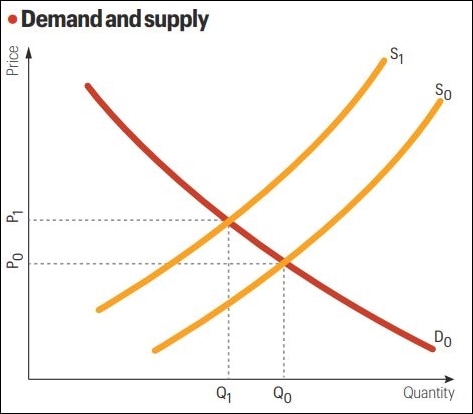 The point where demand and supply curves intersect is the market-clearing equilibrium.
• Stagflation typically arises from “negative supply shocks”. Normally, any increase or decrease in the supply of a good is due to changes in its price, with other factors such as input costs, production conditions and technology remaining the same. The movement here is from one point to another on the same supply curve.
• As already noted, for stagflation, the duration of supply shocks matters as much as their magnitude. If the Iran war were to end soon — and assuming that the attacks on the West Asian oil refineries and natural gas processing facilities haven’t caused significant damage from a production restoration standpoint — the supply curve may revert from S1 to S0 quickly enough to avert a 1970s-style stagflation.
Other Important Articles Covering the same topic:
Previous year UPSC Prelims Question Covering similar theme:
6) Economic growth is usually coupled with?(UPSC CSE, 2011)
(a) Deflation
(b) Inflation
(c) Stagflation
(d) Hyperinflation
Trans rights: How 2026 Amendment Act deviates from decade-long judicial arc
Preliminary Examination:Indian Polity and Governance-Constitution, Political System, Panchayati Raj, Public Policy, Rights Issues, etc.
Mains Examination:General Studies I: Social empowerment
What’s the ongoing story: TheTransgender Persons (Protection of Rights) Amendment Act, 2026, marks a sudden departure in the evolution of transgender rights over the last decade.
Key Points to Ponder:
• What are the key changes proposed in the Transgender Persons (Protection of Rights) amendment bill, 2026?
• Transgender Persons (Protection of Rights) Act, 2019 vs Transgender Protection (Amendment) Bill 2026-compare
• How Transgender Persons (Protection of Rights) amendment bill, 2026 defines Transgender person?
• What percentage of Indian population is transgender?
• “Sex is biologically determined but gender is a social construct”-Critically Analyse
• Transgenders in India are still discriminated even after the Supreme Court has held that the right to self-identification of gender is part of the right to dignity and autonomy under Article 21 of the Constitution-Why?
• What was the Supreme Court’s verdict in National Legal Services Authority vs Union Of India, 2014?
• Decriminalisation of homosexuality was much needed for transgenders and Section 377-Connect the dots
Key Takeaways:
• The bedrock of transgender jurisprudence is the Supreme Court’s 2014 judgment in National Legal Services Authority (NALSA) v. Union of India. In it, the Court legally recognised transgender persons as the “third gender” and recognised the right to self-identification, framing it as a fundamental right.
• “Determination of gender to which a person belongs is to be decided by the person concerned,” the court said. “Self-determination of gender is an integral part of personal autonomy and self-expression and falls within the realm of personal liberty guaranteed under Article 21 of the Constitution of India.”
• It also located self-identification within the right to freedom of expression under Article 19(1)(a) of the Constitution. “Gender identity… lies at the core of one’s personal identity, gender expression and presentation,” it said. “State cannot prohibit, restrict or interfere with a transgender’s expression of such personality, which reflects that inherent personality.”
• The court emphasised that “gender identity refers to each person’s deeply felt internal and individual experience of gender, which may or may not correspond with the sex assigned at birth”. It said that it “prefer[red] to follow the psyche of the person in determining sex and gender … instead of ‘Biological Test’.”
Do You Know:
• In 2018, the Supreme Court in Navtej Singh Johar v. Union of India decriminalised consensual same-sex relations, ruling that sexual orientation and gender identity are innate because “[a]t the core of the concept of identity lies self-determination, realization of one’s own abilities visualizing the opportunities and rejection of external views with a clear conscience that is in accord with constitutional norms and values…”
• High Courts have ever since consistently applied this principle to prevent state and institutional interference in an individual’s self-identified gender. In 2020, the Madras High Court held that “[i]t is entirely for the transgender person to self-identify her gender and… this self determination cannot be questioned by others” while confirming that sexual harassment laws apply to transwomen.
• In the Supriyo v. Union of India marriage equality case in 2023, the Supreme Court affirmed that transgender persons in heterosexual relationships have the right to marry under existing laws.
• In 2020, the Orissa High Court in 2020 granted police protection to a transman and his female partner, upholding their right to a live-
in relationship.
• The 2026 Amendment Act goes against this by removing the definition of a transgender person based on self-perceived identity. Instead, it mandates that a certificate of transgender identity will only be issued by a district magistrate after examining the recommendation of a designated medical board, headed by a chief medical officer. It deletes categories like “trans-man”. “trans-woman,” and “genderqueer” from the definition of “transgender person” in the Transgender Persons (Protection of Rights) Act, 2019, and explicitly mandates surgery to obtain a revised certificate for a change in gender.
Other Important Articles Covering the same topic:
📍Why Transgender Protection (Amendment) Bill 2026 has attracted criticism
Previous year UPSC Prelims Question Covering similar theme:
7) In India, Legal Services Authorities provide free legal services to which of the following type of citizens? (UPSC CSE, 2020)
1. Person with an annual income of less than Rs. 1,00,000
2. Transgender with an annual income of less than Rs. 2,00,000
3. Member of Other Backward Classes (OBC) with an annual income of less than Rs. 3,00,000
4. All Senior Citizens
Select the correct answer using the code given below:
(a) 1 and 2 only
(b) 3 and 4 only
(c) 2 and 3 only
(d) 1 and 4 only
|
PRELIMS ANSWER KEY |
| 1.(c) 2.(d) 3.(c) 4.(b) 5.(d) 6.(b) 7.(a) |
