

India is one of the few countries in the world with a long experience of developing nuclear technologies, including the generation of nuclear power. This includes a mastery over the pressurised heavy water reactor (PHWR) technology, or reactors that use natural uranium as fuel and heavy water (deuterium oxide) as coolant and moderator. These reactors now comprise the bulk of India’s installed atomic power capacity of 8,180 MWe (megawatt electric), alongside some imported light water reactors (LWRs) units.
Two other technologies are a work-in-progress: atomic reactors called fast breeders and a longstanding project that aims at eventually fabricating thorium-based nuclear reactors. These three technologies (PHWRs-FBRs-Thorium reactors), progressing in series, make up India’s ambitious three-stage nuclear power programme. This programme envisages a pathway to utilising India’s abundant thorium reserves – found in coastal and inland placer sands on the beaches of Kerala, Tamil Nadu, Odisha, Andhra Pradesh, Maharashtra and Gujarat, and in the inland riverine sands of Jharkhand and West Bengal – to generate electricity.

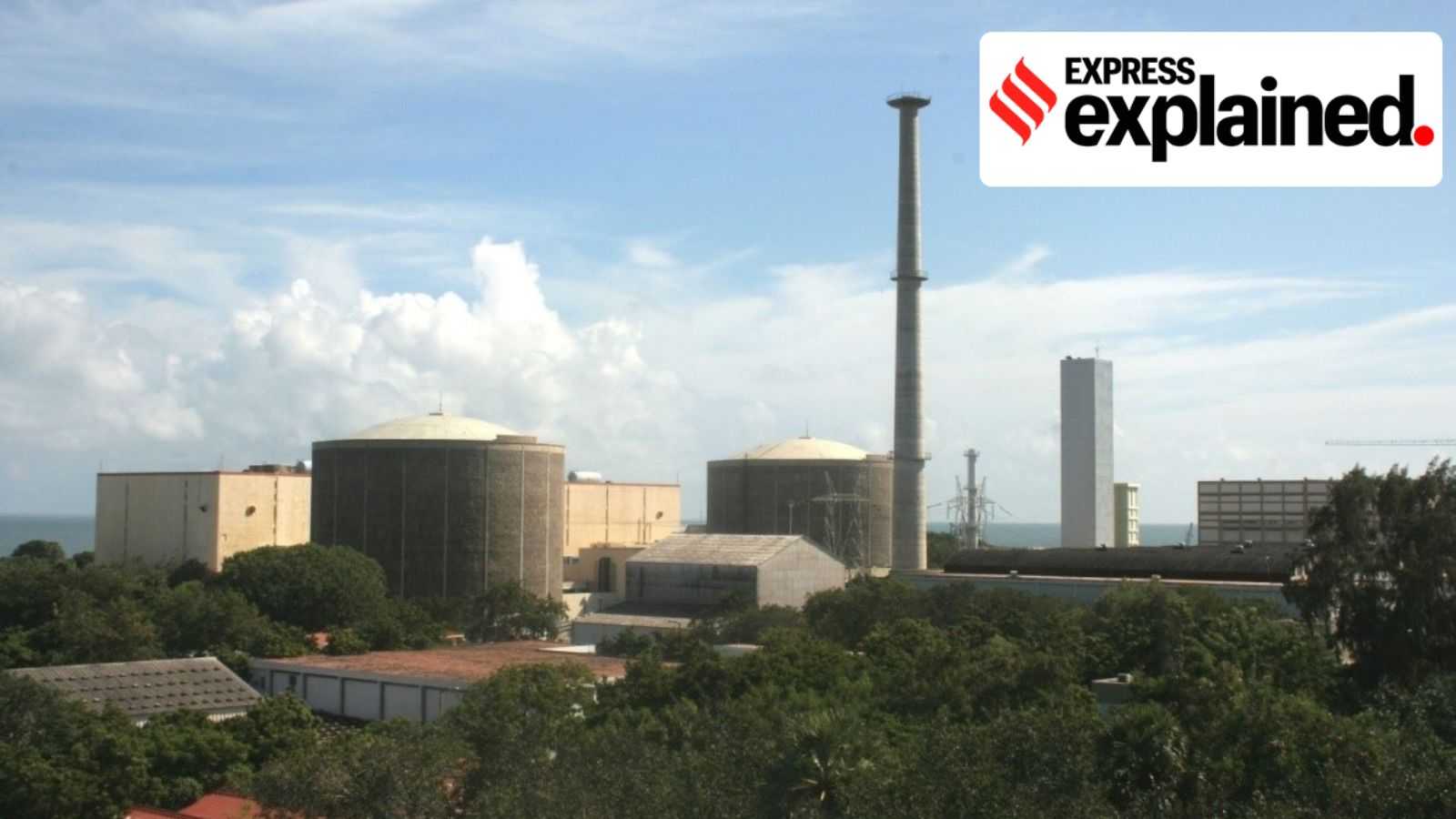
The vital second stage of India’s three-stage nuclear programme got a boost Monday with the country’s first indigenous Fast Breeder Reactor (FBR) at Kalpakkam in Tamil Nadu attaining criticality. Attaining criticality, or going critical, means the initiation of a self-sustaining nuclear fission reaction that will eventually lead to the generation of power by the 500-megawatt electric (MWe) FBR. Attaining criticality is a key milestone before full power generation, indicating that the reactor core is functioning as designed and that each fission event in the core now releases a sufficient number of neutrons to sustain an ongoing series of reactions.
Prime Minister Narendra Modi, in a post on X, called it a “defining step” in advancing the country’s civil nuclear programme and said the indigenously designed and built reactor reflects “the depth of our scientific capability and the strength of our engineering enterprise” which, he said, is a key step towards harnessing India’s thorium reserves under the third stage of the programme.
A little over two years ago, the completion of ‘core loading’, or the process of placing nuclear fuel assemblies inside the core of a nuclear reactor, was completed in March 2024 in case of the Kalpakkam FBR. This reactor will initially use uranium-plutonium mixed oxide (MOX) fuel, with a ‘blanket’ of a Uranium isotope (U238) around the fuel core that will undergo nuclear transmutation to produce more fuel – therefore, the name ‘breeder’. Nuclear transmutation involves the conversion of a chemical element or isotope into another chemical element, with the numbers of protons or neutrons in the nucleus of the atom undergoing a change.
Vital second stage
The first stage entails the setting up of PHWRs and associated fuel cycle facilities, which is currently in progress. For the PHWR programme, the India-US civil nuclear deal has opened the doors for India to buy uranium for its domestic reactors, thus increasing the pace of its nuclear programme.
Story continues below this ad
In the second stage of India’s nuclear power programme, the FBRs would be deployed at scale. Fast reactors are essentially designed to produce more fuel than they consume and in the Indian context, ‘higher breeding’ is desired so that the rate at which the power capacity can grow would be higher. FBRs enable the potential to harness the energy of natural uranium by over 60 times through multiple recycles.
These breeder reactors are also crucial for enlarging the inventory of plutonium — produced after the first stage PHWRs — so that a much larger irradiation capacity to produce an isotope of Uranium (U-233) at scale for use in the third stage programme can be built up. For this, at an appropriate stage, the FBRs would need to be loaded with thorium (Th232) as the blanket material which would be converted to U-233. With sufficient inventory and production capacity for U-233 having built up,the move onto the third stage can then happen. Thus, FBRs provide the essential link between the first and third stages of the power programme based on the indigenous nuclear material resources.
India started the fast reactor programme by setting up a 13.5MWe Fast Breeder Test Reactor (FBTR) which has been in operation since 1985. The first power reactor, the 500 MWe prototype FBR, indigenously designed and built, is now in an advanced stage of commissioning at Kalpakkam. Towards closing the fuel cycle, a Fast Reactor Fuel Cycle Facility (FRFCF) is under construction at Kalpakkam. Beyond the FBR, it is planned to construct six more fast breeder reactors of 600MWe each. Two of these six reactors are planned to be constructed at the site adjacent to the PFBR, whereas, another site will be identified to build four more reactors, according to an expert committee report of the Vivekananda International Foundation.
Successive governments have nurtured the FBR project as a step towards India developing comprehensive capabilities that span the entire nuclear fuel cycle, by which electricity is produced from uranium in nuclear power reactors. In 2003, when Atal Bihari Vajpayee was Prime Minister, the Bharatiya Nabhikiya Vidyut Nigam Ltd or BHAVINI was incorporated to build and operate what was then India’s most advanced nuclear reactor, the prototype FBR. The project was expected to be completed by September 2010, but was delayed due to technological challenges. The last set of approvals had revised the completion target to October 2022.
Story continues below this ad
Once commissioned, India will be the second country after Russia to have a commercial operating FBR. China has a small programme on fast breeders; programmes in countries such as Japan, France, and the United States were shut down amid safety concerns.
The DAE aims to increase the share of nuclear power in the energy mix by 2032 by producing 22,400 MWe from its nuclear power plants. It has approved the construction of 10 new PHWRs in ‘fleet mode’, in which a plant is expected to be built in five years from the first pouring of concrete. The second stage leads up to the phase where thorium can be utilised as the main fuel. The three stages, in this process, involve the conversion of ‘fertile material’ (which is not fissionable by thermal neutrons but can be converted into fissile material) into fissile material.
For example, U238, the dominant isotope of uranium, is a fertile material that cannot by itself make the reactor achieve criticality, and has to be converted to fissile plutonium (Pu239) in a nuclear reactor. The spent fuel from thermal reactors contains Pu239, which is most efficiently burnt in a fast reactor. Thorium-bearing monazite too, is a fertile material that has to be converted to fissile material U233. India has adopted a “closed fuel cycle” approach, which involves the reprocessing of spent fuel to separate the useful Pu239 and U233 isotopes from U238 and Th232. To multiply the fissile inventory and to gradually work towards establishing a higher power base, it is key to ultimately use thorium in the third stage of the programme.
The FBR is clearly being seen as an important milestone for getting to the third stage, clearing the way for the eventual full utilisation of the country’s thorium. Transitioning to thorium-based nuclear power generation in India is vital for securing our energy independence, which requires building sufficient inventory of fissile uranium233 through irradiation of thorium in thermal or fast nuclear reactors of relevant capacity, according to nuclear scientist Anil Kakodkar.
Story continues below this ad
Now that India is able to build large PHWR capacity with imported uranium (as fuel), the country has the possibility of using this reactor capacity for conversion of thorium to fissile uranium through irradiation of thorium along with HALEU (a fuel variant called high assay, low enriched uranium) in the country’s indigenous PHWRs at scale, he told The Indian Express. This enables the launch of the thorium phase (the third phase of India’s three-stage nuclear programme) earlier than envisaged, without having to wait for build up of required fast breeder reactor capacity that comprises the second stage.
The used fuel from these PHWRs – the mainstay of India’s nuclear power programme – can then be recycled to set up additional power generation capacity, including through the new-age molten salt reactors or MSRs as part of the third stage of India’s three-stage nuclear power development programme. This will enable faster energy independence from imported nuclear fuel, Kakodkar, who is now the Chancellor of the Homi Bhabha National Institute and the Chairman of the Rajiv Gandhi Science & Technology Commission, and was former Chairman, Atomic Energy Commission, told The Indian Express.
