

2 min readMumbaiUpdated: Apr 9, 2026 04:07 PM IST
Most couples seeking infertility treatment at a Mumbai government facility are from urban areas and tend to delay medical consultation for years, with ovulatory disorders emerging as a leading cause, according to a study conducted at Cama and Albless Hospital.
Titled Study of Demographic and Clinical Profiles of Patients Attending an ART Centre in a Tertiary Care Government Hospital, the research was published on April 6, 2026 in the International Journal of Life Sciences, Biotechnology and Pharma Research. The study, authored by Dr Afifa Naushad, Dr Tushar Palve and Dr Rajashree Thatikonda, analysed 60 patients who attended the hospital’s Assisted Reproductive Technology centre between August and October 2025.

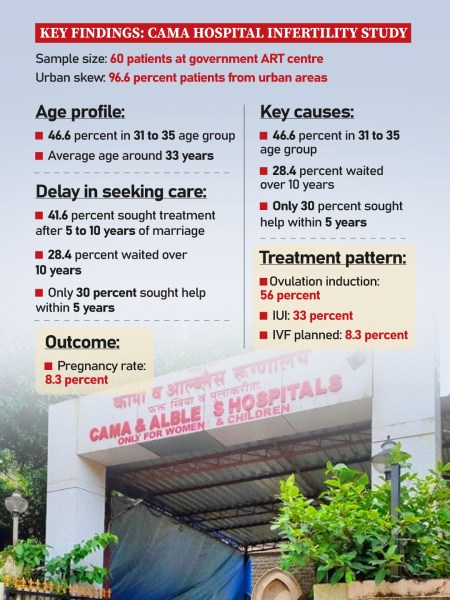 Cama hospital infertility study
The findings show that 96.6 percent of patients were from urban areas, indicating gaps in access and awareness among rural populations. Nearly half of the patients were in the 31 to 35 age group, with an average age of around 33, pointing to delayed childbearing and late entry into treatment.
A key concern highlighted in the study is the delay in seeking care. “We found that over 41.6 percent of patients had been married for 5 to 10 years before approaching the ART centre, while 28.4 percent had waited more than 10 years. Only 30 percent sought help within the first five years of marriage,” said Dr Palve.
Primary infertility accounted for 51.67 percent of cases, slightly higher than secondary infertility. The study also found that structural issues such as blocked fallopian tubes were not the dominant cause. More than 70 percent of patients had normal tubal patency, suggesting that ovulatory dysfunction and hormonal imbalances are the primary contributors in this group.
Treatment patterns reflected a stepwise approach suited to public healthcare settings. Ovulation induction was the most common intervention, followed by intrauterine insemination, while in vitro fertilisation was planned for a small proportion of patients. The overall pregnancy rate recorded in the study was 8.3 percent.
Researchers noted that delayed presentation, limited awareness and financial constraints continue to affect treatment outcomes, underlining the need for early intervention and stronger outreach in public health systems.
