

WITH TEHRAN weaponising the Strait of Hormuz and jeopardising global oil and gas flows, countries in the Gulf region led by the United Arab Emirates and Saudi Arabia are scrambling to reduce their dependence and vulnerability on this chokepoint. From ports to pipelines, countries are hoping to ramp up infrastructure in the coming years.
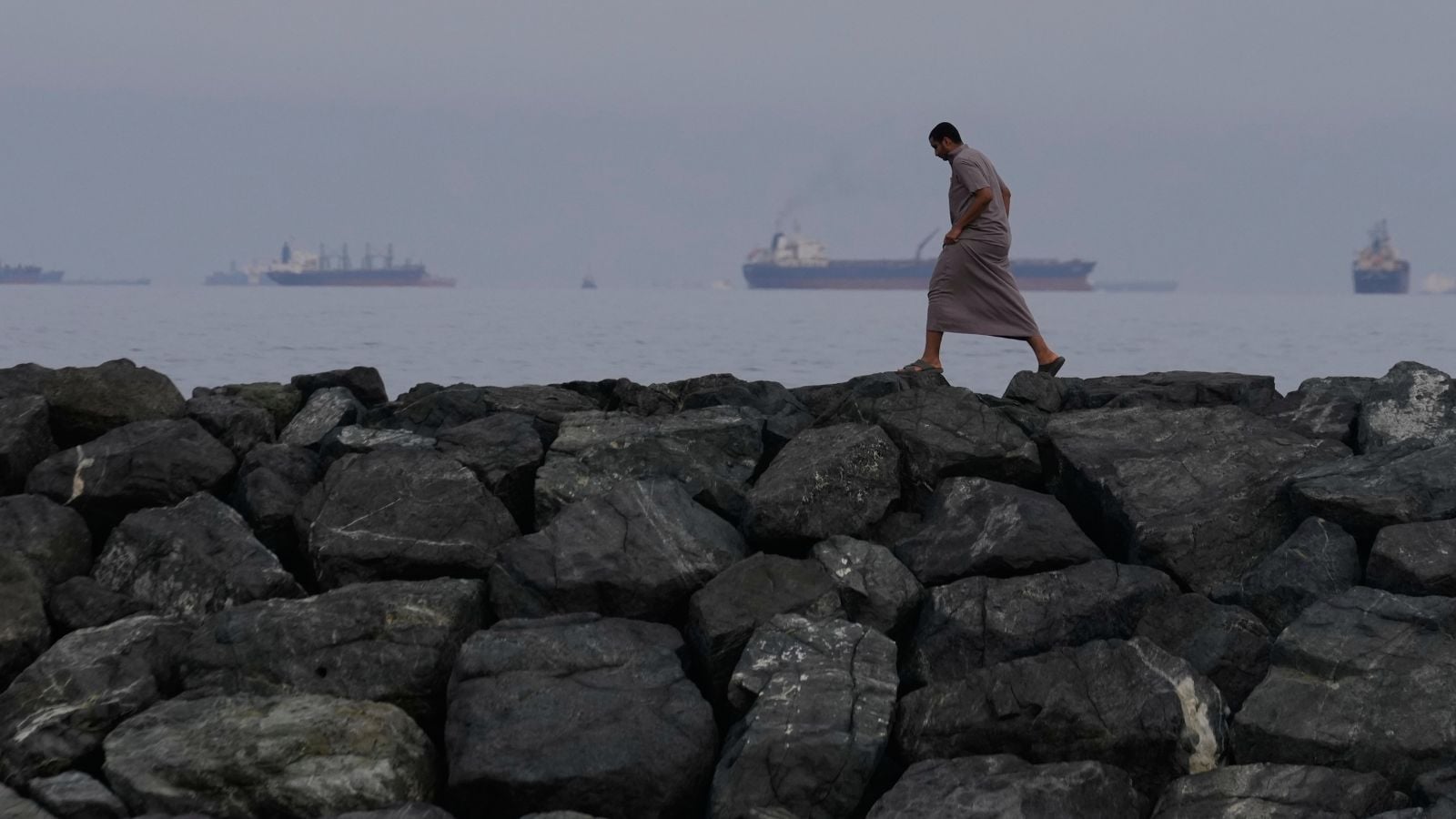
The Iran-Israel/ US conflict has seen an unprecedented halt in maritime traffic through the Strait—a narrow waterway between Iran and Oman—through which about one-fifth of global oil and liquefied natural gas (LNG) flows.
The West Asia war gives reason enough for the Gulf states to collaborate and coordinate for revitalising old pipelines and building new ones. According to reports from the region, early efforts may already be underway to do just that.
“I have spent the past month in discussions with hundreds of business leaders and senior Gulf government officials on the crisis and what comes after it. The conversation has already shifted—from managing the immediate crisis to redesigning the systems that created this vulnerability in the first place,” UAE based businessman and the country’s Special Envoy for Business & Philanthropy Badr Jafar wrote recently in Financial Times.
“The crisis is doing what years of summitry could not—creating the conditions for genuine intraregional economic integration. States whose ties were strained only weeks ago are now finding common cause. Rerouting essential commerce away from a single chokepoint de-risks not only the economies of the region but global supply chains,” Jafar wrote.
For decades, Iran threatened to close the Strait, but didn’t actually do it. The US-Israel war against Iran that started on February 28 changed that. Tehran—and the world—now know that it can effectively halt vessel movements through the maritime chokepoint almost at will, and impose a massive cost on the global economy.
The West Asia war has clearly demonstrated the criticality of the Strait of Hormuz for global flows of oil, gas, and some other key commodities, with its effective closure by Iran sending shockwaves, particularly through energy markets.
Story continues below this ad
“Looking ahead, several pipeline options could be expanded, reactivated, or newly constructed to further reduce reliance on the Strait of Hormuz. However, all of these would require a significant financial investment and several years to be realised,” Victoria Grabenwöger, senior oil analyst at commodity market analytics firm Kpler, told The Indian Express.
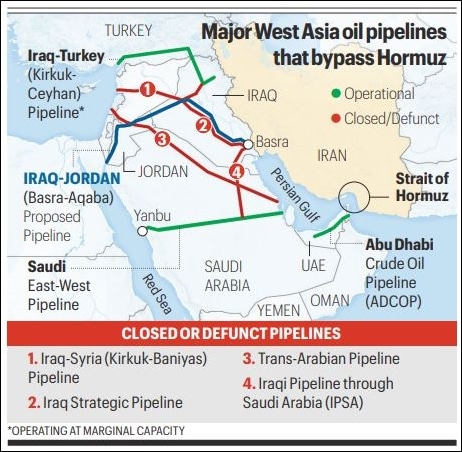
Even as numerous oil tankers, among scores of merchant vessels, have been stranded in the Persian Gulf, Saudi Arabia and the UAE managed to export some of their oil using pipelines that bypass the Strait of Hormuz. These are Saudi Arabia’s 1,200-km long East-West pipeline that runs from oil fields near the Persian Gulf all the way to the Red Sea port of Yanbu, and the UAE’s Abu Dhabi Crude Oil Pipeline (ADCOP) that connects the Habshan oil field to the port of Fujairah in the Gulf of Oman.
While the volumes that can be moved through these pipelines are much lower than what Saudi Arabia and the UAE usually export through the Strait of Hormuz, they have exhibited the potential of pipelines as a tool to reduce dependence on the Strait of Hormuz.
This realisation could lead to a tectonic shift in how energy flows from West Asia in the future. According to experts and analysts, the war has jolted other West Asian powers into recognising the importance of building massive infrastructure like pipelines to bypass the Strait of Hormuz. Such infrastructure build-up—which could include building new pipelines, expanding capacities of existing pipeline systems in the region, and reviving discarded or mothballed pipelines—would take years, huge investments, and a great degree of cooperation between the Gulf states. But with Iran having tasted blood by disrupting the Strait of Hormuz, it is likely that more pipeline and port infrastructure will be come up in West Asia to divert exports away from the Strait through alternative routes like the Gulf of Oman, the Red Sea, and the Mediterranean Sea.
Story continues below this ad
It’s not like West Asia didn’t have oil export pipelines in the past. Yet, hardly any has stood the test of time and regional tensions. “When looking at the historical performance of the oil export pipelines in the Gulf, one could easily note that every line in the region has been shut down at least once, and that most of them remain closed until the present time. The main reasons behind the shutdown of many export pipelines in the Gulf remain the political conflicts within producing countries or transit states, and interstate disputes. In fact, most of the pipelines crossing state boundaries have fallen victim to the region’s political rivalries and conflicts at one point or another,” Naji Abi-Aad, senior advisor on energy studies at the Gulf Research Center wrote in an analysis.
The pipeline options
“The most feasible measures would likely include capacity expansions of Saudi Arabia’s East–West pipeline/Yanbu, as well as enhancements or parallel lines to the UAE’s ADCOP pipeline to Fujairah,” said Kpler oil analyst Grabenwöger.
“Increasing throughput on the Iraq–Turkey pipeline (Kirkuk to Ceyhan) could also enable greater volumes of Iraqi crude to bypass the Gulf. In addition, several projects currently on hold could be revived in the coming years, including the Basra–Aqaba (Iraq-Jordan) pipeline and the IPSA (Iraqi Pipeline through Saudi Arabia) pipeline. The latter—linking Iraq to Saudi Arabia and onward to Yanbu on the Red Sea—has been out of service since the early 1990s and would require significant technical refurbishment and political coordination to restart. If reactivated, however, it could provide a substantial alternative export route that avoids the Strait entirely,” she said.
Abu Dhabi-based energy analyst Natalia Katona echoed Grabenwöger, and said connecting the oil production in Iraq’s Basra to Kirkuk and then onward to Ceyhan in Turkey makes a “lot of sense on paper”.
Story continues below this ad
“The infrastructure partly exists, but expanding and stabilising it would take time, money, and a much more predictable security environment. That said, Iraq probably has the most pressure to act—limited storage, limited refining, and a heavy reliance on continuous exports. If we go into more “big vision” territory, there’s always the idea of reviving something like the old Trans-Arabian Pipeline (from Saudi Arabia) through Jordan and Syria to the Mediterranean. But realistically, given the current geopolitical situation, that’s more of a thought experiment than a near-term option,” Katona told this newspaper.
Apart from the Trans-Arabian Pipeline and IPSA, other major defunct or inactive West Asian oil pipeline systems include a pipeline that connected Kirkuk in Iraq with the Syrian port of Baniyas and the Iraq-Syria-Lebanon pipeline. Most of such pipelines have effectively been shut and abandoned due to regional wars and political tensions, although talks of reviving them do surface from time to time.
“For countries like Kuwait, Qatar, and Bahrain, geography really works against them. They don’t have many viable pipeline alternatives, so in the short to medium term it’s more about building up storage and managing risk rather than rerouting flows entirely. In terms of timing, the UAE probably has the most flexibility to move relatively quickly on incremental projects. But the real structural pressure is on Iraq and the smaller Gulf countries—they are the most exposed and have the fewest fallback options,” Katona said.
But the current limitations faced by the likes of Kuwait, Qatar, and Bahrain doesn’t stop them from collaborating with their Gulf neighbours to build pipeline infrastructure for the future.
Story continues below this ad
“Saudi Arabia and the United Arab Emirates managed to circumvent the chokepoint to a limited degree via their bypass pipelines. Riyadh and Abu Dhabi are almost certain to double down, expanding those emergency conduits further. Kuwait would doubtless join forces with the Saudis to build its own bypass pipeline. Iraq would struggle with the expense, but it has every incentive to rebuild its old strategic pipeline that let it move oil from the south to the Mediterranean via Turkey,” Javier Blas, energy and commodity columnist at Bloomberg wrote in a recent column.
“Five years from now, the Persian Gulf will have far better bypass options than it does today. No matter what the US and Iran agree over the future of Hormuz, the strait’s status will change. But the waterway will never be as critical to the global economy as it was when the fighting started six weeks ago,” Blas wrote.
