

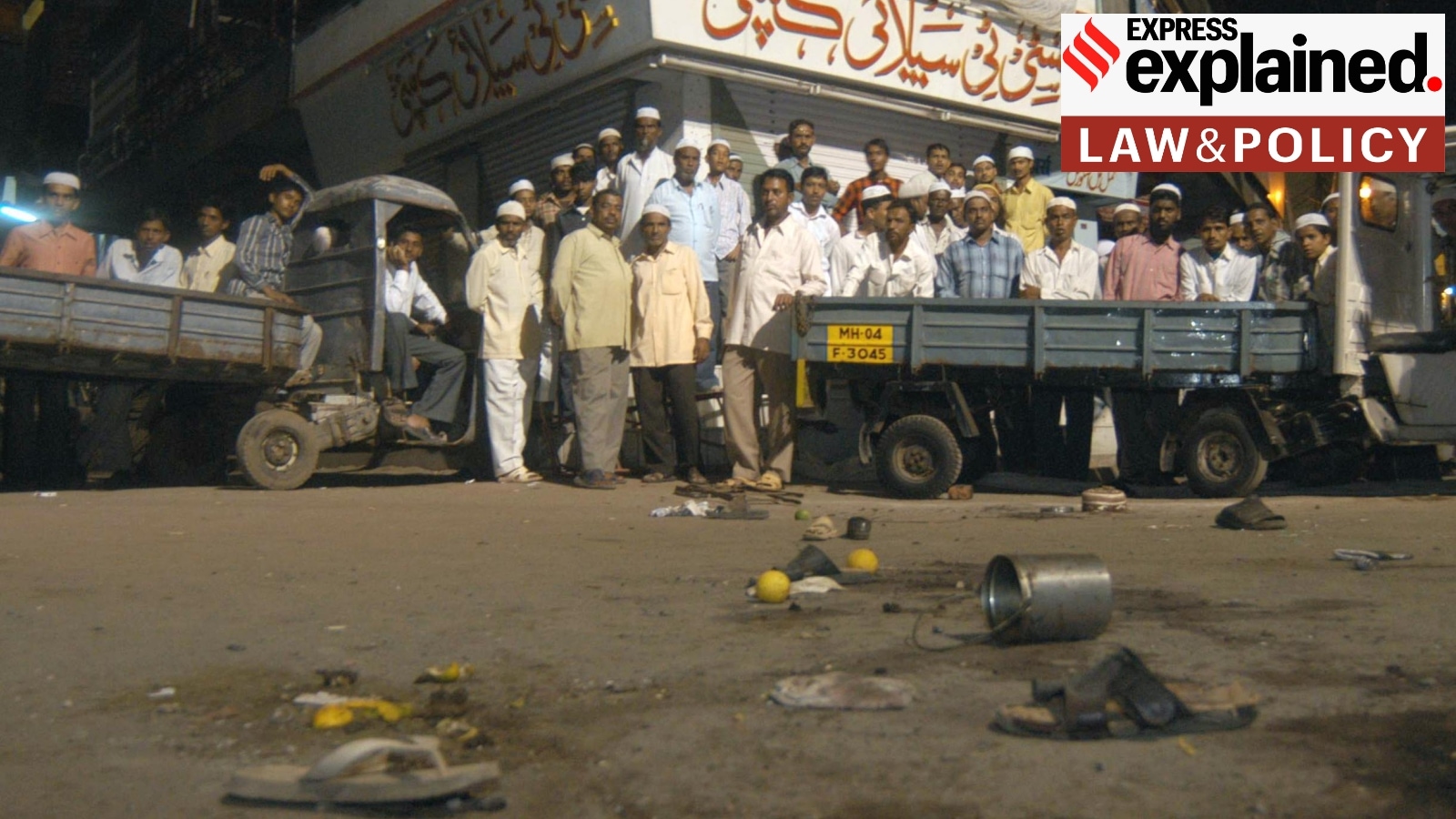
Nearly 20 years and three investigation agency probes later, the fate of the 2006 Malegaon blasts case remains uncertain, with no accused left standing trial for the terror attack that killed 31 people.
These four men — Manohar Narwaria, Rajendra Chaudhary, Dhan Singh and Lokesh Sharma — are not the first set of accused to be booked in the case and subsequently let off. Before them were nine Muslim men who were discharged in 2016.
The verdict comes less than a year after a special NIA court acquitted all seven accused in the separate 2008 Malegaon blast case, including former BJP MP Sadhvi Pragya Singh Thakur and Lt Col Prasad Purohit, citing insufficient evidence.
The 2006 case saw probes by the Maharashtra Anti-Terrorism Squad (ATS), then the CBI (Central Bureau of Investigation) and finally the current prosecuting agency, the National Investigation Agency (NIA). Here’s a look at the twists of the case which now appears to have hit a wall, dimming hopes for justice.
The attack
On September 8, 2006, four bombs exploded at around 1.50 pm, just after Friday prayers, in the Muslim-majority town of Malegaon, near Nashik in Maharashtra. One of the bombs was placed at the entrance of Hamidia Masjid and Bada Kabrastan, one on a bicycle in a parking lot inside its compound, another on the wall of a power supply room also within its premises and a fourth on a bicycle in Mushawarat Chowk, a crowded spot.
The explosions killed 31 people and injured 312. Police carried out the initial probe but handed the matter to the ATS in October 2006.
The ATS and CBI probe
Story continues below this ad
The ATS alleged that the blasts were the handiwork of 13 Muslim men linked to the banned group Students Islamic Movement of India. The agency arrested nine men — Noorul Huda, Shabbir Masiullah, Raees Mansuri, Salman Farsi, Dr Farogh Magdumi, Shaikh Mohammed Ali, Asif Khan, Mohammed Zahid and Abrar Ahmed.
Two of them, Ali and Asif, were also booked by the ATS in connection with the Mumbai serial train blasts, which had occurred weeks before the Malegaon blasts, on July 11, 2006.
The Bombay High Court acquitted both Ali and Asif in the train blasts case in July 2025. It picked holes in the ATS probe, termed the confessions used in the case as inadmissible and untruthful, and accepted that they were tortured.
Story continues below this ad
In the Malegaon case, too, the ATS claimed that seven of the nine men had given confessions. The ATS alleged that the conspiracy was planned in May 2006, during Huda’s wedding, and that the bombs were put together in Mumbai with the help of two Pakistani nationals, who were named as ‘wanted accused’ along with two others.
The nine arrested men remained behind bars for six years.
In 2007, the case was transferred to the CBI. The central agency, too, maintained that the same set of accused were behind the conspiracy.
NIA probe
On May 18, 2007, an explosion took place in Hyderabad’s Mecca Masjid. The CBI investigated this case and, in 2010, arrested Swami Aseemanand. It alleged that he was involved in not just the Hyderabad blast but other such attacks as well.
Story continues below this ad
According to the CBI, Aseemanand claimed in a confession before a magistrate in 2010 — it was subsequently declared involuntary — that Sunil Joshi and his men carried out the Malegaon blasts.
In 2011, the Union government decided to transfer probes linked to terror cases to the NIA, which was formed in 2008.
The Malegaon blasts case was among the probes handed to the NIA. The agency visited the sites, attempted to reconstruct the events and gathered additional information. It found that the nine arrested men were not involved in the case and that their confessions were obtained under pressure. They were granted bail in 2011.
In 2013, the NIA filed a chargesheet naming a different set of people.
Story continues below this ad
Among them were the four who were cleared of charges by the Bombay High Court on Friday — Narwaria, Chaudhary, Singh and Sharma. The chargesheet also named Joshi (who was mysteriously killed in 2007), Ramji Kalsangra, Sandeep Dange and Ramesh Mahalkar.
The agency backed the discharge of the nine men who had been arrested by the ATS, saying the proceedings against them were a “wastage of time of the court”.
On April 25, 2016, eight of the nine were discharged. One of them, Shabbir, had died during the pendency of the plea.
Story continues below this ad
The ATS, along with the four men whose appeal was accepted Friday, have filed an appeal against this discharge order. The appeal is pending before the High Court.
The NIA probe into the four men
The NIA had alleged in its chargesheet that the four men had carried out the blasts under Joshi’s supervision, carrying the bombs from Indore to Malegaon.
It said Narwaria and Chaudhari purchased two bicycles in Malegaon. While Singh and Chaudhari allegedly placed the two bombs in the premises of the masjid, Kalsangra and Narwaria allegedly planted the other two. The NIA alleged that the Muslim-majority Malegaon was deliberately chosen to spark communal unrest.
The four men who were arrested in 2013 also spent six years in jail, waiting for the trial to begin.
Story continues below this ad
The High Court granted them bail on June 14, 2019, saying there were no witnesses who had seen them planting the bombs or purchasing the bicycles. The High Court also questioned how bicycle shop owners had identified them after a gap of seven years in 2013, during the NIA investigation.
The four men had filed discharge pleas before the special court after getting bail. However, they were withdrawn and, in September 2025, the special court framed charges against them. The four sought to quash the charges before the High Court, which allowed their appeal on Wednesday.
