

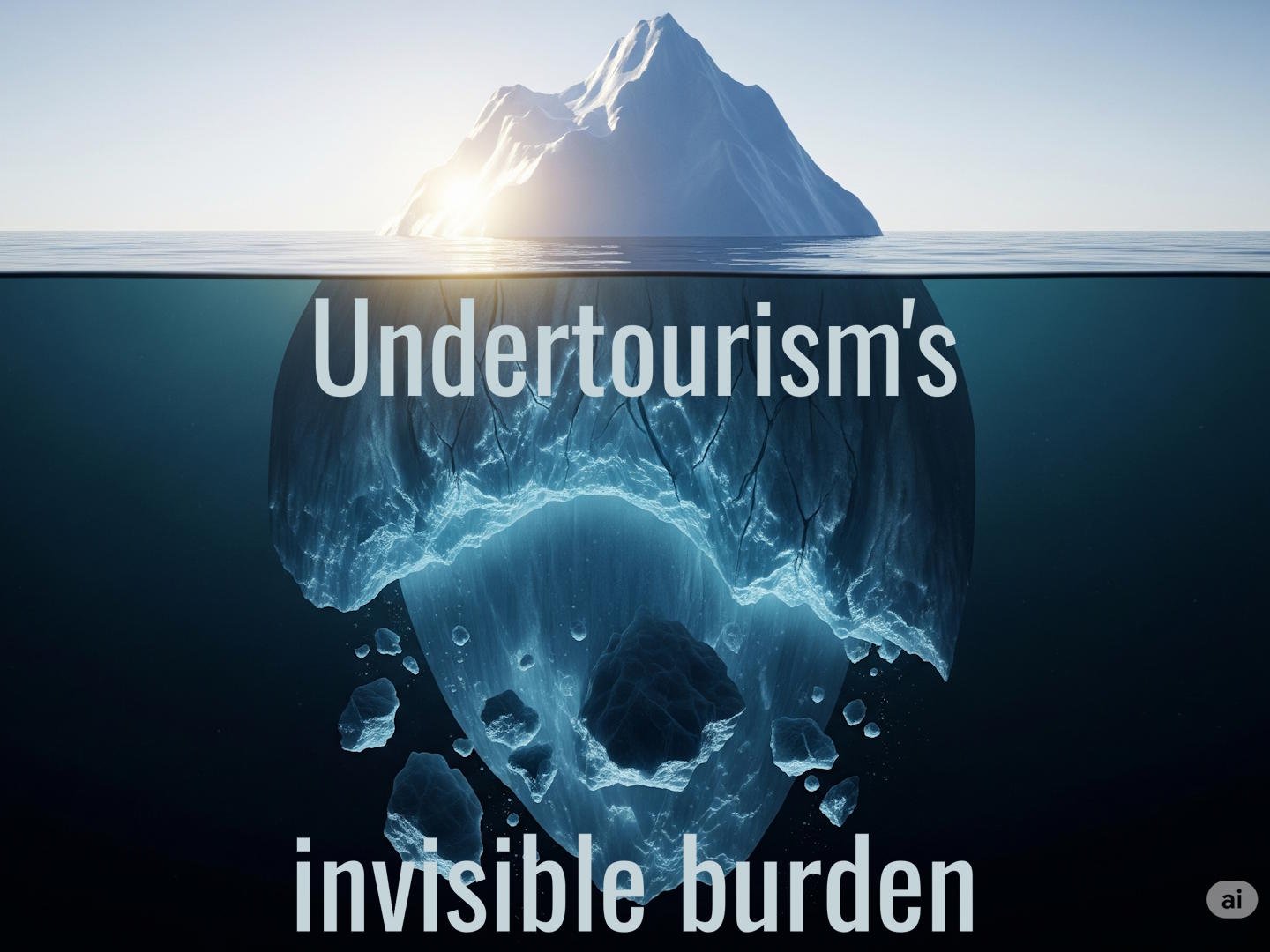

Undertourism: Who’s suffering, andwhy?
‘Undertourism is both a challenge and an opportunity’
Chris Kittishinnakuppe, Head of Marketing & Sales,VHG Hospitality Asia, Thailand
Undertourism — characterised by an insufficient number of visitors to sustain vital tourism-dependent systems — is a growing concern for remote destinations. At Cardamom Tented Camp in Cambodia, undertourism has a direct impact on both conservation and the well-being of the local community.
Our eco-camp sits in the heart of the Cardamom Mountains, protecting 18,000 hectares of rainforest alongside Wildlife Alliance rangers. Visitor fees help fund patrols that deter poaching and illegal logging. When guest numbers drop, so does the financial support for these essential operations.
Undertourism also impacts the livelihoods of our team and the surrounding villages. Former poachers, now employed as rangers, rely on eco-tourism for stable incomes. Fewer guests mean fewer guided treks, less demand for local supplies, and reduced opportunities for cultural exchange.
Part of the challenge lies in our location: deep in the forest, far from Cambodia’s main tourism hubs. Our appeal lies in exclusivity and immersion in nature, but without targeted marketing, we risk being overshadowed by more famous destinations.
However, we see undertourism as a chance to offer something rare: complete seclusion in one of Southeast Asia’s last great rainforests. During quieter months, guests enjoy near-private access to trails, wildlife encounters, and conservation activities. They spend more time with our rangers, learning first-hand about protecting biodiversity.
To address undertourism, we focus on attracting niche markets — eco-conscious travellers, birdwatchers, conservation supporters — who appreciate that their visit directly funds forest protection. We share measurable impact data each year to demonstrate precisely how guest stays contribute to preserved habitat and community benefits.
For Cardamom Tented Camp, undertourism is both a challenge and an opportunity. With each visitor, we keep the forest standing, livelihoods secure, and peace between people and nature alive.
Cardamom Tented Campis a valued “Good Tourism” Partner.
Problems with undertourism are less often considered matters of ‘social justice’
Jim Butcher, Reader,Canterbury Christ Church University, UK;Tourism’s Horizon: Travel for the Millions
There is no doubt ‘overtourism’ expresses real, pressing problems. As the only industry that requires its consumers to travel and stay in another place to consume it, tourism’s cultural effects — both positive and negative — deserve special attention.
But I’d like to make the case for undertourism.
The large majority of the world’s population are not international tourists. Vast swathes of the globe receive few tourists, and produce fewer. Why? Poverty. It’s almost an iron law of history that as societies get richer, people take holidays. Equally, most people travel to places where there is infrastructure and security.
It is fashionable for experts and commentators — especially in the universities — to view tourism in a one-sided way. Problems with too much tourism — and admittedly there are a fair few problems — become defining. Communities are often presented as victims, and self-styled ‘social justice’ academics seek to protect them from the ravages of mass tourism. (Although, when asked, it usually turns out that most locals do not see it thatway).
By contrast, problems with too little tourism are less often considered matters of ‘social justice’. Have you seen the article on how developing the Eritrean coast could prospectively contribute to social progress? No, nor have I. Or the piece about the community campaign to double tourism to the Orkney Island of Stronsay to stop depopulation?Nope.
But they should be considered, and perhaps seen as ‘undertourism’. An older tradition of social justice sought to ‘level up’ by generalising the good things wealth can bring. ‘Undertourism’ could be invoked to make thecase.
PS: I understand there has been a back and forth over who ‘invented’ the term, ‘overtourism’. For the avoidance of doubt, the first usage of ‘undertourism’ was in Spiked, by me. No trademark sought! Use it wisely.
Tourism’s Horizon: Travel for the Millionsis a valued“Good Tourism” Partner.
‘Severe consequences’ at the lower end of Bhutan’s valuechain
Dorji Dhradhul, author and creativist, Bhutan (former Director General,Bhutan Tourism)
While tourism is often framed by the risks of overtourism — crowds, commodification, and degradation — the opposite phenomenon, undertourism, is equally painful, particularly in Bhutan’s present context.
For nearly three years, during the COVID-19 shutdowns, Bhutan’s tourism industry came to a standstill. When tourism finally reopened, the rebound was slower than expected. Global travel patterns had shifted, and Bhutan, like many destinations, faced a lingering hesitation from travellers.
It is also believed that Bhutan’s deliberate High Value, Low Volume (HVLV) policy — anchored in sustainability and cultural preservation — also played a role. The increase in the Sustainable Development Fee (SDF), while aligned with Bhutan’s long-term vision, has made the country less accessible to budget-conscious travellers.
Together, these factors have deepened the undertourism effect, with severe consequences for those at the lower-budget end of the tourism valuechain:
- Small and budget accommodation providers.
- Small tour operators, and those who catered to budget-conscious tourists.
- Local communities in less-frequented areas, as fewer tourists mean fewer opportunities for homestays, handicrafts, and small-scale services.
In essence, undertourism in Bhutan today has created a disproportionate burden on the weakest links in the tourism supply chain. While luxury hotels and high-end operators are adapting more smoothly, those serving the grassroots economy are caught in uncertainty. However, I believe this situation is temporary and that, within the next few years, the sector will be stable and thriving.
The challenge for us is to balance policy ideals with inclusivity.HVLV is non-negotiable for sustainability in Bhutan, but mechanisms — such as targeted incentives, training, and the diversification of tourism products — are needed to ensure that small players are not left behind. Otherwise, the noble pursuit of mindful tourism risks creating silent casualties within its own ecosystem.
‘There is no such thing as overtourismor undertourism’
Saverio Francesco Bertolucci, Business Development Specialist,VDB Luxury Properties, Spain
Undertourism can be seen from multiple perspectives. Overall, this term refers to a combination of low visitor arrivals and revenues with respect to the total capacity and profitability projection of a specificarea.
I want to start with the premise that I have to agree with Dimitrios Buhalis and Chris Christou (among many) that terms are overwhelmingly exploited and lose their meaning to the point of becoming detrimental to finding solutions.
There is no such thing as overtourism or undertourism, but rather the ability or inability to keep up with the industry patterns and/or disruptively transform the tourism business.
Destinations currently suffering from bad tourism outcomes are mainly present in low security zones and in war areas, of course, or they have marketed themselves to inappropriate niches or segments of the market.
The tourism marketplace constantly evolves. A destination’s prosperity will depend on its companies’ skills and knowledge to adapt and appeal to the right customer segments.
A further boost or hindrance to the success of private firms in a destination is related to government policies. The allocation of funds and the limitations or incentives governments place on the industry highly influence demand/supply patterns and shape results
My research in Iceland and the Faroe Islands shows how a lack of infrastructure, and late or poor government interventions, are other factors that diminish chances of sustained growth and economic stability from tourism.
All in all, I hope such generic terms will be forgotten in the books of the few academics who frequently write about them. Those words do not help find the root causes of problems, nor do they help with eventual solutions.
Destinations need ‘some semblance of capacity management and control’
K Michael Haywood, publisher,‘Destinations-in-Action’, Canada
These days everyone is familiar with what is driving overtourism, but ignores the fact that many communities are hemorrhaging visitors for multiple reasons:
- Closure of manufacturing plants and other industries, including many retailers, that decimate corporate and local markets.
- No re-investment in local tourism-related infrastructure, placemaking, attractions, recreational and nature-based areas.
- Declines in the vibrancy and functionality of public spaces, their appeal and attractiveness.
- Disruptions in accessibility.
- Safety and security concerns.
- Degrading quality not only of physical properties but also in the provision of visitor services.
- Cutbacks in funding for DMOs, cultural attractions, historicsites.
- Ignorance as to what visitors desire andenjoy.
- Negative word-of-mouth reviews especially on social media platforms.
When the capacities of existing tourism-related enterprises aren‘t filled beyond typical break-even points, many close, go into receivership, declare bankruptcy, or pivot in search of new markets. Communities dependent on visitor flows inevitably slide into further decline when degrowth descends.
In contrast, and to my mind, undertourism does not represent and should not characterise the act of developing or discovering lesser-known places that offer authentic and sustainable experiences for both travellers and local communities. What is (or should be) being practiced is limits-to-growth management designed to curtail access, prevent over-development, and to try to remain sustainable.
In either regard, what is required is some semblance of capacity management and control; finding the right balance between demand and supply. Such a stance or requirement doesn‘t simply reside in planning documents but in the purpose of a community or a destination; a purpose that must be achieved and activated through strategies that identify appropriate outcomes desired by communities.
What do youthink?
In a comment below share your own thoughtsaboutundertourism.
SIGN INorREGISTERfirst. (After signing in you will need to refresh this page to see the comments section.)
Orwrite a“GT” Insightor“GT” Insight Biteof your own.The “Good Tourism” Blogwelcomes diversity of opinion and perspective about travel & tourism, because travel & tourism is everyone’s business.
This is an open invitation to travel & tourism stakeholders from any background to share their thoughts in plain English with a global industry audience.
“GT” doesn’t judge. “GT” publishes.“GT” is where free thought travels.
If you think the tourism media landscape is better with “GT” in it, then please…
Previous “GT” Insight Bites
- Tourism, war, andpeace
- Signalling or substance in tourism: What’s yourtake?
- Visitor value, values, volume: What’s good where youare?
- Outbound doesn’t care about sustainability | Well-being must include meaning
- Is a travel & tourism career still attractive? Important things to understand in2025
- Wishwashing tourism
- Butler’s conundrum: Air travel and ‘sustainable’ tourism
- What is tourism’s biggest opportunity and/or threat where you are in2025?
- “GT” Insight Bites: Nostalgia
- “GT” Insight Bites: Geopolitics and tourism
- Tourism stakeholders: Who has an outsized voice? Who has no voice? Whocares?
- Would you abolish taxes ontips?
- Three critics walk into abar…
- How are emerging technologies transforming the travel & tourism industry?
- What does it mean to be critical of tourism?
- What constitutes ‘progress’ for travel & tourism in2024?
- Considering a career in tourism? Important things you should know in2024
- What did tourism learn from the COVID-19 pandemic?
- In 2024, what are the best opportunities for tourism over the next fiveyears?
- Tourism’s biggest challenges & threats over the next five years to2028
- On empowerment, promotion, and the power of expression
- On enrichment, repatriation, the double-edged blade, andwar
- On tourism technology, progress, and local benefit-sharing
- Hey, travel & tourism, are you ‘neocolonialist’?
- Who’s the new boss? Asia Pacific tourism industry association seeks leader
- ‘The hospitality industry offers a great career.’ Really?
- Cruise ships: Blessing or blight?
- Tourist vs traveller: What’s the difference?
- The heads of finance, operations, and PR walk into their boss’s office…
- Yes, Tourism Minister
- What are tourism’s biggest challenges & threats over the next fiveyears?
- ‘Tourism is built on the backbone of white supremacy’. What do youthink?
- Really, what’s the difference? ‘Sustainable tourism’ vs ‘regenerative tourism’
- Want a career in tourism? Important things you should know
- Diverse perspectives on travel & tourism and a fairer world
- Diverse perspectives on economic degrowth and tourism
- Diverse perspectives on visitor dispersion
Featured image (top ofpost)
Gemini AI-generated image prompted by the headline of this post: Undertourism: “Who’s suffering, and why?” Per Gemini: “This image uses the well-known ‘tip of the iceberg’ metaphor. The beautiful, stable tip above the water represents the visible, successful luxury end of the tourism industry. Below the surface, however, the massive, unseen foundation is fracturing and breaking apart, symbolising the hidden suffering of the smaller, foundational players who support the entire structure.”
“GT” cropped it and added thewords.
