
Close Menu
  • Home
  • Education
  • Health
  • National News
  • Politics
  • Relationship & Wellness
  • World News
What's Hot

Congress brass may meet Shashi Tharoor to settle issues | India News – The Times of India

January 27, 2026

Cancer Horoscope Today, 26 January 2026: Hard work strengthens your finances, says Ganesha

January 27, 2026

Use gender-neutral terms, courts told | India News – The Times of India

January 27, 2026
Facebook X (Twitter) Instagram
Global News Bulletin
SUBSCRIBE
  • Home
  • Education
  • Health
  • National News
  • Politics
  • Relationship & Wellness
  • World News
Global News Bulletin
Home»Uncategorized»How To Teach For Knowledge Through Humility
Uncategorized

How To Teach For Knowledge Through Humility

editorialBy editorialSeptember 15, 2025No Comments3 Mins Read
Facebook Twitter Pinterest LinkedIn Tumblr Email Telegram Copy Link
How To Teach For Knowledge Through Humility
Share
Facebook Twitter LinkedIn Pinterest Email Copy Link
Learn Through Humility Teach For Knowledge

by Terry Heick

Humility is an interesting starting point for learning.

In an era of media that is digital, social, chopped up, and endlessly recirculated, the challenge is no longer access but the quality of access—and the reflex to then judge uncertainty and “truth.”

Discernment.

On ‘Knowing’

There is a tempting and warped sense of “knowing” that can lead to a loss of reverence and even entitlement to “know things.” If nothing else, modern technology access (in much of the world) has replaced subtlety with spectacle, and process with access.

A mind that is properly observant is also properly humble. In A Native Hill, Wendell Berry points to humility and limits. Standing in the face of all that is unknown can either be overwhelming—or illuminating. How would it change the learning process to start with a tone of humility?

Humility is the core of critical thinking. It says, ‘I don’t know enough to have an informed opinion’ or ‘Let’s learn to reduce uncertainty.’

To be self-aware in your own knowledge, and the limits of that knowledge? To clarify what can be known, and what cannot? To be able to match your understanding with an authentic need to know—work that naturally strengthens critical thinking and sustained inquiry.

What This Looks Like In a Classroom

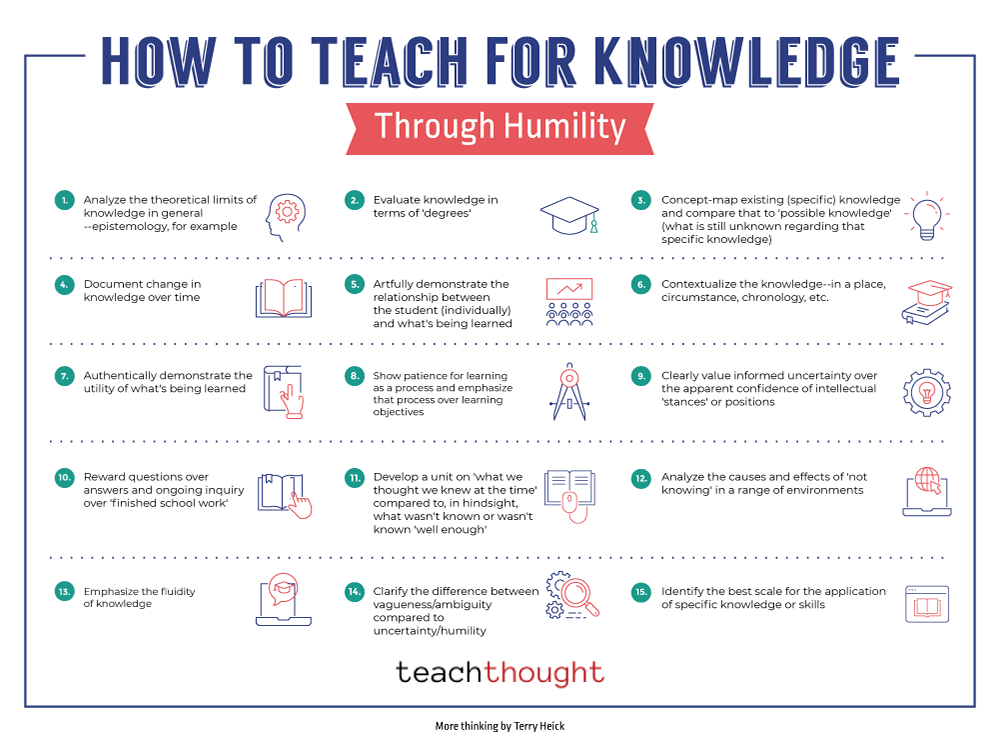
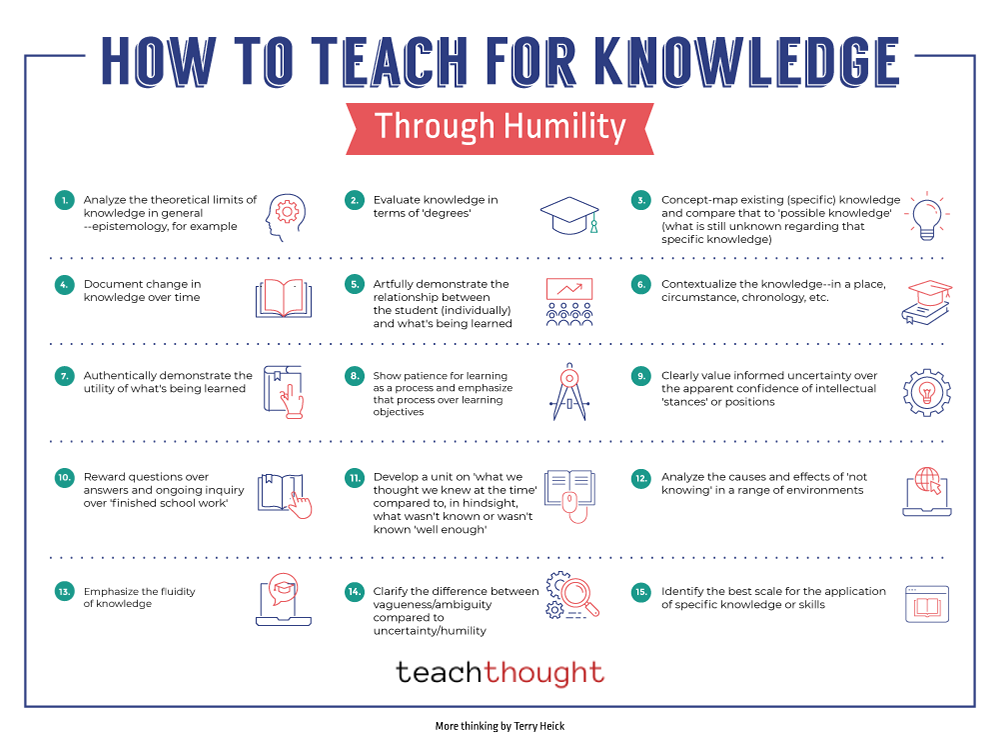
  1. Analyze the limits of knowledge in plain terms (a simple introduction to epistemology).
  2. Evaluate knowledge in degrees (e.g., certain, probable, possible, unlikely).
  3. Concept-map what is currently understood about a specific topic and compare it to unanswered questions.
  4. Document how knowledge changes over time (personal learning logs and historical snapshots).
  5. Show how each student’s perspective shapes their relationship to what’s being learned.
  6. Contextualize knowledge—place, circumstance, chronology, stakeholders.
  7. Demonstrate authentic utility: where and how this knowledge is used outside school.
  8. Show patience for learning as a process and emphasize that process alongside objectives.
  9. Clearly value informed uncertainty over the confidence of quick conclusions.
  10. Reward ongoing questions and follow-up investigations more than “finished” answers.
  11. Create a unit on “what we thought we knew then” versus what hindsight shows we missed.
  12. Analyze causes and effects of “not knowing” in science, history, civic life, or daily decisions.
  13. Highlight the fluid, evolving nature of knowledge.
  14. Differentiate vagueness/ambiguity (lack of clarity) from uncertainty/humility (awareness of limits).
  15. Identify the best scale for applying specific knowledge or skills (individual, local, systemic).

Research Note

Research shows that people who practice intellectual humility—being willing to admit what they don’t know—are more open to learning and less likely to cling to false certainty.
Source: Leary, M. R., Diebels, K. J., Davisson, E. K., et al. (2017). Cognitive and interpersonal features of intellectual humility. Personality and Social Psychology Bulletin, 43(6), 793–813.

Literary Touchstone

Berry, W. (1969). “A Native Hill,” in The Long-Legged House. New York: Harcourt.

This idea may seem abstract and even out of place in increasingly “research-based” and “data-driven” systems of learning. But that is part of its value: it helps students see knowledge not as fixed, but as a living process they can join with care, evidence, and humility.

Teaching For Knowledge, Learning Through Humility

wendell berry quote
Follow on Google News Follow on Flipboard
Share. Facebook Twitter Pinterest LinkedIn Tumblr Email
Previous ArticleHow EC is shooting itself in the foot with its ‘vote chori’ response
Next Article NSUI shake-up before DUSU polls jolts Congress student body as Kanhaiya engineers ‘cultural shift’
editorial
  • Website

Related Posts

Moby Dick Is Dead: The Search For The Modern Reader

September 15, 2025

100 Things You Can Say To Encourage A Child

September 15, 2025

28 Critical Thinking Question Stems For Any Content Area

September 15, 2025

My Pedagogic Creed By John Dewey

September 15, 2025

Quotes About Identity And Who You Are

September 15, 2025

Critical Thinking Is A Mindset

September 15, 2025
Add A Comment
Leave A Reply Cancel Reply

Economy News

Congress brass may meet Shashi Tharoor to settle issues | India News – The Times of India

By editorialJanuary 27, 2026

NEW DELHI: The Congress leadership is likely to meet senior party member Shashi Tharoor after…

Cancer Horoscope Today, 26 January 2026: Hard work strengthens your finances, says Ganesha

January 27, 2026

Use gender-neutral terms, courts told | India News – The Times of India

January 27, 2026
Top Trending

Congress brass may meet Shashi Tharoor to settle issues | India News – The Times of India

By editorialJanuary 27, 2026

NEW DELHI: The Congress leadership is likely to meet senior party member…

Cancer Horoscope Today, 26 January 2026: Hard work strengthens your finances, says Ganesha

By editorialJanuary 27, 2026

Cancer Horoscope Prediction Today, 26 January 2026: A long-awaited achievement finally materialises…

Use gender-neutral terms, courts told | India News – The Times of India

By editorialJanuary 27, 2026

NEW DELHI: Delhi High Court has heeded a suggestion of a woman…

Subscribe to News

Get the latest sports news from NewsSite about world, sports and politics.

Facebook X (Twitter) Pinterest Vimeo WhatsApp TikTok Instagram

News

  • Education
  • Health
  • National News
  • Relationship & Wellness
  • World News
  • Politics

Company

  • Information
  • Advertising
  • Classified Ads
  • Contact Info
  • Do Not Sell Data
  • GDPR Policy
  • Media Kits

Services

  • Subscriptions
  • Customer Support
  • Bulk Packages
  • Newsletters
  • Sponsored News
  • Work With Us

Subscribe to Updates

Get the latest creative news from FooBar about art, design and business.

© Copyright Global News Bulletin.
  • Privacy Policy
  • Terms
  • Accessibility
  • Website Developed by Digital Strikers

Type above and press Enter to search. Press Esc to cancel.