

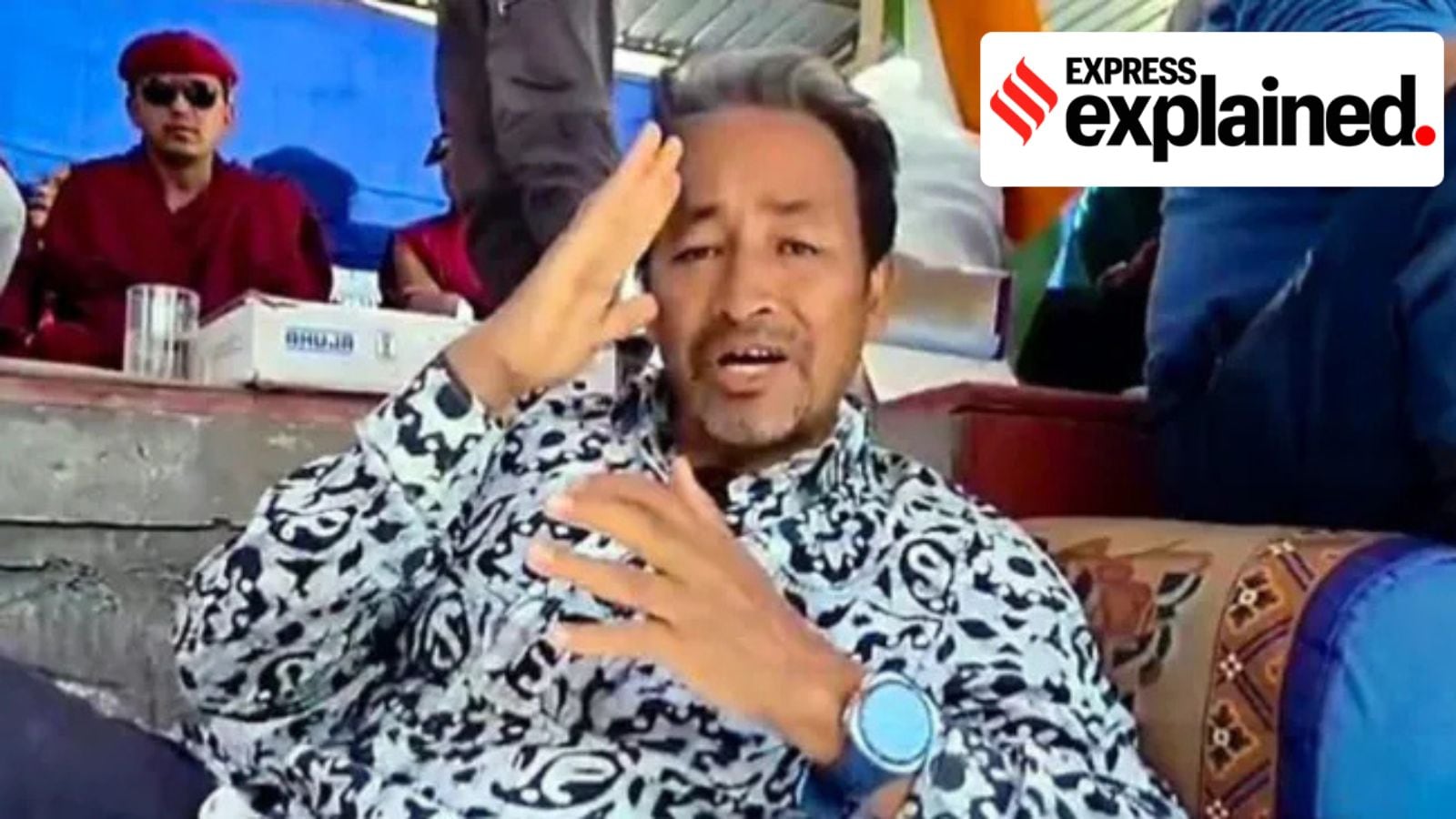
Climate activist Sonam Wangchuk, at the forefront of the movement seeking statehood and protections under the Sixth Schedule for Ladakh, was detained under the stringent National Security Act (NSA) by the police in Leh on Friday (September 26). According to his wife, he has been taken to a jail in Jodhpur.
The Centre had previously held him responsible for instigating the violent protests that broke out in Leh on Wednesday, in which four persons were killed in police firing, and 50 were injured.

The use of the NSA has brought focus back on one of India’s most stringent preventive detention laws. Invoked in the past against separatists, gangsters and radical preachers, the NSA empowers governments to act pre-emptively against individuals seen as a threat to public order or national security. Here is what to know.
Preventive detention and NSA
Preventive detention has a long history in India, dating back to colonial times when it was used to control dissent during wars. After Independence, Parliament passed the Preventive Detention Act, 1950, followed by the Maintenance of Internal Security Act (MISA), 1971, which became notorious for misuse during the Emergency. MISA was repealed in 1978, and two years later, the National Security Act was enacted.
The NSA, 1980, empowers the Centre and states to detain individuals to prevent them from acting in a manner “prejudicial to the defence of India, relations with foreign powers, the security of India, or the maintenance of public order or essential supplies”. District Magistrates and Police Commissioners can also exercise these powers when authorised. Unlike an arrest under criminal law, NSA detention is preventive, not punitive—it is designed to prevent an individual from committing an act deemed harmful.
The stated purpose of the NSA was to give the government wide ranging powers to deal with threats to security, law and order, and essential supplies, while building in some procedural safeguards.
What the NSA entails
A detention order under the NSA can be executed like a warrant of arrest. Once detained, a person can be held in specified places, moved across states, and subjected to conditions set by the government.
Story continues below this ad
The Act mandates that the grounds of detention must be communicated to the detainee within five days, and 15 days at most. It also says that the detainee has the right to make a representation to the government, and that an Advisory Board of High Court judges must review the case within 3 weeks, releasing the detainee if it finds “no sufficient cause.” Detention cannot ordinarily exceed 12 months, though it may be revoked earlier.
However, there are serious limitations. The detainee has no right to legal representation before the Advisory Board, and the government may withhold facts in “public interest.” These provisions leave wide discretion in official hands.
Wangchuk’s options
Wangchuk could either challenge the detention order by filing a representation to the government, as provided under the Act, or wait for the Advisory Board’s review within three weeks. If the Board finds no sufficient cause, he must be released immediately.
Alternatively, he may move the High Court or Supreme Court under writ jurisdiction (Articles 226/32 of the Constitution) to contest the legality of his detention. He can also seek revocation if the government itself decides the detention is unnecessary at any stage.
Story continues below this ad
Until these remedies play out, however, the NSA allows authorities to hold him without filing formal charges or producing evidence in open court.
How the NSA has been used previously
Wangchuk is the latest in a series of high-profile cases where the law has been invoked. In recent years, the law has been invoked in several high-profile cases. In 2023, radical Sikh preacher Amritpal Singh, leader of ‘Waris Punjab De,’ was detained under NSA and shifted to Assam’s Dibrugarh jail.
In 2017, Bhim Army chief Chandrashekhar Azad “Ravan” was booked under the NSA in Uttar Pradesh. The order was revoked after the matter reached the Supreme Court, and he was released in September 2018. And during the anti-CAA protests in 2020, several protesters in Uttar Pradesh were booked under the NSA.
Civil liberties groups and courts have repeatedly flagged the misuse of the NSA.
Story continues below this ad
In 2020, paediatrician Dr Kafeel Khan was detained under the NSA by the Uttar Pradesh government following an alleged inflammatory speech. His case received widespread attention after the Allahabad High Court questioned the grounds for detention and ordered his release.
In Madhya Pradesh, the Act has been invoked in “Love Jihad” cases, and in Uttar Pradesh, it has been used during episodes of communal violence.
NSA has also been used against those accused of cow slaughter or habitual criminals in states like Madhya Pradesh and Uttar Pradesh, which critics say stretches the definition of a “national security” threat.
In 2012, the Supreme Court struck down the NSA detention of a man accused of black-marketing kerosene, holding that the grounds were unjustified.
Story continues below this ad
Together, these instances highlight a recurring pattern: governments defend the act as a necessary tool for security, while critics see it as a blunt instrument prone to misuse.
