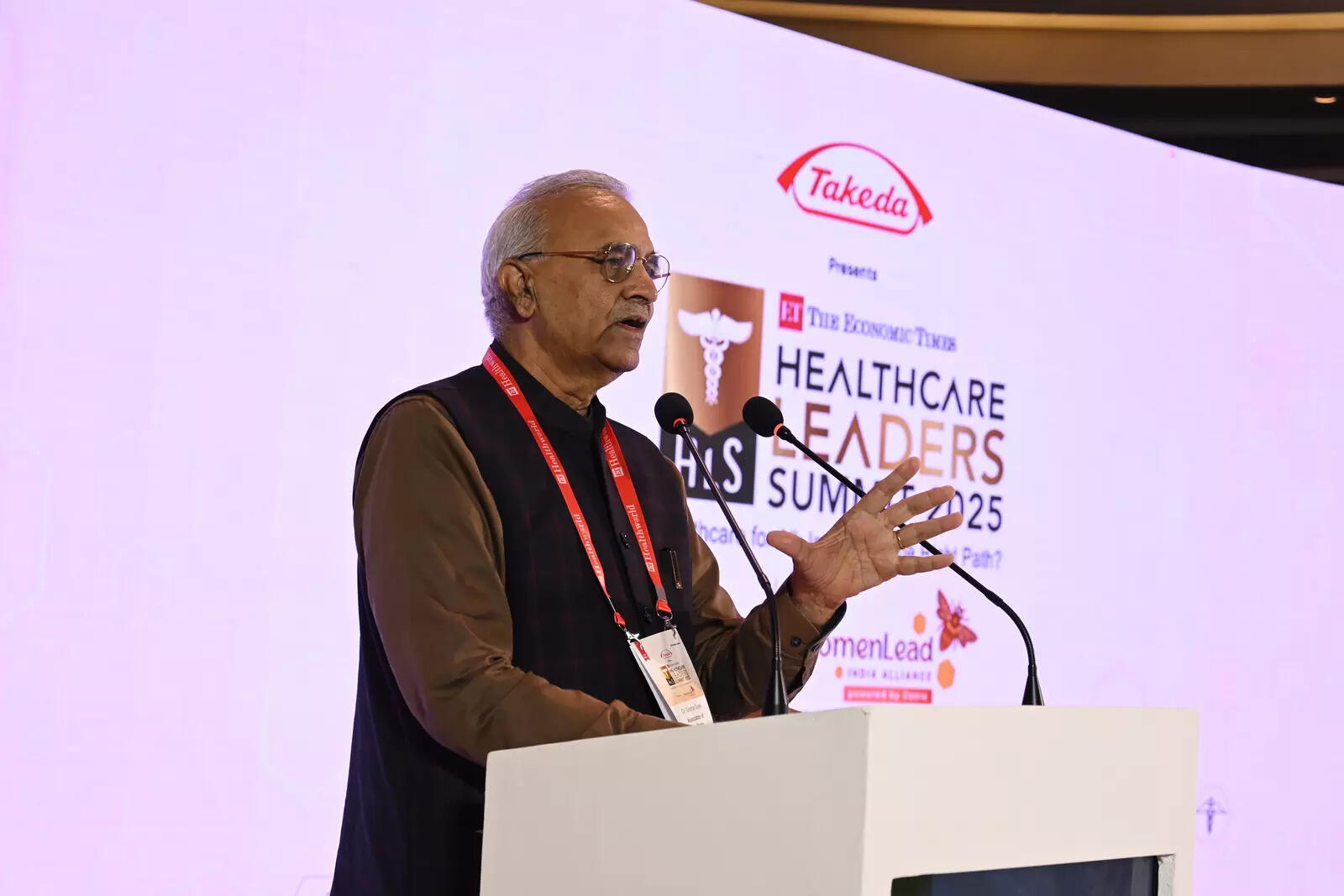
New Delhi: India’s healthcare debate has for years revolved around affordability, but without equal focus on sustainability, the system risks becoming unviable, warned Dr Girdhar Gyani, Director General, Association of Healthcare Providers (India). Calling for a shift in perspective, he said both issues must be tackled together if the country is to achieve its health vision for 2047.
Speaking at the 5th flagship edition of ETHealthworld’s Healthcare Leaders Summit (HLS) on the topic Medical Inflation vs. Patient Affordability: Who Bears the Real Cost of Healthcare? Dr. Gyani remarked: “For years we have talked only about affordability, but now the question is, how do we balance it with sustainability?”
“India today has 21 lakh hospital beds, out of which 13 lakh are in the private sector and around nine lakh in the public sector. That comes to 1.5 beds per thousand population when the requirement is three,” he pointed out.
On accessibility, drawing the sharp contrasts between states, Dr Gyani said, “Karnataka has 4.2 beds per thousand population, while Bihar has only 0.3. Someone asked me where to invest in healthcare, and I said—invest in Bihar, because that is where beds are needed the most.”
Adding that even within states, distribution remains skewed, he said, “Take Telangana. It has 126 hospitals with more than 100 beds, but 118 are in Hyderabad. Imagine the patient from a small district who has to come all the way to Hyderabad for care.”
On government claims of 70 per cent population coverage through Ayushman Bharat, central schemes, and private insurance, Dr Gyani said, “To be very frank, we have not even covered 30 per cent of the population under Ayushman Bharat. Cards may have been issued, but many people are unable to access care. States are even pulling out of the scheme, and we know the reasons.”
Addressing concerns about healthcare inflation, he said, “At the time of Independence, India’s life expectancy was less than 37 years. Today it is 73. How has this happened? Only because of advancements in healthcare. Quality healthcare will cost. Absence of quality healthcare will cost lives. That is the difference people need to understand.”
He also took aim at private insurers, saying, “Your medical loss ratio is too high. You are spending 35 to 40 per cent of the premium received on administrative costs. In the US it is 10 to 15 per cent. In Germany and France, it is less than 10 per cent. This is mind-boggling. You too must pull up your socks and improve efficiency.”
Outlining three critical priorities for healthcare, he said, “We have to double the number of beds and ensure that every district has at least three per thousand population. The government must incentivize private hospitals to go to tier-3 towns. In 2018, the PM announced 3,000 new hospitals in tier-3 towns. But nothing has happened because no incentives were provided. “We need more specialists. Increasing MD seats is not enough—it takes years. For areas like stroke management, we must create aggressive fellowship programs to quickly build capacity.”
Suggesting that government hospitals must begin issuing bills, even if fully subsidised, he said, “If a general ward costs Rs 7,500 a day, show them the bill and then write subsidy Rs 7,500, payable zero. At least people will know what healthcare actually costs. Then when they come to Apollo, Fortis and pay a little more, they will understand it is for personalised care.”
With a call for collective accountability, Dr. Gyani, concluded,”If government, insurers, and providers work together with technology and efficiency at the core, India will not just make healthcare affordable but also sustainable and by 2047, we can truly stand as a global healthcare leader.”