

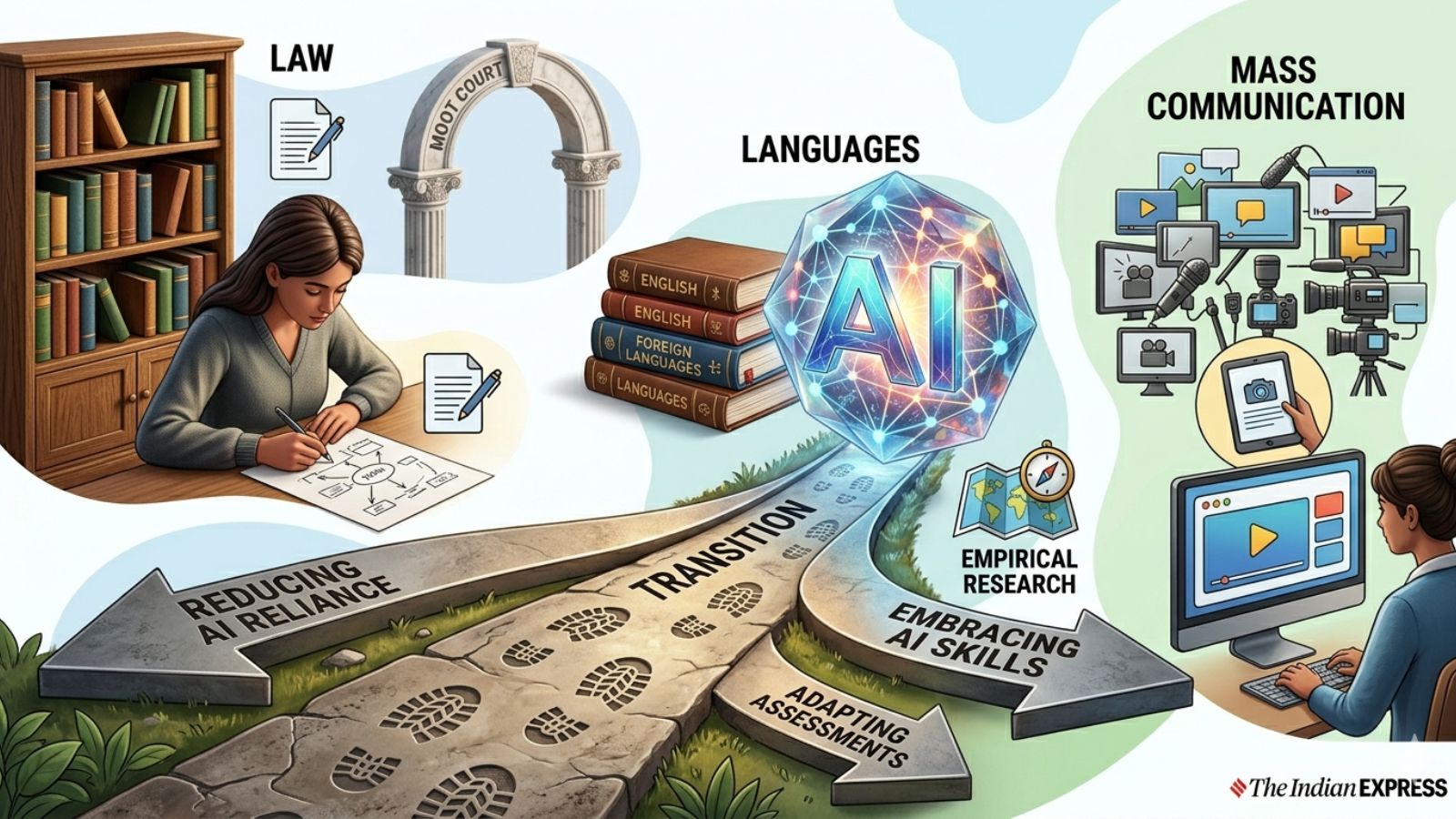
With the release of ChatGPT in late 2022 and a range of other generative artificial intelligence (AI) platforms in the following years, college education has undergone a big disruption. Research and writing assignments that would keep students up at night catching up with deadlines can now be completed in a few minutes with well designed prompts.
At the same time, after college, employers look for not just skills in the field but also AI capabilities. This puts educators in a situation where assignments have to be AI-proofed and, at the same time, AI-skills have to be imparted.
The Indian Express spoke to educators in the fields of law, languages, and mass communication about how AI has changed their teaching methods.
Law
Professor Shashikala Gurpur, Dean of the Symbiosis Law School, said that AI makes research easier for students, and that she has noticed an increase in the quality, structure, and grammar of research.
“But the sad thing is that I was reading a report that 90% of the PhD thesis in India now looks plagiarised. So the best case is to identify your problem, read up literature using AI tools, but go and get the reality from the field in empirical research. Statistical tools can be used utilising AI but only original examination and interaction with society will make the research meaningful,” she said.
Assessments, also, have completely changed. Prof Gurpur says “Teachers were earlier free to choose from multiple types of assessment types. However, now we have made pen-and-paper tests compulsory because post-ChatGPT, we are seeing most of the assignments looking similar. So in a semester we conduct one test which has a substantial portion of marks. Similarly, we have increased skill-based assignments like mock-trials and moot-courts.”
SLS has introduced two AI courses in its syllabus. A two-credit course titled AI, Data Analytics and Legal Technology in the first semester involves introduction to machine-learning and artificial intelligence, data privacy and intellectual property concerts in research, databases and law, data collection and analysis, ethical considerations and AI hallucinations, and future trends in tech, AI, and law. In the second semester, SLS offers a one credit course focused on practical applications like data collection, analysis, and AI and ML in legal data analysis.
Story continues below this ad
Languages
Language degrees, having a high percentage of written assignments, have also been majorly affected due to the widespread use of generative AI.
Professor Chetan Sonawane from the English Department at Fergusson College said “The negative side of AI is that if they are given a topic for an assignment, they just ChatGPT it,” he remarks. Consequently, written assignments have been reduced while increasing in-class writings and presentations have been increased.
However, he also acknowledges the benefits AI provides to both students and educators.
“For teaching, I am using AI. I was teaching an essay titled ‘Can The Subaltern Speak’ by Gayatri Chakravorty Spivak from Columbia University. While teaching it I realised that some parts were so obscure that I could not really understand them. I took a picture of that part and uploaded it on ChatGPT and I found a very good explanation of the given part. So it is very useful as well. But the important thing is that are you using it as an aid or a replacement?” said prof Sonawane.
Story continues below this ad
Assistant Professor Anagha Bhat-Behere, Head of the Foreign Languages Department at Savitribai Phule Pune University, said that it had become very easy to get the foreign language content in one’s language due to generative AI. “However, on the other hand, this ease kills the curiosity about the linguistic structure of language.” she said.
“It is not possible to completely eliminate written assignments, but I have switched to more presentations as even though the presentation might be made using AI, there will be questions and counter-questions the student will have to answer,” she adds.
Even though no AI-based courses have currently been introduced, Prof Bhat-Behere believes that the demand for linguistic experts in training of Natural Language Processing (NLP) models gives a great scope for their introduction in the future.
Mass communication
Angad Taur, Assistant Professor at the faculty of Media and Communication at Vishwakarma University, said that education had become more challenging from a teaching and learning point of view.
“We are actually facing this vicious cycle, that to find the easy shortcut, students and teachers are likely to use AI. We have this contradiction where we cannot tell our students not to use AI. Now you have to find that sweet spot in student usage of AI. They have to use their creativity, their own way of finding real world issues and problems, and then they can use AI as an aid.”
Story continues below this ad
The Bachelor of Journalism and Mass Communication degree at Vishwakarma University now has a three credit AI and ML in Media course in its sixth semester. This course includes foundations of AI and ML in media, AI in journalism and mass communication, AI in branding and advertising, ethics and governance of media, and AI content and future trends.
