

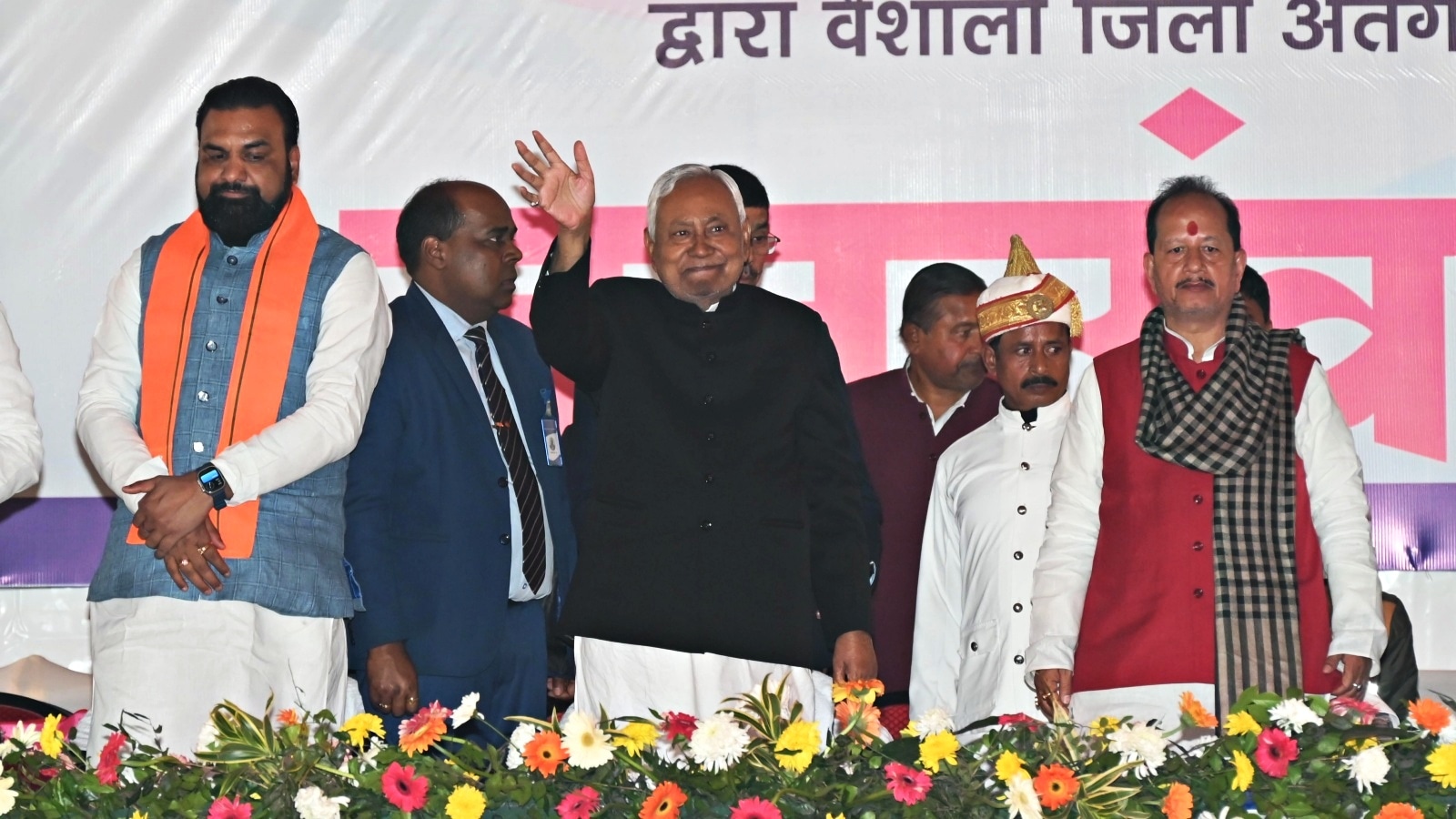
As the first leg of Bihar Chief Minister Nitish Kumar’s state-wide ‘Samriddhi (prosperity) Yatra’ comes to a close Saturday, a crowd of more than 10,000 supporters has gathered in Vaishali to hear the Janata Dal (United) supremo’s speech.
In his 15th state-wide yatra as the CM, and 16th since 2005, Nitish has so far covered nine of Bihar’s 38 districts as he takes stock of his government’s key projects and welfare schemes during it.

With the main entrance of the Baba Bateshwar Nath Dham campus, the site of Nitish’s rally in Vaishali, closed off for the movement of VIPs and government officials, several women take a detour through mustard and cabbage fields to reach the rally venue in the hope of arriving well in advance and securing a seat close to the stage.
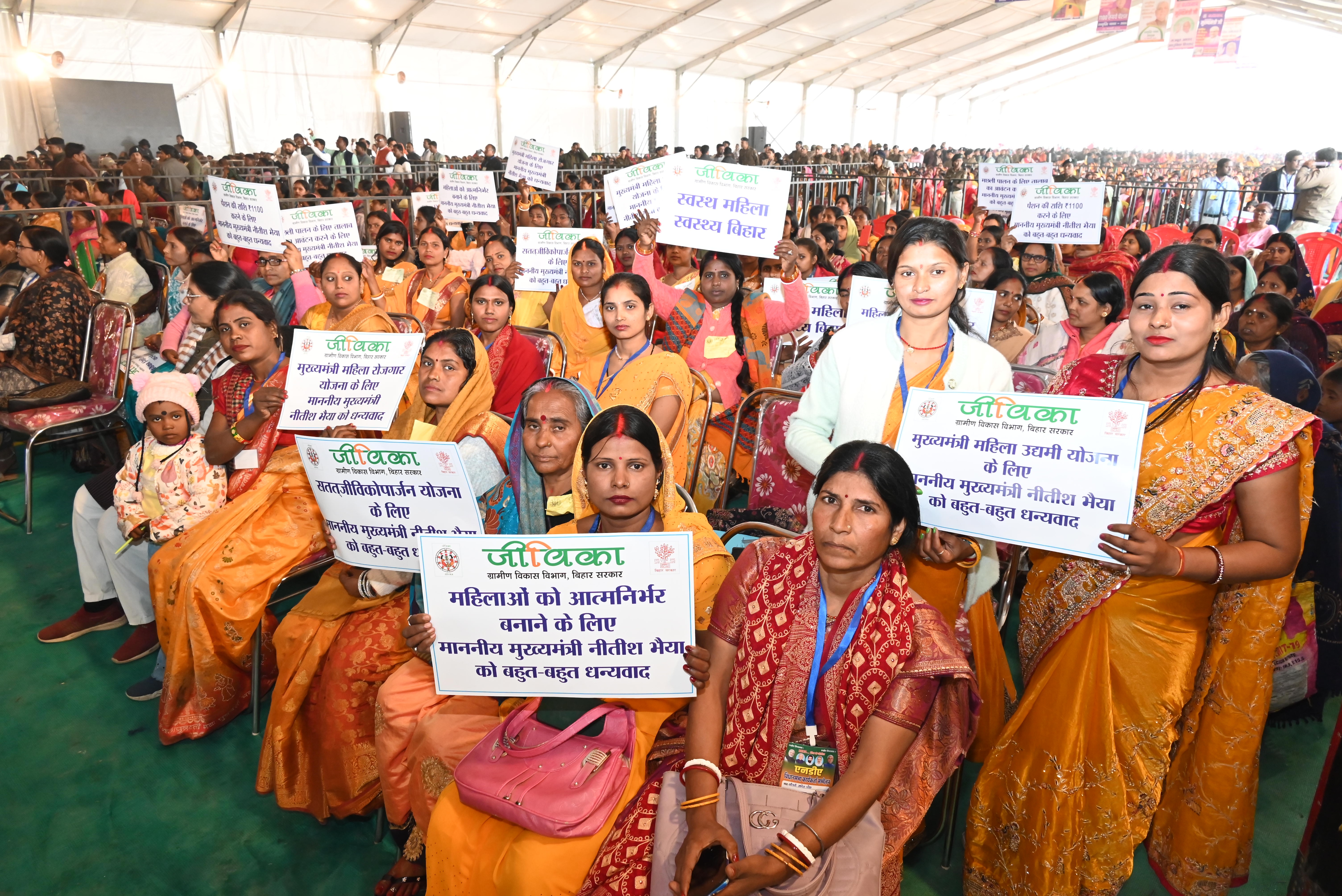 By any measure, the turnout at this rally appears to be far in excess of those even at Nitish’s election rallies.
As more groups of women and girls, who make up a majority of the crowd, converge at the rally ground, police personnel find it increasingly difficult to maintain order. Some women wearing black saris, salwars or dupattas are stopped by the police, who flag the colour of their attire as a matter of potential protests. But as another surge of Nitish’s supporters, mostly women, comes to squeeze through the metal detectors at the gates, and the crowd outside swells, creating a near-stampede situation, the police relents and lets everyone through.
By any measure, the turnout at this rally appears to be far in excess of those even at Nitish’s election rallies.
“This is Nitish’s dashazari sena,” says an elderly farmer Ramkishan Paswan, referring to the beneficiaries of the Mukyamantri Mahila Rozgar Yojana (MMRY), which the CM had announced in the run-up to the November 2025 Assembly elections, under which women entrepreneurs received a first instalment of Rs 10,000 with a promise of getting a total of up to Rs 2.1 lakh over some future instalments.
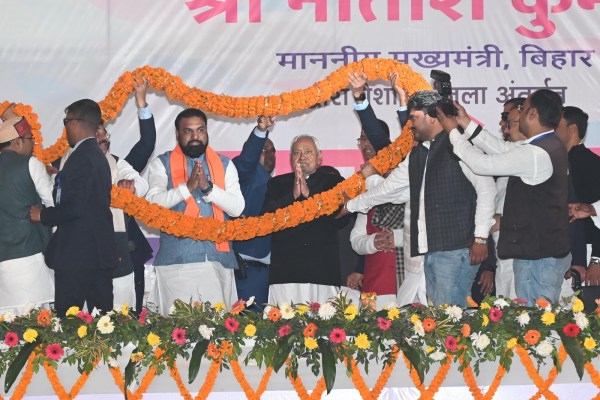 Flanked by his Deputy CM Samrat Choudhary and Cabinet colleagues Bijendra Prasad Yadav and Vijay Kumar Choudhary, Nitish, wearing a black prince coat, takes to the stage.(Express Photo)
While praising Nitish, Ramkali Devi, a “JEEViKA didi” or a beneficiary of the state government’s women empowerment initiative through self-help groups, says, “We were asked to attend the rally mandatorily; otherwise, we might not get subsequent instalments of the women employment scheme, which could be cumulatively up to Rs 2 lakh.”
Despite questions swirling around the flagship women-oriented scheme, several women say that attending the CM’s rallies is a must. Shanti Devi wonders how much she would receive in subsequent instalments, while Ruby Devi, who repaid an old loan with the first instalment, asks if she is entitled to another instalment.
“I am not sure if I am entitled to another instalment. Still, I have to attend the CM’s rally. It is almost a rule now to do so,” says Ruby, a homemaker whose husband runs a small paan shop.
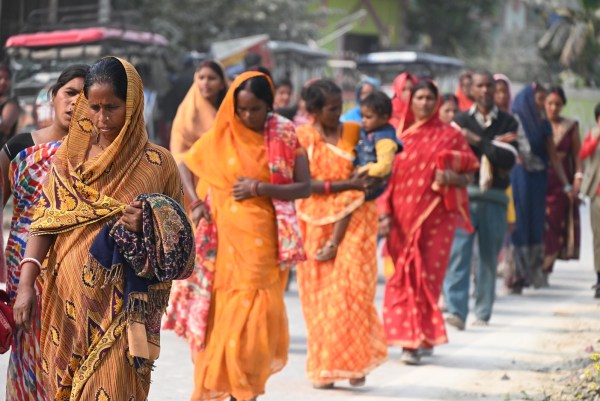 As more groups of women and girls, who make up a majority of the crowd, converge at the rally ground, police personnel find it increasingly difficult to maintain order. (Express Photo)
At 12.40 pm, as the CM’s helicopter approaches the rally site, several women take photographs on their phones, even snapping selfies with the helicopter as it descends onto the helipad.
Flanked by his Deputy CM Samrat Choudhary and Cabinet colleagues Bijendra Prasad Yadav and Vijay Kumar Choudhary, Nitish, wearing a black prince coat, takes to the stage.
Though his speech begins the same way as his recent election campaign addresses, Nitish explains the purpose of the Samriddhi Yatra – to set out across the state and assess the implementation status of his ‘Saat Nischay-3’, the third iteration of his seven-point development roadmap.
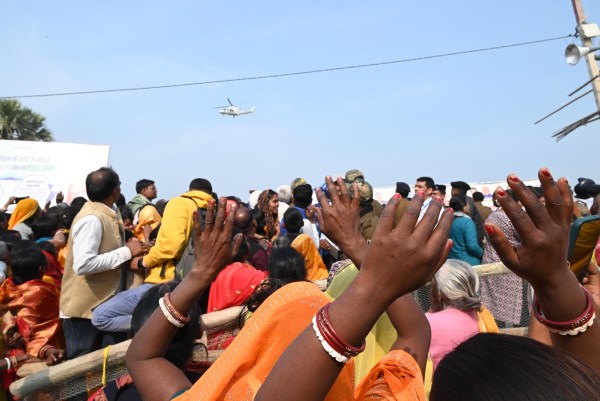 At 12.40 pm, as the CM’s helicopter approaches the rally site, several women take photographs on their phones, even snapping selfies with the helicopter as it descends onto the helipad. (Express Photo)
In the next five years, he says, the state government will focus on industrialisation, building a medical college in each district, developing new towns around the concept of “ease of living”, and, most crucially, follow through on his election promise to generate one crore jobs in Bihar.
“What did the government before us do? When (Lalu Prasad) had to quit as CM after seven years, he installed his wife (Rabri Devi) as CM… But our government has done a lot for women’s empowerment, from 50% quota in panchayats to 35% quota in state government jobs to now being all set to create mass self-employment through the women employment scheme. We are overwhelmed with your support in Assembly polls,” Nitish says.
The MMRY, in particular, was widely credited with cementing Nitish and the JD(U)’s support among women and delivering a thumping victory in the Assembly elections. The JD(U) won 85 of the state’s 243 seats, with the NDA securing a landslide win with 202 seats.
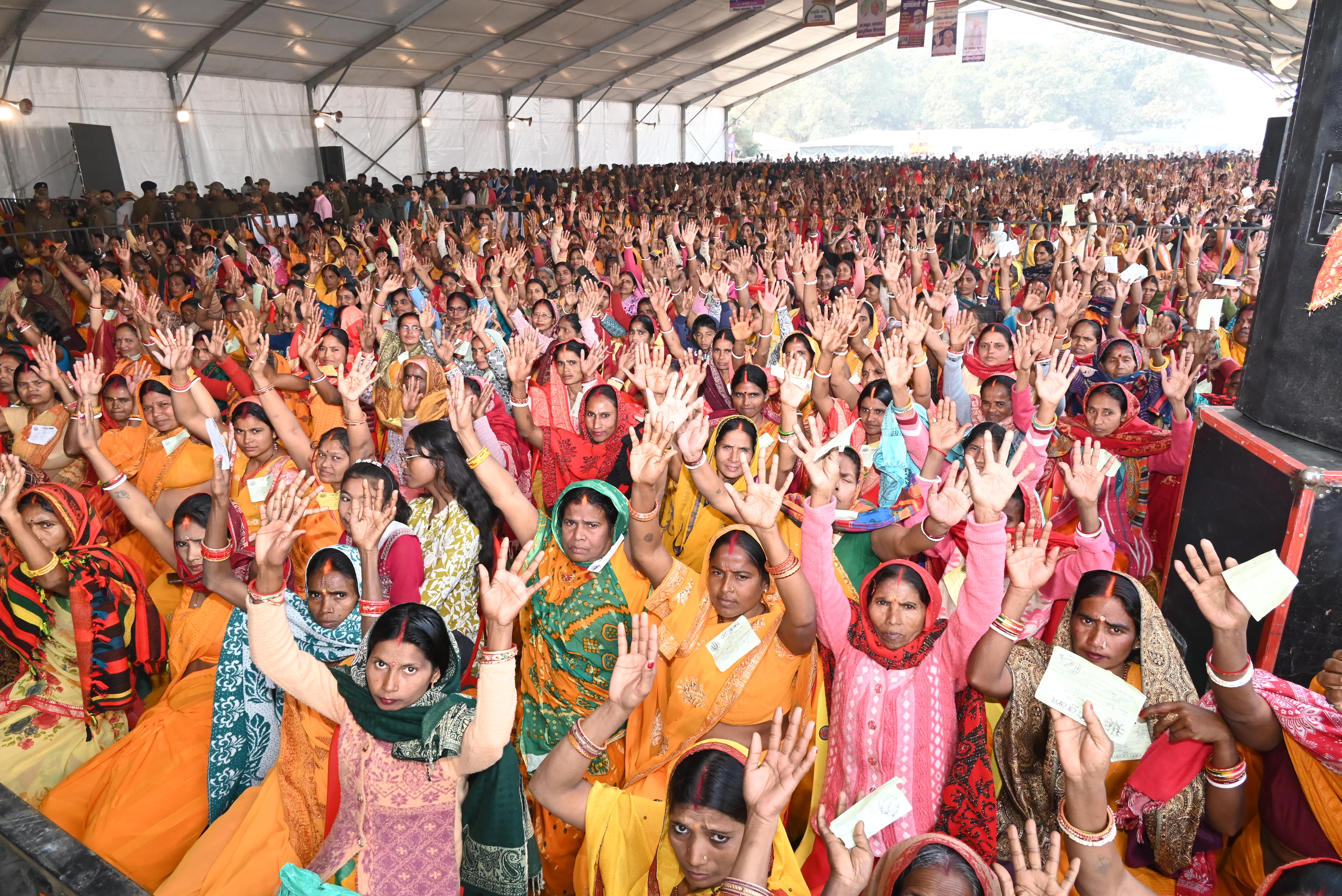 Despite questions swirling around the flagship women-oriented scheme, several women say that attending the CM’s rallies is a must.
In the remainder of his speech, Nitish further commits to his government’s objective of a “samriddh (developed) Bihar”. “Each of the 38 districts will have a devoted industrial zone. We are also constructing five new expressways. Five new townships are also proposed,” he says, reiterating that healthcare and education are still among the government’s top five priorities.
All along a 500-metre stretch of a road leading to the rally venue, banners and posters hail the government’s initiatives and promises – from the second instalment of the Mahila Rojgar scheme to the creation of a devoted Youth, Employment and Skill Development Department, to prioritising 94 lakh poor families for welfare schemes.
But despite these declarations, two graduate students, Ayush Kumar and Niket Kumar, who are preparing for competitive examinations, called Nitish’s Yatra “too women-centric”. “There is a crowd surge because of the heavy presence of women, who are beneficiaries of the Rs 10,000 scheme. We came here to know what is there for the youth,” says Ayush, as Niket adds, “We want to know more about ways to generate employment. There is too much populism in the entire theme of this yatra.”
