

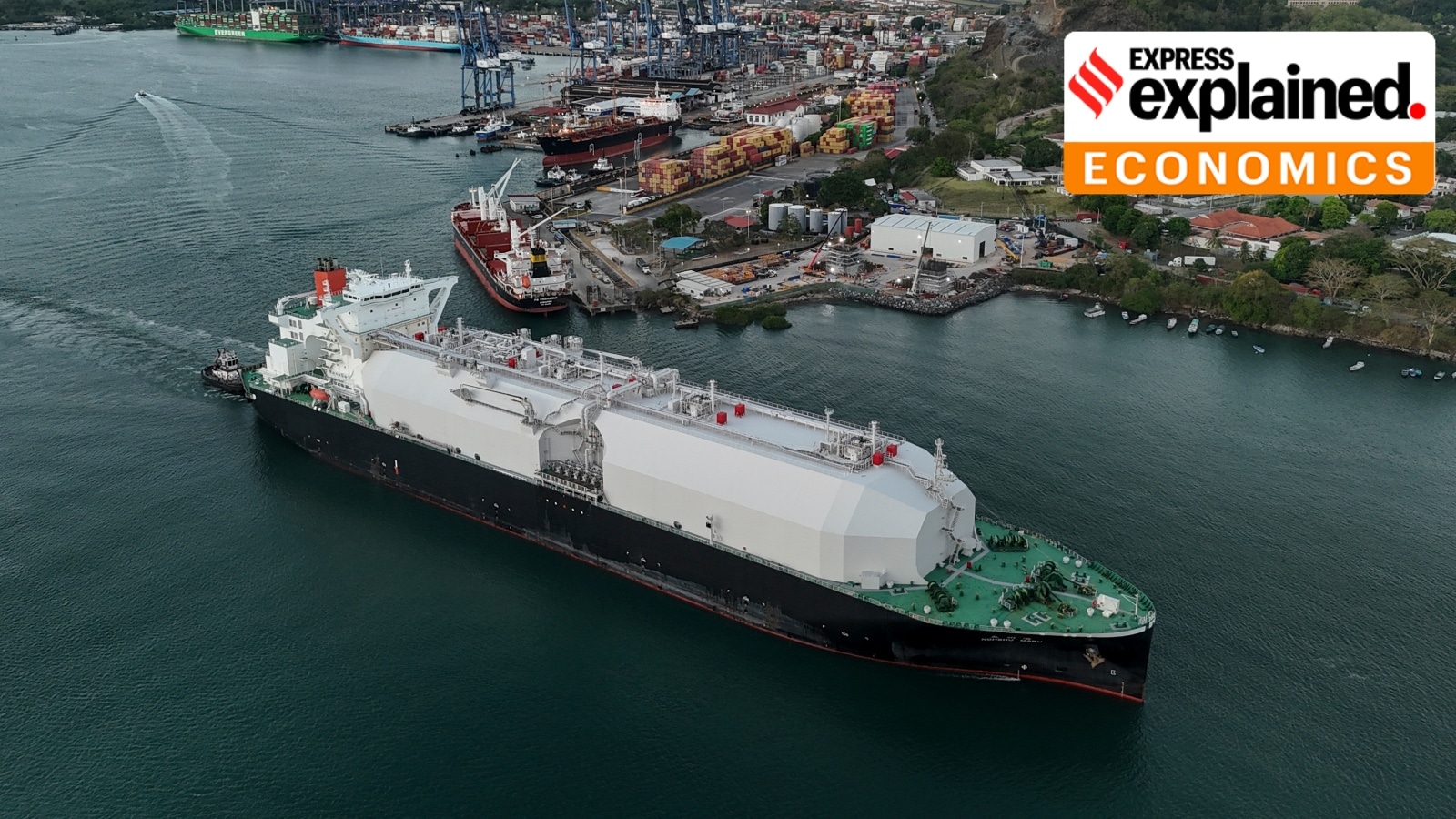
Amid the effective halt in vessel movements through the Strait of Hormuz and liquefied natural gas (LNG) production suspension by Qatar, a growing number of LNG tankers that were carrying cargoes meant for Europe are diverting to Asia, including India.
According to maritime firm MarineTraffic, around 11 LNG tankers originally bound for Europe have diverted to Asia since March 3 “as buyers respond to tightening supply and rising spot prices following the closure of the Strait of Hormuz and outages at Qatar’s Ras Laffan LNG complex”.
“The latest diversion involves the LNG carrier La Seine, which altered course from Montoir (France) to Asia on 19 March after loading in the United States. Other vessels, including BW Brussels and LNG Cross River, are now heading toward Dahej, India, while additional cargoes are signalling destinations in Taiwan and East Asia,” MarineTraffic said Monday.
So, why are these Europe-bound LNG cargoes being diverted to Asia, including India? Here’s what to know.
Supply hit due to Hormuz closure, Qatar outage
Most of the LNG exports from West Asia depend on the Strait of Hormuz—the narrow waterway between Iran and Oman that connects the Persian Gulf with the Gulf of Oman—to enter the international market. With vessel movements through the critical maritime chokepoint all but halted amid the West Asia war, supplies to Asian LNG importers, including India, have been hit, creating an immediate supply gap.
This has forced India and the other buyers to scout for LNG from alternative geographies through spot market purchases, which has led to a surge in Asian LNG prices, making it lucrative for cargoes even from faraway geographies like the US to head to Asia instead of Europe.
The Strait of Hormuz, under normal circumstances, accounted for one-fifth of global LNG flows. As for India, 55-60% of the country’s LNG imports—mainly supplies from Qatar and the UAE—depend on the strait. India depends on LNG to meet around half of its natural gas requirement, which means that the West Asia war has effectively made 30% of India’s natural gas supply unavailable.
Story continues below this ad
According to industry insiders and experts, the trend of LNG cargoes diverting to Asia could continue going forward, as long as LNG flows through the Strait of Hormuz remain heavily disrupted. Various countries in Asia—India among them—have high dependency on West Asia, particularly Qatar, for LNG supplies. Unless supplies through the Strait of Hormuz normalise, Asian buyers are expected to compete with Europe for LNG supplies from alternative sources, even at soaring prices.
In the current scenario where the physical supply risk is clearly present, supply security takes precedence over price, at least for sectors where LNG use is critical and demand inelastic. Apart from India, countries that are in the market to cover supply shortages from West Asia include the likes of South Korea, Japan, Thailand, Taiwan, and Bangladesh, according to analysts.
Apart from the effective halt in shipping through the Strait of Hormuz, QatarEnergy has also suspended LNG production at its flagship Ras Laffan facility, which came under attack twice; while the first attack did not cause much damage, the second attack led to notable damage to parts of the facility.
QatarEnergy’s primary LNG production units, liquefaction plants, and export infrastructure are all concentrated in Ras Laffan, making it the world’s largest LNG hub that accounts for roughly a fifth of global LNG supply. The attacks by Iran damaged two LNG producing trains totalling 12.8 million tonnes per annum (mtpa) of production, representing approximately 17% of Qatar’s LNG exports, and could take up to five years to repair, according to QatarEnergy.
Story continues below this ad
QatarEnergy has an LNG production capacity of 77 mtpa, which is under expansion. In 2025, QatarEnergy exported around 81 million tonnes of LNG. The strikes on Ras Laffan could cost QatarEnergy about $20 billion a year in lost revenue, the company said. According to industry estimates, over 80% of Qatar’s LNG exports go to Asian buyers.
The India impact
Although QatarEnergy has so far not specifically mentioned the impact on supplies to India, there have been concerns that long-term LNG flows to India could be impacted. With LNG from Qatar and other sources in West Asia unable to reach India due to the effective closure of the Strait of Hormuz and production suspension by QatarEnergy, New Delhi had already cut natural gas supplies to certain industries, and drawn out a priority list of the critical consuming sectors.
Qatar alone accounts for over two-fifths of India’s LNG imports, and almost all of India’s Qatari LNG comes from Ras Laffan. According to Commerce Ministry data, India imported 27 million tonnes of LNG in 2024-25, of which 11.2 million tonnes, or 41.4%, came from Qatar. India has long-term LNG contracts totalling 8.5 mtpa with QatarEnergy; India also buys Qatari LNG from the spot market.
The country’s LNG importers have also aggressively entered the market to secure LNG cargoes from wherever possible to ensure adequate supplies, at least for critical natural gas-dependent sectors that do not have the option to quickly switch to alternative fuels. Industry insiders said that Indian LNG importers have been able to secure some additional cargoes from the spot market, even as competition for such volumes continues to intensify globally.
The priority list
Story continues below this ad
The government order on prioritisation of natural gas supplies lists four priority categories that shall receive, subject to availability, natural gas in varying quantities based on their average gas consumption levels of the past six months.
The top priority category, which will receive 100% of the average gas consumption of the last six months, include PNG for households, CNG for transportation, natural gas used for LPG production, and gas consumed for essential pipeline operations. The second priority category, according to the order, is fertiliser units, which will receive 70% of their average gas consumption of the past six months.
The third category includes “tea industries, manufacturing and other industrial consumers supplied through the national gas grid”, for which supply will be maintained at 80% of their six-month average consumption. In the fourth category are commercial and industrial consumers of city gas distribution companies; they will get 80% of their past six-months average gas use.
On the other hand, natural gas supplies to some petrochemical manufacturing units, refineries, gas-based power plants, and consumers of domestic gas produced from difficult blocks have been curtailed.
