

The newspaper of August 15, 1947, was eagerly awaited across much of South Asia. It was no different in Calcutta. The headlines of the late city edition of theMorning Newsproclaimed in bold: Sovereign Pakistan and India Born. Clustered around it were other announcements, including assurances of equal treatment for minorities, tributes to Mahatma Gandhi, and reports on Muhammad Ali Jinnah extending goodwill to British nations.
Yet, tucked into the left corner of the page was a headline of a different tenor. It read, “ANNOUNCEMENT: Thank God AMINIA HOTEL is opening a branch at Old Hindustan Building near New Market on the auspicious day of Id-ul-Fitr. We expect our patron’s appreciation as usual.” In a moment defined by the birth of nations, a restaurant’s expansion nonetheless found its place in the headlines. This was, after all, Calcutta.

It’s a sentiment that resonates with Ammar Hamid today. A regular at Aminia Restaurant, he says, dining there is more than just the biryani. “It is about the slow cooking, the perfect blend of spices, and the delectable cuisine passed down over generations,” he tellsThe Indian Express. “Moreover, the location of the restaurant in New Market, Futnani Chambers, which former West Bengal chief minister Jyoti Basu called home in his formative years, is steeped in heritage,” he adds.
Preserving and expanding that heritage is Kabir Azhar, the fourth-generation owner. Over a plate of his favourite mutton biryani, he recounts how his great-grandfather carried the legacy of Awadhi cuisine to Calcutta. And how, what began as a modest establishment grew into one of Calcutta’s most beloved biryani houses.
From Dariabad in Uttar Pradesh
Azhar’s family traces its roots to Dariyabad, a small town near Lucknow. His great-grandfather, Abdul Rahim, spent his early childhood there. In A Taste of Time: A Food History of Calcutta, author Mohona Kanjilal notes that Maulvi Abdul Rahim was the son of Abdul Karim, a resident of Dariyabad in the Barabanki district of Uttar Pradesh. Abdul Karim was descended from a sepoy who had participated in the Indian Rebellion of 1857. After the revolt was suppressed, British officers pursued those they branded “traitorous” mutineers. To escape persecution, the family sought refuge in Dariyabad, where they turned to weaving for their livelihood.
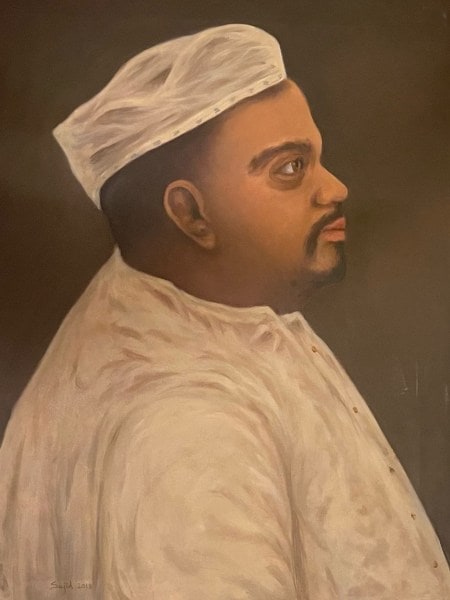 Abdul Rahim (Kabir Azhar)
In search of better prospects, Abdul Karim later relocated to Calcutta. In the early 1900s, he bought a house in Mechua Bazar and opened a modest eatery serving kebabs and chaap. The establishment was eventually looked over by Rahim.
Rahim had two sons, and it was the younger, Mohammed Amin, who would ultimately reshape the family’s fortunes. “My grandfather, Abdul Qayum, often said the younger son [Mohammed Amin] was his favourite,” Azhar recalls with a smile. “It was at his urging that my great-grandfather moved from running a cart to opening a proper restaurant.”
Story continues below this ad
Thus, Aminia Restaurant was established in 1929 on Zakaria Street, serving biryanis, slow-cooked kormas, and tender kebabs prepared in the traditional Awadhi style. “Although Dariyabad is a small town, its culinary traditions are widely respected. Many Mughlai restaurateurs in Calcutta trace their roots there, including India Restaurant,” Azhar notes.
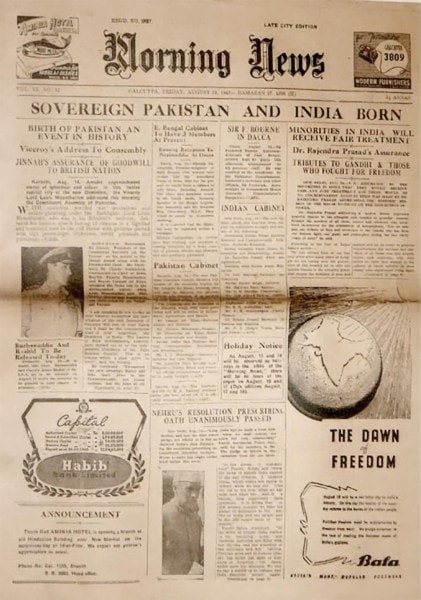 Morning News, August 15, 1947 (Kabir Azhar)
As the family expanded, so did the enterprise. “By the time the second generation took over, the demand for Awadhi and Mughlai cuisine in the city had grown tremendously,” Azhar says. “Expansion wasn’t driven by ambition alone—it was a response to what Calcutta wanted.”
The Calcutta Biryani
Recalling his favourite dishes, Azhar does not hesitate. “It has to be the Mutton Pasinda Kebab and the biryani,” he says. When asked what makes Kolkata biryani truly special, he leans forward. “See, Calcutta biryani has its own character. Firstly, it’s about the meat.”
In a Hyderabad biryani, he explains, the meat is typically cut into smaller pieces and distributed throughout the rice. “Calcutta biryani does it differently. We serve a single, chunky piece of meat. Bengalis believe the bigger the piece, the happier you are,” he laughs. The generous cut is not just a flourish—it defines the dish.
Story continues below this ad
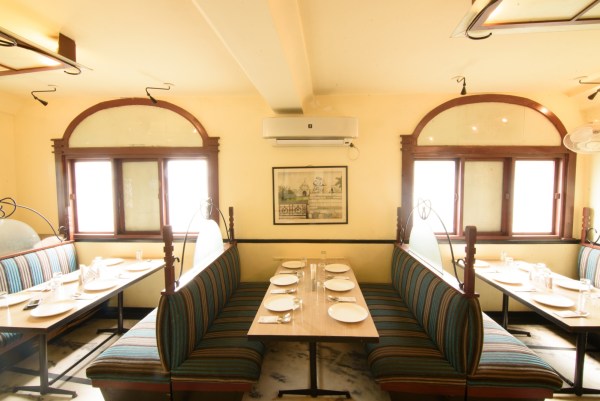 Aminia Restaurant (Kabir Azhar)
The second difference lies in the masala. While both traditions draw on subcontinental spices such as cardamom, their flavour profiles diverge sharply. “We use some interesting ingredients—dried rose petals, mace, white pepper,” says Azhar. By contrast, Hyderabadi biryani relies more heavily on black pepper and curry leaves. “The masala blend is completely different,” he emphasises. The Kolkata style is subtler, more aromatic than fiery.
Then there is the rice. “Our basmati grains are much longer,” he explains. The visual elegance of long, slender rice is central to the appeal, and, of course, there is the potato.
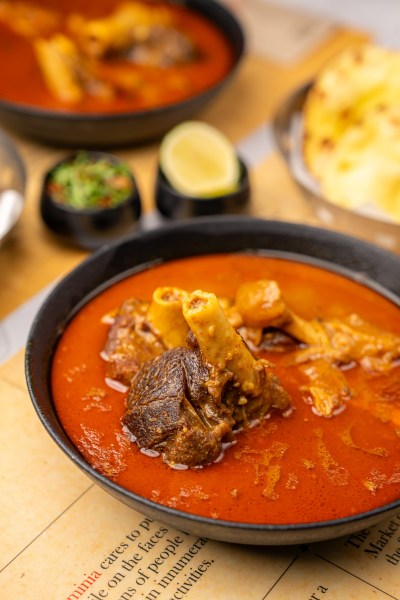 Aminia mutton curry (Kabir Azhar)
“No potatoes in their biryani,” Azhar says of the Hyderabadi version. “That’s the biggest difference.” In Kolkata, however, the potato is indispensable—soft, golden, and richly infused with meat juices and spice.
Any discussion of Kolkata biryani inevitably turns to the legend of Wajid Ali Shah, the exiled Nawab of Awadh who was sent to Calcutta by the British in 1856. According to popular lore, his royal chefs, constrained by reduced circumstances, added potatoes to stretch the dish, thereby creating the Calcutta biryani.
Story continues below this ad
Azhar recalls discussing this story with food writer Vir Sanghvi. “Sanghvi told me most of this is nonsense,” he says bluntly. The biryanis we recognise today, he argues, were shaped in the early decades of the 20th century by Muslim restaurateurs who migrated to Kolkata in search of opportunity—men such as Rahim.
The biryani at Aminia Restaurant, Azhar maintains, is closer in spirit to a Lucknow-style pulao. Interestingly, unlike typical Calcutta biryani houses, Aminia does not add eggs to its biryani. Instead, Azhar suggests one take a little mutton, a bit of potato, and some rice to get the best taste.
An assimilation of Bengali and Awadhi cuisine
Among the few culinary secrets Azhar agreed to share were two that beautifully illustrate how Aminia Restaurant evolved into a symbol of Bengali–Awadhi fusion. One was the introduction of a distinctive chaap. At Aminia, it took on a local character with the addition of poppy seeds. In Bengali cuisine, poppy seeds, also known as posto, are a beloved ingredient. Ground into a creamy paste, they lend a mild sweetness to dishes. “The use of posto in chaap created a subtle sweetness. It became one of the restaurant’s iconic preparations,” shares Azhar.
The second innovation was in the phirni. Traditionally, in Lucknow, phirni is made with ground basmati rice. However, Aminia substituted it with Gobindobhog rice, a short, Bengali grain variety.
Story continues below this ad
Interestingly, Hamid says that this unique cultural fusion is not restricted to Aminia Restaurant’s kitchen but is also prevalent in the neighbourhood. Adjacent to Aminia stands the famed Taj Mahal Paan Shop, where the songs of Mohammed Rafi play on loop. Hamid says that the shop’s founder spent 15 years working in Bollywood, where he met the legendary singer and became an ardent admirer. After moving to Kolkata and establishing the paan shop, he kept his devotion alive through Rafi’s music. Today, his son continues the tradition by adorning the walls with photographs of the maestro. “This adds yet another layer of nostalgia to the Aminia neighbourhood,” says Hamid.
97 years strong
Much like other establishments in Calcutta, Aminia Restaurant was hit hard by the economic upheavals of the late 20th century. A wave of radical trade unionism, backed by the Left, created a tense and often militant atmosphere in Bengal’s industrial landscape, discouraging new private investment. Azhar recalls, “Most old-time restaurants in Calcutta were plagued by labour unions, which dictated terms that restricted us commercially and otherwise.” The impact was so severe that Aminia’s Southern Avenue branch had to close, reopening only in 2010 or 2011.
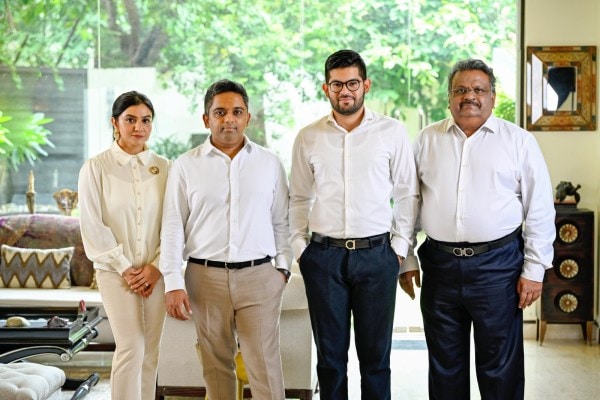 (l-r) Azra Ather, Asher Ather, Kabir Azhar and 3rd generation Mohammed Azhar (Kabir Azhar)
Yet the biryani house has endured since its opening close to 97 years ago. Azhar notes that Bengalis have a deep love for biryani, with Durga Puja, in particular, marking the peak week for footfall. “Aminia is essentially a Bengali brand. About 70 per cent of our customers are Bengalis,” he says.
Today, Aminia has 12 outlets across Kolkata, Siliguri, Guwahati, and even Dubai. Pointing out that the city’s biryani has yet to make its mark on the global stage, Azhar shares his ambitions: “I want to open in Singapore and Australia, where I studied. I want Calcutta to be known for its biryani, just like Hyderabad or Lucknow.”
