

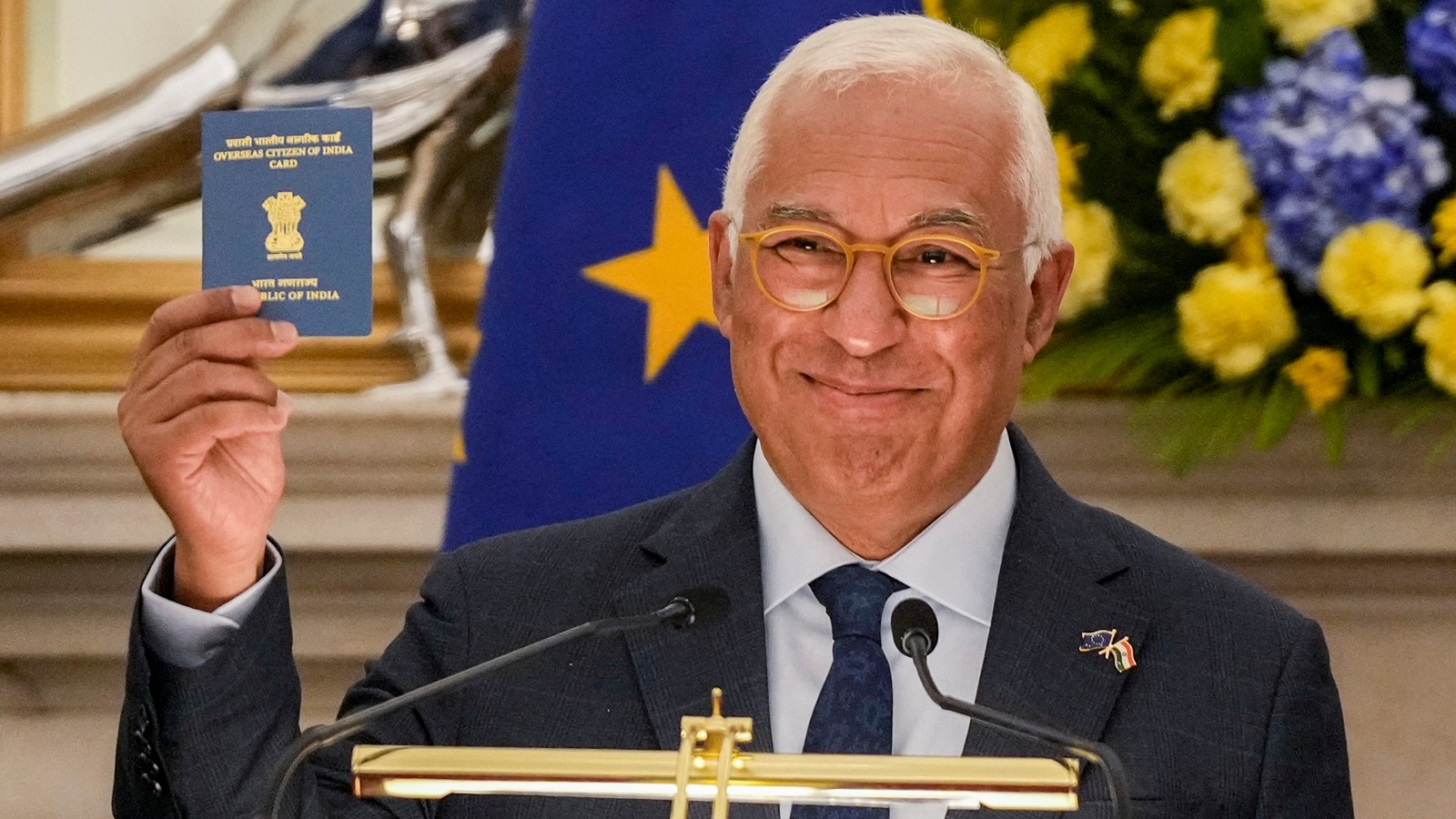
The European Union and India on Tuesday announced the conclusion of a long-awaited free trade agreement, marking a major milestone in bilateral ties and positioning the partnership as a key pillar of the evolving global economic order.
Speaking at a joint press conference with European Commission President Ursula von der Leyen and Prime Minister Narendra Modi, European Council President António Costa stressed on both the strategic and personal significance of the agreement. Referring to his Goan roots, Costa said the EU–India relationship held special meaning for him, adding that the deal sends a strong global message at a time of geopolitical uncertainty.

“I am very proud of my roots in Goa, where my father’s family came from. The connection between Europe and India is something personal. Also, because we conclude today our trade negotiations. We relaunched at the latest meeting that I had the pleasure of hosting in May 2021 in my previous capacity,” Costa, a Person of Indian Origin (PIO), said.
VIDEO | Addressing a joint press conference with European Commission President Ursula von der Leyen and PM Modi, European Council President António Costa said,
“I’m very proud of my roots in Goa, where my father’s family came from. The connection between Europe and India is… pic.twitter.com/HKJ6iGrt4c
— Press Trust of India (@PTI_News) January 27, 2026
“Our summit sent a clear message to the world. At a time when the global order is being fundamentally reshaped, the European Union and India stand together as strategic and reliable partners. Today, we are taking our partnership to the next level,” he added.
PM Modi confirmed that the accord, finalised after nearly two decades of negotiations, aims to significantly deepen economic and strategic cooperation between the two sides. Covering a combined population of nearly two billion people, the agreement has been described by both parties as the “mother of all deals” and one of the largest bilateral trade arrangements in the world.
Addressing an energy conference virtually, Modi said the deal would unlock major opportunities for businesses and citizens across India and Europe. He noted that the partnership represents nearly 25% of global GDP and about one-third of global trade, underscoring its economic weight.
The timing of the agreement is particularly significant as both India and the EU face rising trade pressures from the United States, including steep import tariffs that have disrupted established trade flows. Analysts say the deal reflects a broader push by major economies to diversify partnerships and reduce vulnerability to protectionist policies.
Modi was scheduled to meet later in the day with Ursula von der Leyen and António Costa to formally announce the agreement, flagging a renewed commitment to closer EU–India cooperation amid shifting global alliances.
Story continues below this ad
Costa’s India link
António Costa has ancestral links to India through his father’s family, which hails from Goa. His grandfather was born in the former Portuguese colony and spent much of his life there. Costa’s father, Orlando da Costa, was born in Mozambique, then under Portuguese rule and was a noted writer whose work reflected strong Goan influences and included essays on Rabindranath Tagore. Among his admirers in India, Costa is fondly known as “Babush”, a Konkani word meaning a beloved young one.
In January 2017, Costa visited his ancestral home in Goa and was honoured with the Pravasi Bharatiya Samman. Later that year, in July, he hosted Prime Minister Narendra Modi in Lisbon, marking the first bilateral visit by an Indian Prime Minister to Portugal. During the visit, Modi described Costa as “representing the best of the Indian diaspora across the world,” and Costa was also conferred an Overseas Citizen of India (OCI) card.
Widely regarded as a skilled negotiator, Costa earned the nickname “the Gandhi of Lisbon” in Portugal for his role in transforming a crime-ridden neighbourhood during his tenure as mayor of the capital.
