

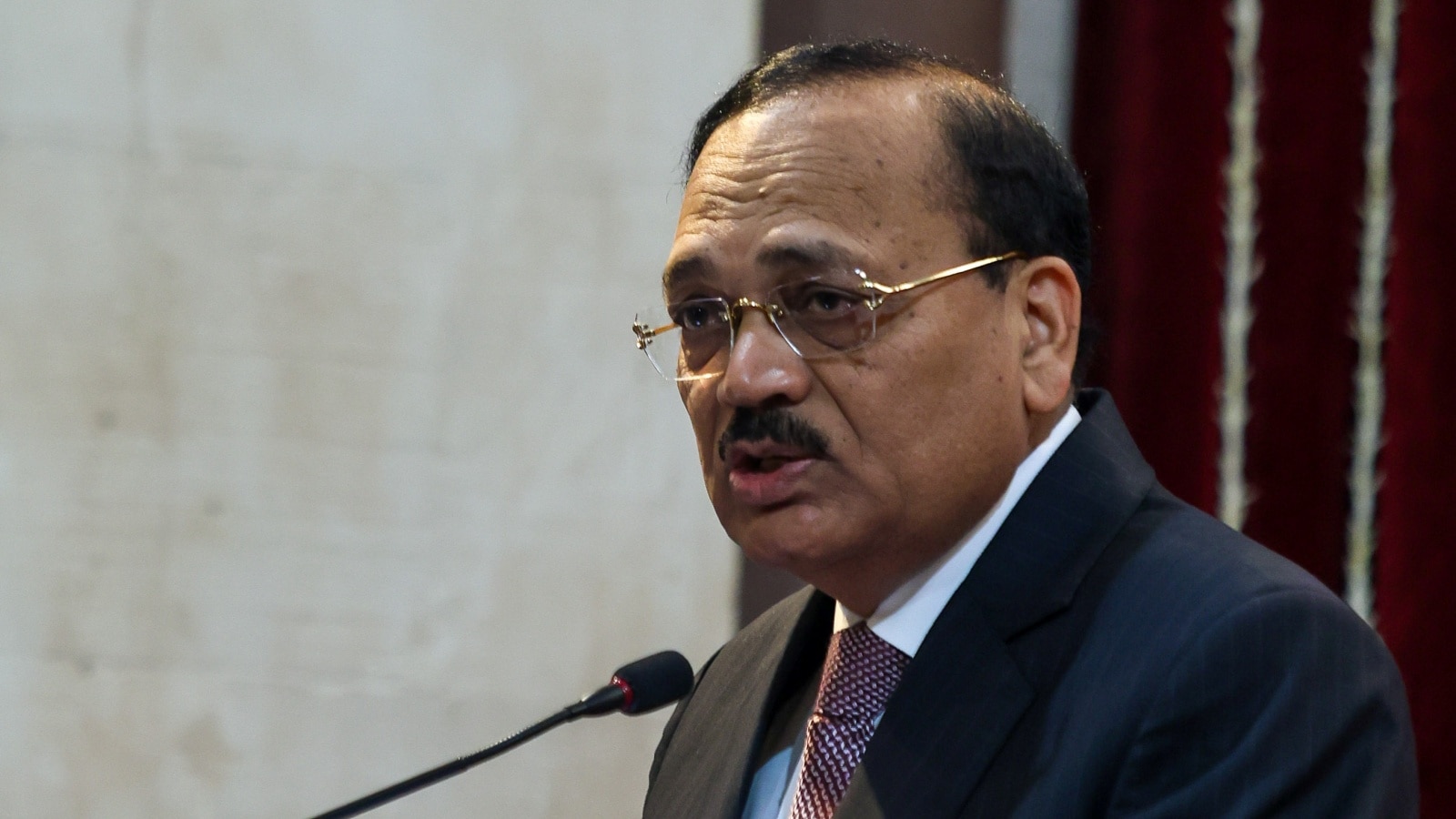
EMPHASISING THE importance of strengthening the country’s arbitration framework, Chief Justice of India (CJI) Surya Kant said on Saturday that institutional arbitration in India must ask if it can “inspire trust” and become a “preferred destination” for international disputes.
Justice Kant was speaking at a ceremony to lay the foundation stone of the new building of the Gujarat High Court Arbitration Centre (GHAC) in Ahmedabad on Saturday. He pointed out that although India’s arbitration framework had “matured” in recent years, parties involved in international arbitrations have their “preferred destinations outside India”.
He said, “India’s arbitrational framework has, by now, matured considerably. Legislative reforms to the Arbitration Act have emphasised minimal judicial intervention, time-bound proceedings and neutrality in appointments. Parallely, judicial pronouncements have reinforced party autonomy and clarified doctrinal uncertainties… Yet, this progress does not eliminate challenges.”
The CJI said, “Institutional arbitration occupies space in India smaller than it ought to be. If substantial volumes of disputes continue to proceed through adhoc mechanisms, our international arbitration disputes have their preferred destinations outside India.
The question to be asked is do our arbitration institutions inspire sufficient trust to become the most preferred choice and destination…”
Saying that conventional litigation may not be the real response to the foreign investors, the Chief Justice reiterated a point made by Gujarat Chief Minister Bhupendra Patel on the state allocating budget for judicial infrastructure in order to extend the “ease of business” to matters of commercial disputes.
CJI Kant said, “Keep in mind the very imminent issue flagged by the Chief Minister (Patel) on how Gujarat is leading the nation in terms of industrial development and technological advancement… and sophisticated and hard industries coming to the state… and how conventional litigation may not be the real response to the foreign investors and therefore, how institutional arbitration acquires a special importance in our legal and jurisdictional framework…”
Story continues below this ad
The CJI said that the inauguration of the GHAC is not a mere ceremonial event and India’s dispute resolution framework should “not merely function but inspire confidence. Just not merely exist but command trust.” Justice Surya Kant said that despite the impetus given to infrastructure, the challenge facing arbitration in India is ‘trust’.
He said, “In commercial matters, when time is capital and certainty is currency… developing the center, reinforces the idea that institutional arbitration in India is prepared to meet global standards… Institutional arbitration fulfills its promise only when its users genuinely trust it…. We must ask if our institutions have earned that trust in full and what they must do further to earn it?”
CJI Kant said that then number of institutional arbitrations in India “remains disproportionately small related to the volume of commercial disputes our country generates” as too many parties “still default in adopting arbitration because institutions have not sufficiently demonstrated the value they add”. Urging for “institutional honesty”, the CJI urged that India ought to invest in training arbitrators, building institutional administrative capacity and developing a coherent pipeline of qualified arbitral professionals, without which, the gap between form and substance will widen.
At the event, Gujarat Chief Minister Bhupendra Patel credited Prime Minister Narendra Modi for his leadership in making India “a global arbitration hub”, laying emphasis on administrative mediation in India. Invoking Mahatma Gandhi, CM Patel said that during his practice as an advocate he stressed on the need for mediation in legal battles.
Story continues below this ad
CM Patel said, “The concept of arbitration is not new to India. The Upanishads describe various mediation organisations. Among these was the panchayat system, which functioned on the premise of Panch Parmeshwar (God speaks through the village head)… We must recall that Mahatma Gandhi believed that the true work of a lawyer is to unite the sides fighting a legal battle. This value (of Mahatma Gandhi) is the foundation of the arbitration process…”
Patel said that the state government is determined to strengthen the judicial infrastructure with new court buildings, advanced technology and facilities. “This year, Rs 2,700 crore has been allocated for this department,” the CM said.
As trade and businesses grow, disputes also rise. It is difficult for courts to bear the burden of such litigations… The state-of-the art mediation centre is our resolve to provide efficient, fair and easy process for mediation and resolution. This is part of ease of business concept (of Gujarat),” Patel said.
Chief Justice of Gujarat High Court, Justice Sunita Agarwal said that under the leadership of CM Patel, “there has been a significant improvement in judicial infrastructure.” Justice Agarwal also credited Supreme Court Justice Aravind Kumar, who was present at the dais for “first mooting” the proposal of the arbitration centre during his tenure as the Chief Justice of Gujarat.
Story continues below this ad
Justice Agarwal added that a fresh batch of 52 high court lawyers and retired district court judges have been “imparted 40 hours training last week and are ready for their induction” into the arbitration centre. “So far, 43 matters arising out of the commercial suit and pre-reference stage of arbitration and two from NCLT have been referred from mediation. Seven of them have been settled with the effort of skilled mediators. Recently, the centre has resolved a decade old commercial dispute at the stage of Arbitration appeal in just two mediation sittings, demonstrating the efficiency and potential of mediation. The construction of the building is a significant step…” Justice Agarwal said.
The centre, set up in February 2021, is currently operating from a make-shift building. First batch of 11 trained mediators, well versed in commercial matters are rendering their pro-bono service, Justice Agarwal said at the event.
