

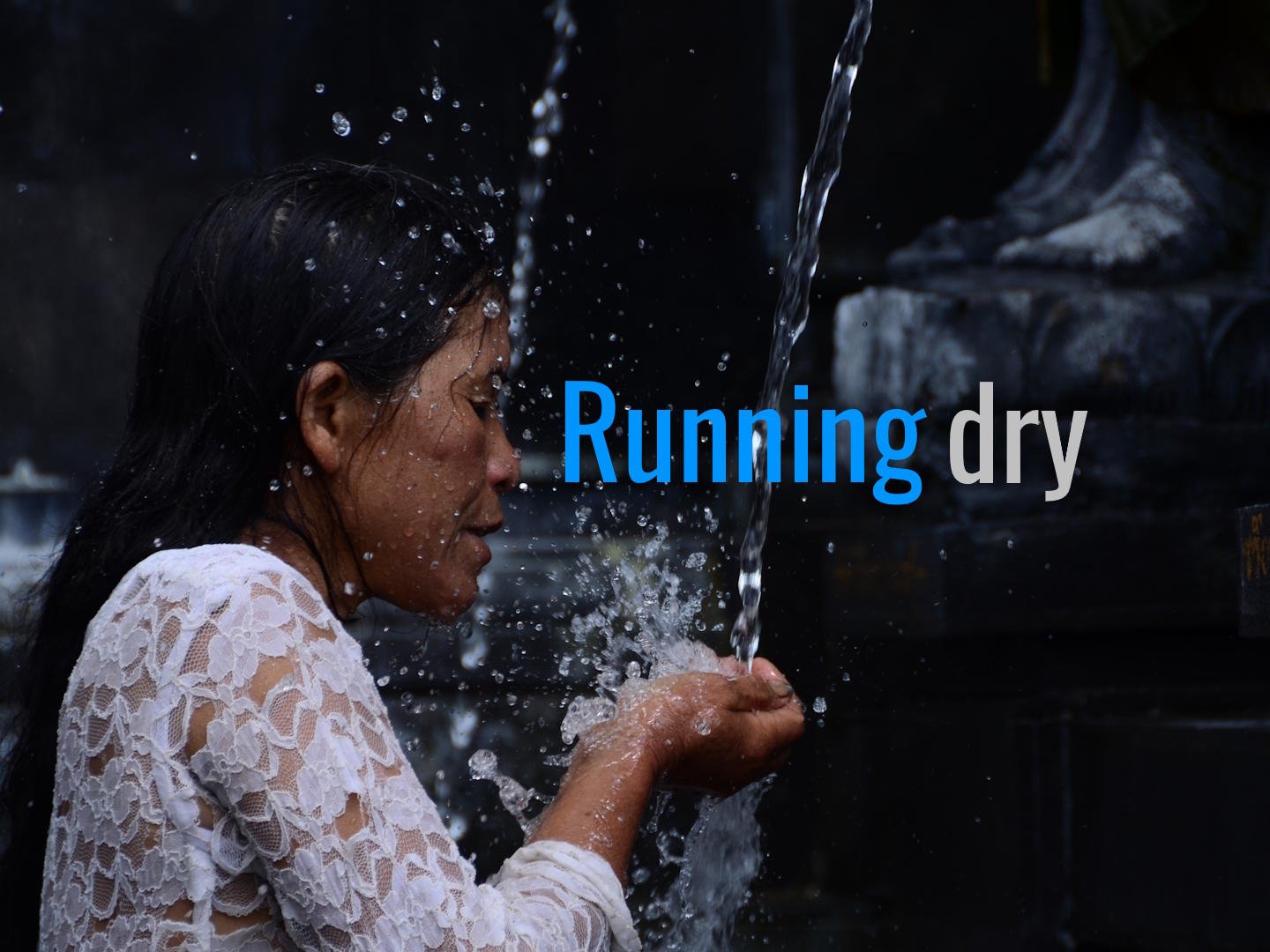
The travel & tourism industry can be expected to honour the human right to water, particularly in communities and destinations in which it operates. Industry stakeholders need not see this as a burden, but rather as a compelling opportunity to meaningfully engage with local people on securing traditional water supplies, all the while developing more sustainable water and waste management systems of theirown.
Nicolaus Sulistyo sheds light on IDEP Foundation’s Bali Water Protection (BWP) initiative; anEXO FoundationSustainability Award winner.
Behind the luxury
A villa or hotel in the heart of a tourist area was once a fertile rice field, where every harvest was a source of livelihood for local communities. The strong flow of water in a guest’s shower — enjoyed so freely today — is the same water that once ran through the subak irrigation channels, managed collectively by customary villages.
Behind the luxury, Bali is facing a water crisis that threatens the island’s very survival.
When we visit Bali, the private pool becomes ‘ours’ for a few days or weeks. The sun rises in the east and sets in the west and, from ‘our’ villa, we can watch it rise over a cliff or set over rice paddies … or we can do yoga. All of it feels like ‘ours’, so long as we pay forit.
Bali remains a tourism paradise only because water is, for now, sufficiently available. It comes from surface sources distributed by the regional water company (PDAM) and from groundwater extracted directly by business owners.
Groundwater extraction beyond household use requires permits and local tax contributions, yet many continue to take it illegally, draining the island’s shared reserves without contributing to their sustainability.
The true cost of comfort
In 2024, the Indonesian Forum for the Environment (Walhi) Bali revealed a stark reality: Star-rated hotels require 800 litres of water per room per day, while non-star hotels need around 250 litres. By comparison, daily domestic water needs per person are only around 200 litres.
“There are two main issues in the water crisis: a quantity problem, where Bali experiences groundwater decline due to over-extraction, and a quality problem, namely seawater intrusion,” explained Prof. Lilik Sudiadjeng, a researcher from Bali State Polytechnic (PNB), presenting joint research with IDEP Selaras Alam during the Bali Water Festival on July 30,2024.
Tourism in Bali is growing rapidly, but the water that sustains it is evaporating just as fast. To ensure tourists have a comfortable stay, rice paddies are disappearing and water catchment areas are shrinking. Not only are we witnessing the degradation of water quality and quantity, we are also already consuming reserves meant for future generations.
Living on the same water: Time to give back toBali
The water that sustains life in Bali — for tourists, business operators, and residents alike — comes from the same limited sources, now under growing pressure. For too long we have taken too much without giving enough back. How much longer can we gamble likethis?
Through its Bali Water Protection (BWP) initiative, the IDEP Foundation calls on the tourism industry to give back to the very element that sustains life and tourism here in Bali: the water that feeds its waterfalls, lakes, rivers, and rice fields.
This initiative is not just another conservation project: it is a pause, a breath for nature, before the gamble runs too far. BWP is a call to restore what Bali urgently needs to survive.
Towards a new standard of tourism: What BWP offers today
Bali Water Protection (BWP) invites you to protect the very water sources that sustain both life and tourism on the island. Every contribution has a direct impact. There are three main actions you can take. Choose one, two, or all three. Each choice makes a real difference. We call this AdopThree: three practical steps to help secure Bali’s water future.
1) Adopt a well to return water to the ground
Groundwater in Bali is becoming critically scarce. Every day, thousands of litres are pumped for hotels, villas, and households, while underground reserves are not being replenished quickly enough. Left unchecked, Bali will run out of clean water much sooner than we expect. Meanwhile, seawater intrusion into groudwater is spreading further inland.
Now is the time to return what we have been taking. Through recharge wells, rainwater that usually runs off can seep back into the soil, replenishing reserves for our collective needs, including the future of the tourism industry.
One recharge well built through the Bali Water Protection (BWP) programme can replenish up to 41,000 litres of groundwater per hour. Put simply, for every hour of effective recharge, one well can restore enough water to cover the annual basic needs of around two families of four, based on the international SPHERE standard of 15 litres per person perday.
2) Adopt a river to reverse its decline
Bali once had clear rivers where children played and villagers fetched water. Today, many have become little more than concrete drains choked with rubbish and waste. If these rivers die, Bali loses one of its primary water sources.
Through the Bali Water Protection (BWP) adopt a river programme, rivers are restored by planting trees along their banks, cleaning up waste, and reviving their ecosystems. Your donation helps restore a section of a river by rehabilitating its bank and planting trees, resulting in cleaner water, healthier ecosystems, and safe, reliable rivers for hundreds of nearby residents.
3) Adopt water awareness to educate the next generation of water guardians
The water crisis is about more than just infrastructure; it’s about awareness. Without knowledge, people will continue to use water without realising its limits. Public education is therefore key to long-term water protection.
Through campaigns and educational programmes — such as the Bali Water Protection (BWP) Competition, the Bali Water Festival, and school and community activities — people are reconnecting with water and its sources: wells, rivers, and the subak system.
Time for tourism to become a guardian of nature
Sustainable tourism is no longer enough. We need regenerative tourism. We need tourism that not only entertains but also heals. Tourism that plants, not just harvests. Tourism that restores, not only consumes.
Bali can become a global example of regenerative tourism, where visitors, businesses, and communities collaborate to restore ecosystems, starting with water. Every litre recharged into the ground, every tree planted along a riverbank, every child learning about water, becomes a living pillar for Bali’s future.
Everyone has a place in this movement. Change will not come from a single source. That is why Bali Water Protection opens its doors to all: five-star hotels, eco-resorts, tour operators, industry associations, universities, CSR donors, educators, influencers, and innovators.
Whether by funding recharge wells, supporting education campaigns, providing facilities and expertise, or helping to spread the word, what matters is that we act together. And not a one-time action; it must be a continuous collective commitment.
Tourism can become a tool for healing, but only if we begin with the awareness that we have caused harm and may still be doingso.
Now is the time to giveback.
Water, like history, carries memory. We still have time to create new memories and change the course of history: not just as users, but as guardians of Bali’s preciouswater.
About IDEP Foundation
In 1998, Indonesia entered a phase of severe financial and social crisis. In response, a diverse group of people from Bali got together to discuss how they could best help. They discussed the growing challenges faced by Indonesian communities and conducted an evaluation of existing natural and human resources nationwide.
Since then, IDEP has been delivering public education and training activities and practical programs to communities all over Indonesia. IDEP develops and delivers training, programs, and media that are primarily focused on sustainable development, especially permaculture, and community-based disaser management. To date IDEP’s work has resultedin:
- >10,000 kids joining environmental educational activities
- >5,000 people learning about environmental management
- >100,000 people given emergency assistance
- >50,000 disaster survivors assisted
- >1,500 people learning about disaster management
- >40 educational films produced
- >14,000 downloads of educationalmedia
IDEP Foundation’s Bali Water Protection (BWP) initiative is anEXO FoundationSustainability Award winner.
About the author
Nicolaus Sulistyo is a media and communications officer at IDEP Foundation, where he tells stories about environmental issues through words and visuals. Before joining IDEP, Nicolaus honed his skills in journalism with the student press at Atma Jaya University Yogyakarta, and took on freelance work as an enumerator and scriptwriter for MLDSPOT TV. Outside of work, he enjoys literature and the music of Majelis Lidah Berduri.
Featured image (top ofpost)
As Bali runs dry, can tourism help replenish itswater?
“The water that sustains life in Bali — for tourists, business operators, and residents alike — comes from the same limited sources, now under growing pressure. For too long, we have taken too much without giving enough back. How much longer can we gamble likethis?”
All images courtesy of the IDEP Foundation. “GT” cropped some of them, and added “Running dry” to the featuredimage.
