

When Donald Trump revived a long-standing threat to invade Greenland, an autonomous territory of Denmark, markets just yawned. This happened even as the US president was coming off a surprise attack that had deposed Venezuelan President Nicolas Maduro three weeks ago.
Cut to last week: Trump refused to rule out invading Greenland by force, and added that he would levy fresh tariffs on eight European allies, unless they support a “Complete and Total purchase of Greenland” by the US. Faced with European resistance, including an “unflinching” promise to respond in kind, he doubled down on these remarks. On Tuesday (January 20), three major US stock indexes fell significantly for the first time since markets crashed last October.

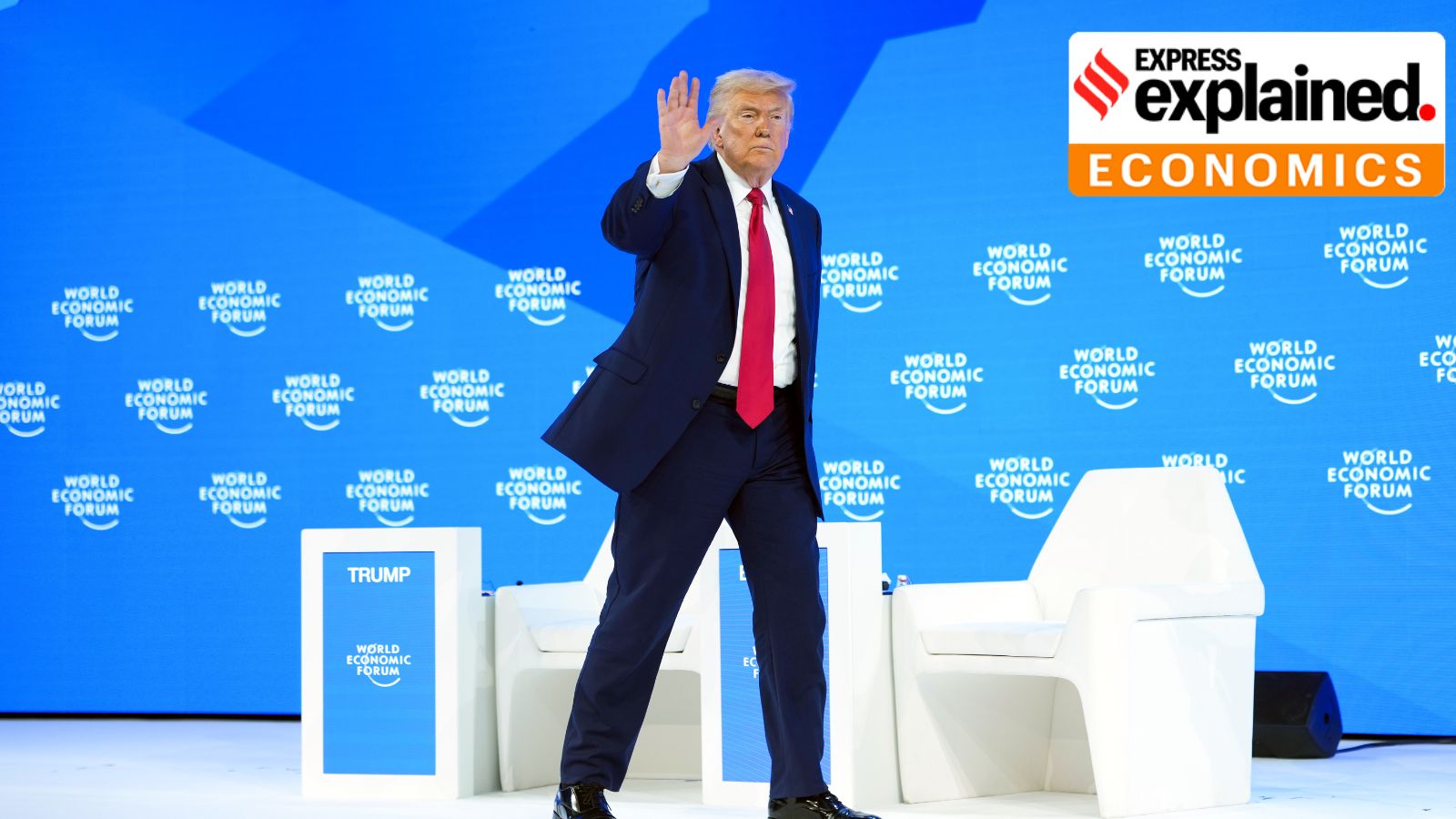
A day later, the President addressed the World Economic Forum at Davos where he struck a remarkably more conciliatory tone. He would later announce that he had had a “very productive meeting” with NATO Secretary-General Mark Rutte where they had “formed the framework of a future deal” on Greenland. He also backed off his tariff threat.
This pattern of escalating to an economic threat, and de-escalating in the face of an absolute rejection by the markets of such strong-arming tactics, has revived the buzz around the TACO trade, short for Trump Always Chickens Out.
Where did the term originate from?
The expression was first used by the Financial Times commentator Robert Armstrong last May while reflecting on the aftermath of a month of Trump’s Liberation Day tariff announcements.
On April 2, 2025, Trump announced a 10% baseline tariff on all trading partners, and country-specific rates on those countries with which the US has maintained trade deficits. He would subsequently relax the latter for 90 days, vowing to conclude 90 trade deals that favoured the US’s balance of trade.
Armstrong then wrote that the decline and the subsequent rise in stocks, as well as the inverse trajectory followed by gold (a safe haven asset whose demand increases during periods of economic uncertainty) were a sign that markets had learned to adapt, “that the US administration does not have a very high tolerance for market and economic pressure, and will be quick to back off when tariffs cause pain.” He called this the “Trump Always Chickens Out”, or simply, the TACO effect.
Story continues below this ad
This pattern has played out a few times over the past year, with the president rolling back his tariff announcements each time the markets took a spin downwards. It appeared to explain why he backed off on his tariff threats since April: he threatened to increase tariffs on the European Union to 50% in May, but reversed this decision two days later after talking to EU leaders, resulting in a market rally.
In October 2025, Trump threatened 100% in additional tariffs on imports from China after Beijing announced new export controls on rare earths and critical minerals. Faced with the biggest single-day selloff, which cleared about $2 trillion from the market, he eventually backtracked on this, too. He announced on November 5 that he had reached a comprehensive deal with China to lower tariffs by 10 percentage points and suspended heightened reciprocal tariffs until November 10, 2026.
How did the TACO effect play out with Greenland?
Following Trump’s continued tariff threats against eight European nations, three major US stock indexes on Tuesday (January 20) took a nosedive for the first time since October – the Dow fell 1.8%, a 2% fall in the S&P 500 and Nasdaq fell by 2.4%.
This fall was informed by the promise of European retaliation. In response to Trump’s renewed tariff threat, the European Union voted on Wednesday (January 21) against ratifying a painfully-concluded deal between the US and European Union forged last July. This deal set a baseline tariff rate of 15% on all imports from Europe, including pharma goods, and also included an EU commitment to purchase American energy products worth $750 billion.
Story continues below this ad
The EU also had other options: it could have invoked its long-held €93 billion package in retaliatory tariffs, or even unleashed a “trade bazooka” or the Anti-Coercion Instrument, which allows the alliance to place export controls, introduce new tariffs or otherwise limit American investments in Europe.
The EU is also the largest lender to the US, holding $8 trillion in bonds and stocks. A selloff of US assets could lower the value of the US Dollar, increasing the costs of living in the US. However, Europe too would stand to lose, with the value of its remaining American assets also declining as a result.
How has the TACO trade affected markets?
A year into Trump’s second term, markets have begun to factor in this phenomenon with each successive economic escalation. For investors, this presents an excellent opportunity to short (bet against) the market.
A 2025 study by Nomura strategist Charlie McElligott showed that each time an investor shorted against S&P500 Futures when the president announced a tariff threat, and bought them days later, they would have earned a 12% return since February 2025. In contrast, merely holding the stocks would not have changed the investor’s portfolio much despite the significant swings up and down.
Story continues below this ad
The downside of the TACO trade mirrors the boy who cried wolf parable. As University of Massachusetts Economics Professor Arin Dube puts it, TACO fundamentally undermines itself over time. If markets learn to read an economic threat by Trump as mere bluster and not react, the president may continue to escalate his tariff threats until he isn’t bluffing any longer. This would completely catch investors off guard.
