

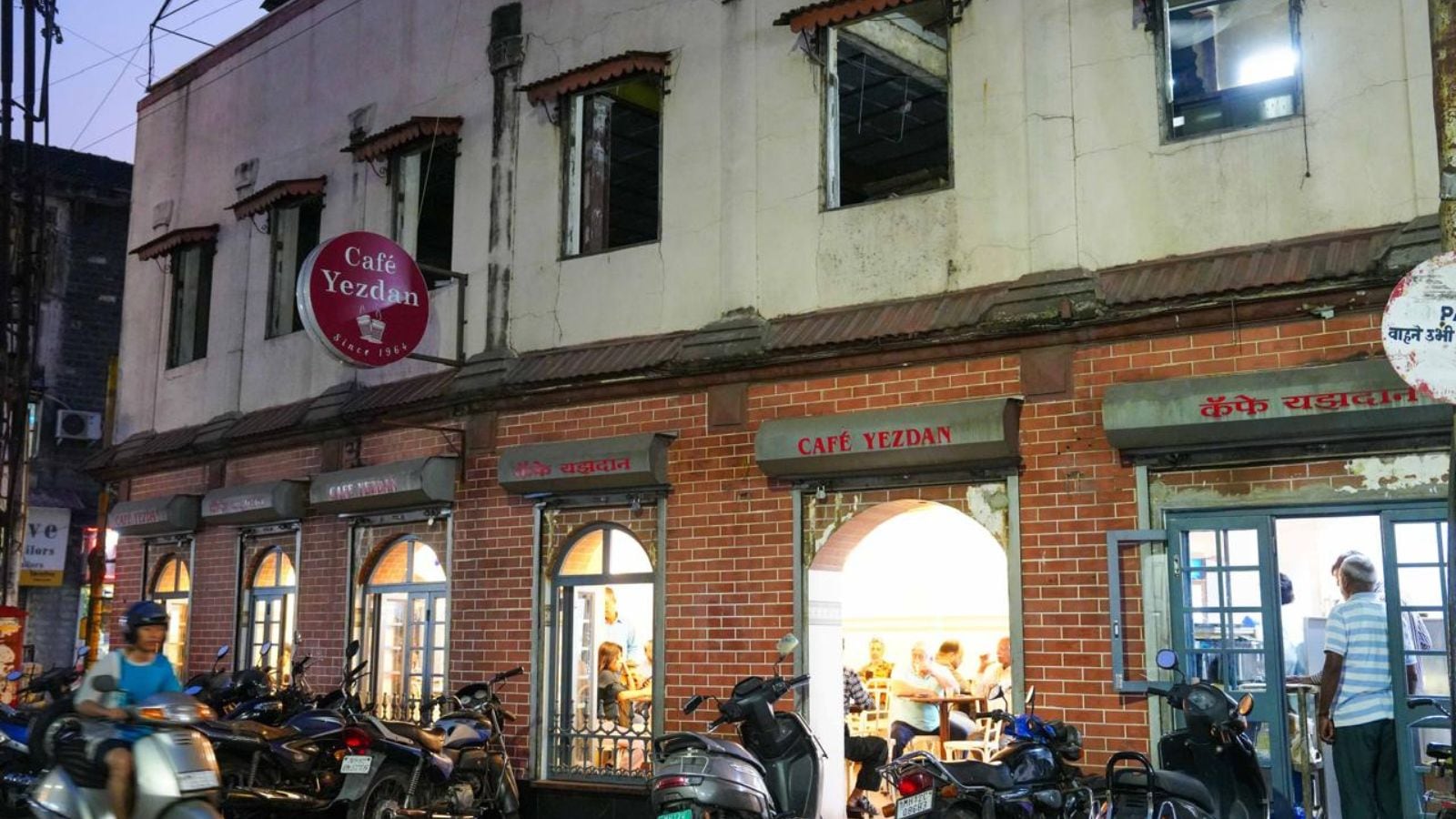
There is no surprise on the menu of Cafe Yezdan. The mainstays from the kitchen are the crusty broom with a soft centre, bun-maska, basic egg dishes, such as omelette and bhurji, tea, coffee, and Ardeshir soda. Cafe Yezdan seems like a place for a good breakfast and little else.
Yet, on a weekday afternoon under a scorching sun – the kind of drowsy hour when workers at restaurants that don’t serve lunch hope for some quiet – Cafe Yezdan is buzzing with people. Almost every table is taken. It is not the AC that lures customers as the restaurant is ventilated entirely by rows of low windows; most people are here because Cafe Yezdan is what restaurants try not to be – familiar, filling, and functional.

“For us, the customers are the same. So, we have to maintain the quality every day. If, one day, you serve something bad, the customer will never come back. They’ll go to some other place. To gather customers takes years, to lose them one day,” says Shapoor Irani, the third-generation owner of Cafe Yezdan.
Fortunately for him, Cafe Yezdan honed the art of retaining customers two generations ago. There is a new outlet at NIBM. “The story starts in Rahmatabad in Iran, from where Khodabanda Irani decided to come to India to escape the unrest. He came by ship to Bombay and, from there, to Pune. He did not know the language of this place or anybody else. All he learned was here,” says Shapoor.
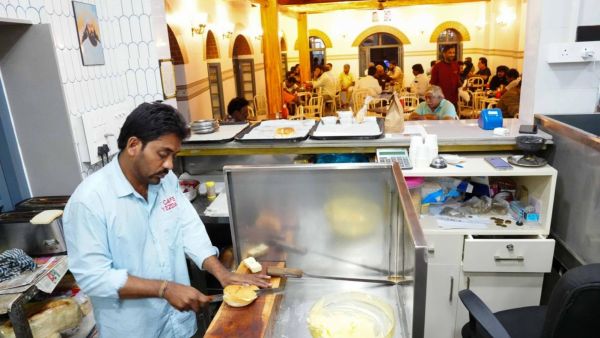 LPG supply crunch and rising cylinder prices have begun affecting the preparation of the Irani chai, which depends on a continuous flame to brew properly. (Express photo by Arul Hrizon)
According to the cultural mapping project, Sahapedia, Khodabanda started an eatery on MG Road before opening Cafe Yezdan at Sharbatwala Chowk in Camp in 1964. A non-vegetarian restaurant existed at the site before Khandobanda took over. Cafe Yezdan was quite like its founder, simple and hardworking.
Khodabanda originally sold only Irani chai before expanding to bun maska, biscuits, and a few other items.
“My grandfather and my uncle, Burjor Irani, would consider it a sin to leave the shop. The whole day they would sit at the counter. Customer satisfaction was of prime importance. They offered food at pocket-friendly rates and gave more quantity. That is what the restaurant came to be well-known for,” says Shapoor, who started coming to the shop when he was in Class VIII. Today, framed photographs of Khandobanda and Burjor watch over customers from the wall opposite the counter.
Story continues below this ad
Shapoor says that he barely saw his grandfather or his uncle at home when he was growing up. They would wake up a few hours after midnight to leave for the restaurant, which they would open at 3.30 am. “They lived by the principle of honesty and hard work,” says Shapoor.
There is a family memory of Shapoor’s father, Mancher Irani, a Chartered Accountant, who sat at the cafe counter for many years. It was only after closing the cafe early on his wedding day that he went to get married. “They were so dedicated, ” says Shapoor.
Burjor was “very, very shy”. “He would talk to people for one minute at most, but he was a very likeable person. He’s just come to the restaurant and does his job. He would make sure that everything was in order, that all purchases were in place.
According to Sahapedia, the cafe was originally double-storeyed, “with an internal staircase connecting the two floors”. Khodabanda soon shut the first floor and, today, the Cafe operates out of the ground floor only. For most of its life, Cafe Yezdan has been a men’s place. Shapoor and his brother, Khaikasroo Irani, have tweaked the décor and opened up the space to make it feel welcoming to women and families. “Slowly, we are seeing the number of women and family groups increasing,” says Shapoor. The only other changes are in the menu, where a delectable Iranian egg dish, the Akuri, has been introduced. “It is one of the bestsellers at present,” says Shapoor.
Story continues below this ad
His parents went on a pilgrimage to Iran, but Shapoor, a Chartered Accountant, has no desire to revisit the place of his ancestors. “When I am old, maybe I will also go on a pilgrimage,” he says. But, true to his Iranian ethos, Cafe Yezdan is open all days of the week all through the year, except on Navroze. This is the reason Shapoor is worried as the gas begins to run low. “We need a cylinder to make tea and, if we don’t get it, we might have to close,” he says.
Our copper samovar works only on a gas flame: Khaikasroo Irani
On most mornings at Café Yezdan, the day begins with the quiet simmer of a samovar — a traditional copper tea urn used to keep strong tea decoction hot through the day. Cups of thick, sweet Irani chai move steadily across the counter as regulars settle into their usual seats over bun maska and conversation. But in recent days, that familiar ritual has faced disruption. LPG supply crunch and rising cylinder prices have begun affecting the preparation of the Irani chai, which depends on a continuous flame to brew properly.
“At the moment, we have stopped making our Irani tea. It is prepared in a copper samovar that works only on a gas flame. It cannot run on induction,” he explains.
“We are trying to experiment with a heat-coil method, but we are not sure if it will work. The brewing process is continuous — once the tea goes off the flame, the taste changes. Between our two branches, we sell around 500 cups of tea a day, so even if heat pads work, we will need several running constantly. Irani says the uncertainty around LPG supply has left café operators in a difficult position.
Story continues below this ad
“Right now, even cylinder vendors have stopped answering our calls, and we are not sure how long this situation will continue,” he says.
The preparation of Irani chai differs from the quick roadside chai commonly served across the city. In most Iranian cafés, a strong tea decoction is kept hot in the samovar while milk is simmered separately for hours until it thickens. When ordered, the two are mixed in the cup, creating the rich, creamy tea that has become synonymous with the cafés.
(Inputs from Neha Rathod)
