

When protesters gathered in Hyderaabad’s Old City last week following the death of Iran’s Supreme Leader Ali Khamenei, they were mourning a loss felt across a world far larger than this metropolis of 10 million. For generations, Hyderabad has been more than a city. It was once a princely state the size of Great Britain, spanning territory that now falls across three Indian states, and its people have for centuries traced their spiritual lineage to Iran and their economic fortunes to the Arabian Peninsula.
On February 28, the United States and Israel launched airstrikes on Iran, killing Khamenei. In the retaliatory exchanges that followed, all six Gulf states found themselves caught in a war they had not entered. That vast Hyderabadi world—from the Old City’s Shia ashurkhanas (dedicated spaces used primarily to mourn the martyrdom of Imam Hussain, grandson of Prophet Muhammad, during the Islamic month of Muharram, especially on the 10th day, Ashura) to the expatriate enclaves of Jeddah and Dubai—is now watching its foundations shake.

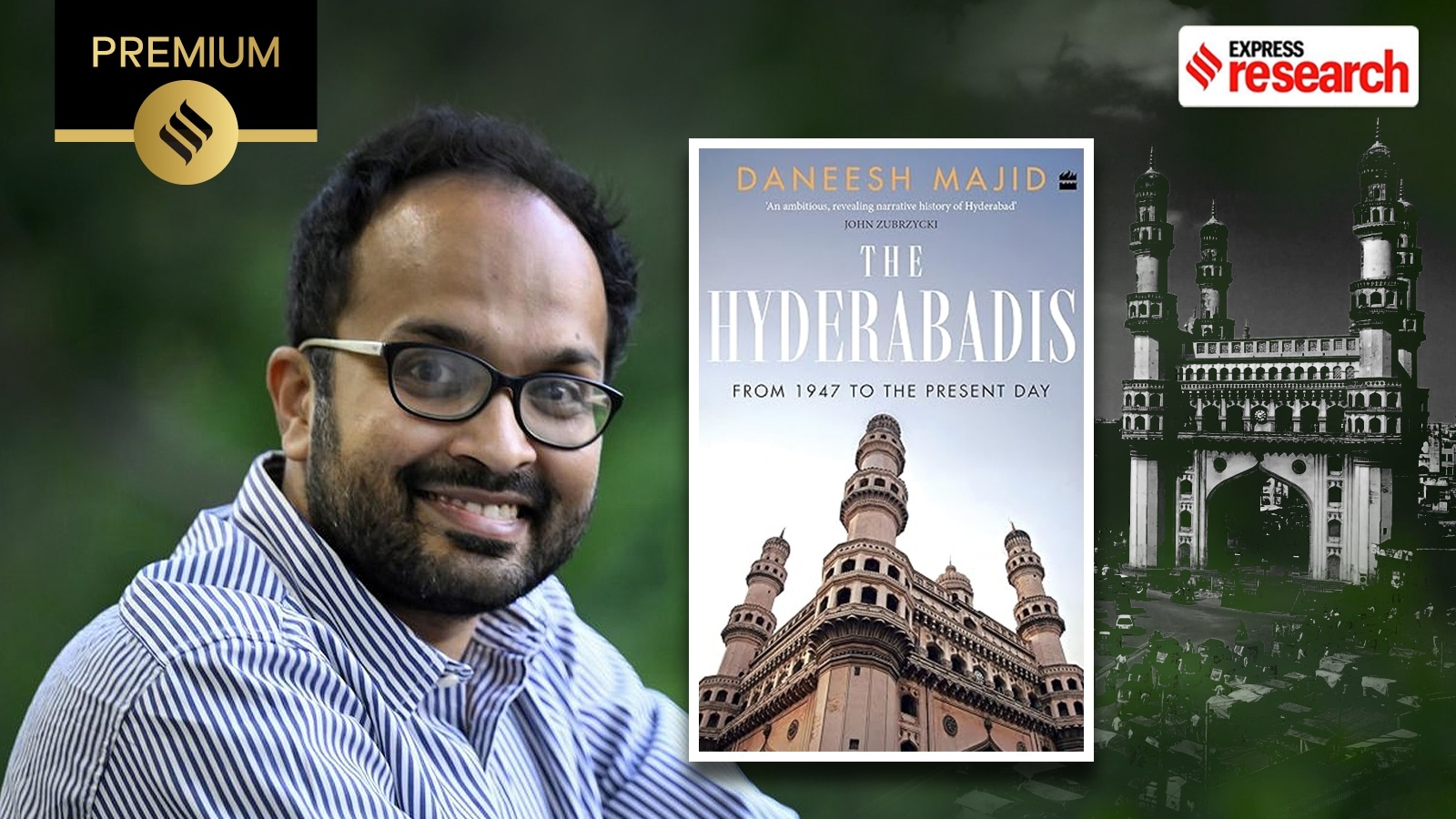
Daneesh Majid’s The Hyderabadis: From 1947 to the Present Day draws on generational interviews, oral histories and Urdu literature. The book traces the families who lived through the Police Action of 1948, the linguistic reorganisation of 1956, the long Telangana struggle, and the mass migrations to the Gulf and beyond. He spoke to indianexpress.com on the sixth day of the conflict.
The protests following Khamenei’s death were immediate and large. Why Hyderabad?
Daneesh Majid: Hyderabad is a city formed by Shias. They trace their roots to Hamadan, Iran, and that historical thread is physically present when you walk through certain quarters of the Old City in Darushifa, Aliabad, Kotla… In Noor Khan Bazaar, there are Shia ashurkhanas with alams (standards or banners representing the battle of Karbala) everywhere. Right when you step out of Noor Khan Bazaar onto the main road, there is the Azakhana Zehra, and the Nizam’s photograph is inside it too.
When Hassan Nasrallah, the former secretary-general of Hezbollah, was killed, I walked past one of the Shia mosques a day later and saw a huge poster: Hassan Nasrallah, Shaheed. I was not the least bit surprised.
And the Shia thread runs through Hyderabadi Sunni households too, in ways people from outside do not expect. There is something called Kundon ki Dawat, celebrated on the 22nd of Rajab in memory of Imam Jafar Sadiq, which involves the whole family gathering and having kheer puri in an earthen pot. My grandfather, who had settled in the United States, still had it done every year. After the Qutb Shahis, the Asaf Jahis were Sunnis, but their ministers, especially the Salar Jungs, were Shia. That sectarian syncretism is baked into the foundation of the city.
What was already happening to the Gulf dream before this war began?
Majid: The avenues were already narrowing. Ever since [Saudi Arabia Crown Prince] Mohammed bin Salman unveiled Vision 2030, an economy diversifying away from oil, into retail, entertainment and services, the push has been toward an indigenous Saudi workforce. Those jobs that South Asians filled for decades now come with quotas requiring a majority to go to Saudis. There was a class of Saudis who received government handouts simply for being Saudi. Mohammed bin Salman has told that generation that that era is over.
Story continues below this ad
Dubai, meanwhile, has become prohibitively expensive. To sustain a life there, you have to be making serious money; remittances alone no longer leave enough disposable income. In Saudi, employers now pay 100 riyals per year per expatriate they hire, with the fee rising by 100 riyals annually. The same applies to dependents. The result has been a steady wave of professionals sending their families back to India. Children who grew up knowing nothing but Saudi Arabia are suddenly here.
If this war is prolonged, it may simply be the moment when what was already happening becomes impossible to look away from.
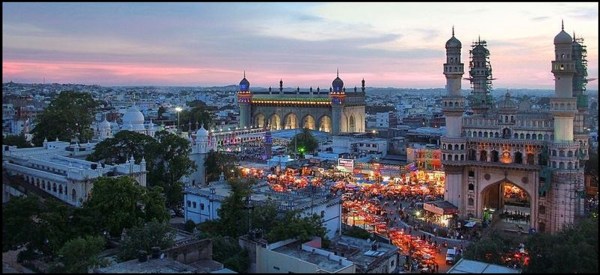 A stunning panorama of Charminar and its surroundings, featuring the vibrant Charminar Bazar, the historic Mekkah Masjid, the renowned Nizamia Unani Hospital, and the colorful Laad Bazaar.(Source: Wikimedia Commons)
What did Hyderabadi identity look like across the migrations your book traces, and what has survived?
Majid: The traditions that survived have a very specific texture. The Bismillah ceremony, which is held when a child first begins reading the Quran, the family gathers, an elder has the child recite duas, it becomes a whole occasion. I have not seen other South Asian Muslim communities mark it with the same weight. In 2013, family members from Karachi came back to Hyderabad specifically to celebrate this with their grandmother.
Hyderabadi Pakistanis still wear sherwanis and Rumi topis to weddings, wherever in the world those ceremonies are held.
Story continues below this ad
In my own family, Dakhani was always spoken at home; that is the reason I can move through Hindi and Urdu comfortably, and why I could begin learning to read and write Urdu properly in my mid-twenties. But among second and third-generation Hyderabadis in Texas or Chicago, the Hindi-Urdu is moderate at best. Hyderabadiness has become sherwani at the wedding, biryani with Mirchi Ka Salan, and Eid gatherings. The memory is there, but the language is going.
How did the Deccani identity fare in Pakistan, and how did it change over time?
Majid: At first, it was very much an asset. Punjabis and Muhajirs shared power in Karachi, and Hyderabadis arrived with credentials and connections. But by the 1960s, there was a discernible shift. A more uniform national identity was being constructed. The sari, which Muslim women from North India wore, came to be seen as Indian during Zia’s [former Pakistan president General Muhammad Zia‑ul‑Haq] time. The shalwar kameez was christened the national dress.
Ali Adil Khan’s parents saw what was happening. If he wanted a career in the military, a name with a Pashtun ring would serve him better than a Muhajir one. So Mohammad Adil Ali became Ali Adil Khan. But within that name, his history was preserved as Ali Adil Shah was a Sultan of Bijapur, and he too was given the title of Khan. The Deccani identity stayed intact, encoded.
Then there is Anwar Maqsood, born in Hyderabad state and educated in Aurangabad, a brilliant satirist, comedian, writer, and his sister Fatima Surayya Bajia, a major figure in Pakistani television. Both shaped Pakistan’s cultural landscape.
Story continues below this ad
Yet even for Ali Adil Khan’s family, who had done everything to blend in, there were limits. When they noticed their Deccani accent being caricatured in shows like Fifty, they felt the difference. As I write in the book, they did wonder aloud: “Did we make the right decision?”
Where does the Isa-Moosi tehzeeb, the composite culture you write about, still live, and what threatens it?
Majid: The word nakko, which Hyderabadis use to mean ‘no’, that’s Marathi. The sour flavours in the cuisine are South Indian. The mourning traditions draw from a Shia ethos centuries old. And in the rural districts of Telangana, on the 10th day of Muharram, there is a celebration called Peerla Panduga, where people take up alams, which are central to Shia symbolism, and dance around a fire pit. You can see it in the opening of the film Mallesham. It commemorates Imam Hussain’s martyrdom, but it is a joyful occasion, accompanied by Telangana Telugu folk songs. That layering is what I mean.
That culture is still alive. And it is under pressure from the polarisation we discussed, from the appropriation of political memory, from the slow replacement of shared public life with more bounded, more defensive identities. Whether it survives is a question I genuinely cannot answer. What I can say is that it deserves more people who know it is worth asking.
Urdu was once the language of government and literature in Hyderabad. What did the city lose when it retreated from public life?
Majid: The bookstores, first. There is nothing sadder than a bookstore closing. Urdu literature no longer has outlets to be sold because the readership has thinned and the writers have thinned with it.
Story continues below this ad
The patronage Urdu commanded during the Nizam era was without parallel. At Osmania University, scholars were convened from across the subcontinent. The Dar-ul-Tarjuma, the House of Translation, rendered books from Arabic, English and Persian into Urdu. It was the language of government, of literature, of education. As early as the 1950s, this was already eroding, and court orders were drafted in English, as economic advancement increasingly required English rather than Urdu. Hyderabad lost something it hadn’t fully appreciated.
And yet something remarkable happened alongside the decline. Between the 1940s and 1980s, Deccani humour poetry flourished. Tragedy, when it goes deep enough, produces a particular sensitivity in writers. When the ’70s and ’80s arrived, and people went to the Gulf to make money, that patronage dried up too, and it has not fully returned.
Back home, what was concretely gained and lost in the creation of Telangana?
Majid: One concrete thing I heard repeatedly: the Assembly sessions now routinely start at 11 am. The Andhra political class was shrewd, even exploitative, but there was a diligence to them that some people say was lost. There were real gains, too. [Actor and former Andhra Pradesh chief minister] NTR, when communal tensions rose, made substantive gestures that went beyond words. When a mosque was vandalised during riots, he went and sat in it. A Sikh friend from Hyderabad told me something his father had said: that in 1984, NTR plainly told [former prime minister] Indira Gandhi, “Do not try anything similar here.”
What I observe now is the appropriation of the struggle’s legacy. And within the districts where Telangana sentiment was strongest, there has been a polarisation that is hard to attribute to any single cause but impossible to ignore. Under both [former Telangana chief minister] KCR and [Telangana Chief Minister] Revanth Reddy, despite both professing secular politics. Whether that is a consequence of statehood or simply the current of the times, I cannot say with certainty.
Story continues below this ad
(The Hyderabadis: From 1947 to the Present Day is published by HarperCollins.)
@keyframes ieFadeIn {to {opacity: 1;transform: translateY(0);}}
