

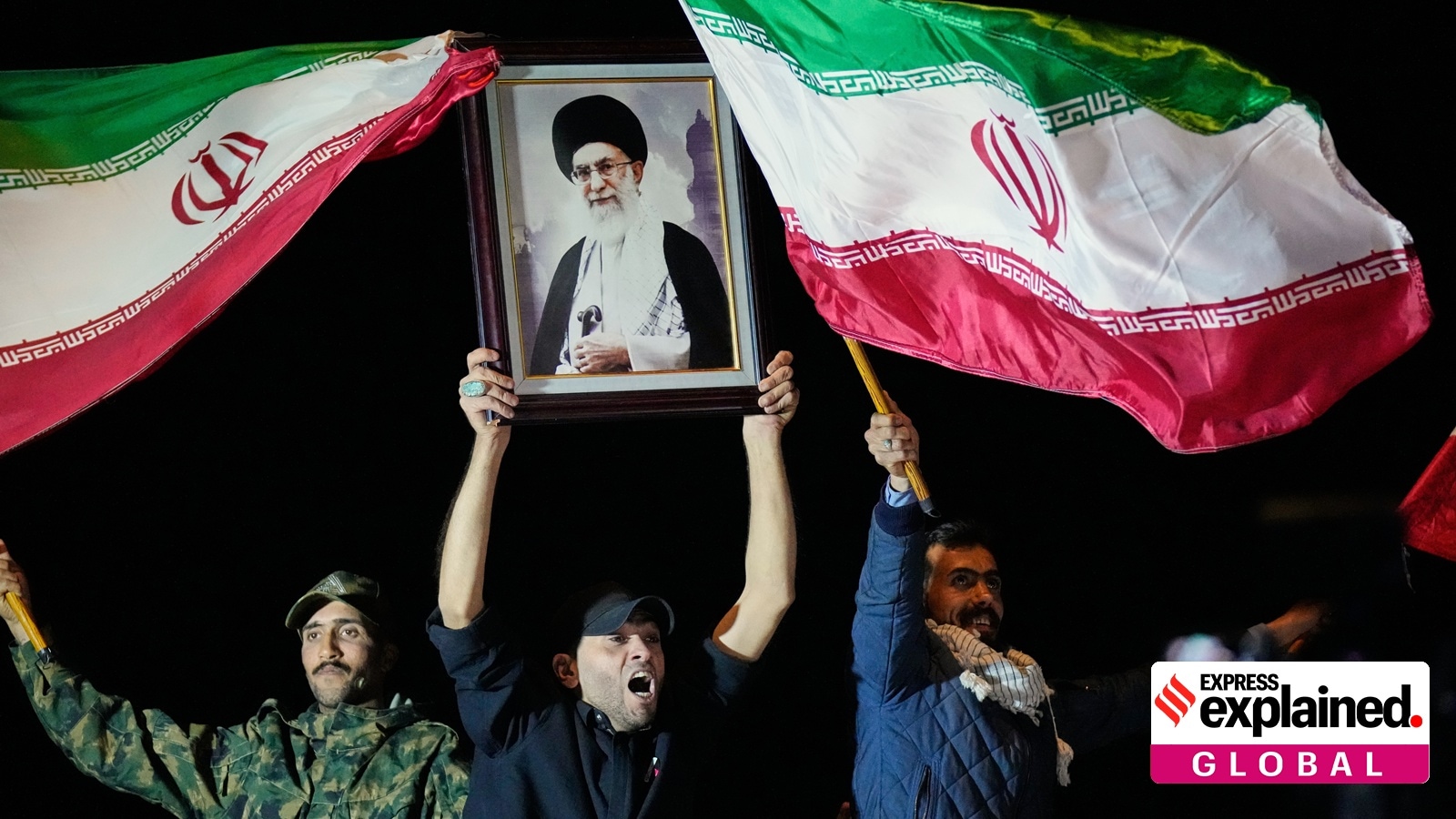
Iran’s Supreme Leader Ayatollah Ali Khamenei, who shaped the country in its present form, maintained a fierce rivalry with the US, and ruled with an iron fist, was killed in Israeli and US strikes, Iranian media has confirmed. Earlier, US President Donal Trump had claimed that Khamenei was killed in the Israel-US joint operation. Iran has declared 40 days of public mourning and seven days of public holidays to mark the ‘martrydom’ of Supreme Leader Khamenei.
In Iran’s theocratic system, the Supreme Leader is the most powerful figure in the country ranking above the president, parliament, and judiciary. Khamenei commanded the armed forces, appointed heads of the judiciary, state media, and key security agencies, and held the power to dismiss elected officials, countermand legislation, and declare war or peace.
His control also extended to foreign and military policy through his oversight of the Islamic Revolutionary Guards Force (IRGC) and the Quds Force, which orchestrates Iran’s regional operations.
His position is established on the doctrine of velayat-e faqih, or “guardianship of the jurist”, which gives a cleric ultimate sovereignty over an Islamic state. The ideology was developed by his predecessor Ayatollah Ruhollah Khomeini, and enshrined in the constitution of 1979.
Who was Ayatollah Ali Khamenei?
Ali Khamenei was born in 1939, in the northern Iranian city of Mashhad. He was the second of eight children in a modest family headed by his father, a religious cleric. Khamenei followed his father’s footsteps, pursuing clerical studies in Qom from 1958 to 1964, before joining Ayatollah Ruhollah Khomeini’s movement against the Shah of Iran in 1962.
After being imprisoned multiple times by the Shah’s regime, Khamenei emerged as a key figure in the 1979 revolution. He served as president from 1981 to 1989, steering Iran through the Iran-Iraq War, before succeeding Khomeini as Supreme Leader.
Story continues below this ad
Khamenei’s early years reveal a man of eclectic tastes. He engaged with Iranian intellectuals, absorbing both secular and Islamist ideas. A lover of literature, he lauded Victor Hugo’s Les Misérables as “the best novel that has been written in history,” telling state television officials in 2004, “Go read Les Misérables once. This… is a miracle in the world of novel writing.”
What did Khamenei believe in?
Khamenei viewed liberal democracy and capitalism as flawed, and saw the West as materialistic and Islamophobic. Yet, he was not wholly anti-Western. “Western culture is a combination of beautiful and ugly things,” he told a group of young Iranians in 1999. “A sensible nation… will take the good and add it to their own culture… and reject the bad.”
Ayatollah Ali Khamenei: From Mashhad to Supreme Leader
A LIFE IN MILESTONES
1939
Born in Mashhad, second of eight children; father was a religious cleric
1958–64
Pursued clerical studies in Qom; immersed in Islamic jurisprudence
1962
Joined Ayatollah Khomeini’s movement against Shah Mohammad Reza Pahlavi
1960s–70s
Imprisoned multiple times by the Shah’s regime for political activism
1979
Emerged as a key figure in the Islamic Revolution that toppled the Shah
1981–89
Served as President of Iran; steered the country through the Iran-Iraq War
1989
Succeeded Khomeini as Supreme Leader — a position he held for over 35 years
2026
Killed in joint Israeli-US strikes; Iran declared 40 days of national mourning
His fundamental critique of western civilisation was that it is overly materialistic. “The West looks at only one dimension — the material,” he said in a meeting on development. In contrast, Islamic civilisation includes justice, prayer, independence, and “approaching the exalted God.” His ideal, thus, was not simply a strong Iran, but a spiritually superior one.
Khamenei’s influences included Islamist thinkers like the Egyptian Islamic theorist Sayyid Qutb, who wrote “Islam without government and a Muslim nation without Islam are meaningless” and, of course, Ayatollah Khomeini, the fountainhead of the Islamic Revolution.
Story continues below this ad
And like Khomeini, who referred to the US as “Great Satan” and Israel as “Little Satan”, Khamenei was known for his unabated hostility towards these two countries. After a Florida pastor threatened to burn the Quran in 2010, Khamenei insinuated there was a larger plot at play. “The operational command of these acts are in the hands of the system of hegemony and Zionist planning centres,” he said at the time.
What did Khamenei do?
Iranian analyst Mohsen Milani once wrote in the Foreign Affairs magazine: “Khamenei has made it his mission to preserve the revolutionary identity of the state, particularly that it remains devoted to Islamic principles and opposed to the West.”
Under Khamenei, Iran became a regional power through asymmetric means. The Islamic Republic has funded, trained, and armed a network of proxies from Lebanon to Yemen, enabling Tehran to confront its enemies in Israel, Saudi Arabia, and the United States, without risking direct war. Hezbollah, Hamas, the Houthis, and various militias in Iraq and Syria have all been recipients of Iranian support.
Khamenei also reshaped Iran’s economy through what he calls the “resistance” doctrine, a strategy aimed at making the country less vulnerable to international sanctions. This includes reducing reliance on oil, expanding trade with China and Russia, and cutting state subsidies. The efficacy of this doctrine was another matter altogether — the Iranian economy still leans heavily on oil, and subsidy cuts have sparked protests across the country.
Story continues below this ad
Khamenei termed nuclear science as a marker of national pride and progress. For Khamenei, Iran’s right to enrich uranium is about not just energy but sovereignty. He, however, claimed that Iran does not seek nuclear weapons and he permitted negotiations over the 2015 nuclear deal before criticising the US for pulling out.
How Khamenei suppressed dissent
At home, Khamenei orchestrated a political system designed to preserve his rule. He stacked every avenue of government with loyalists making it difficult for moderates or reformists to gain influence. He was also ruthless in suppressing dissent.
Iran saw at least two major rounds of protests in recent years. In 2022, the death in police custody of Mahsa Amini sparked protests that spiralled into some of the worst political turmoil since the 1979 Islamic Revolution.
Amini, 22, had been arrested by morality police for allegedly violating Iran’s mandatory Islamic dress code.
The protests were crushed and over 500 people were killed.
Story continues below this ad
The morality police, who largely vanished during the Woman, Life, Freedom protests, have returned to the streets, but officials have signalled a softer approach.
The other major protest under Khamenei’s rule began on December 28 last year. The unrest, which began in the form of demonstrations by merchants in Tehran’s Grand Bazaar, was fueled by serious economic concerns and spread across the country.
While US President Donald Trump said the US was “locked and loaded” to support the protesters, these demonstrations too, were ruthlessly crushed.
