

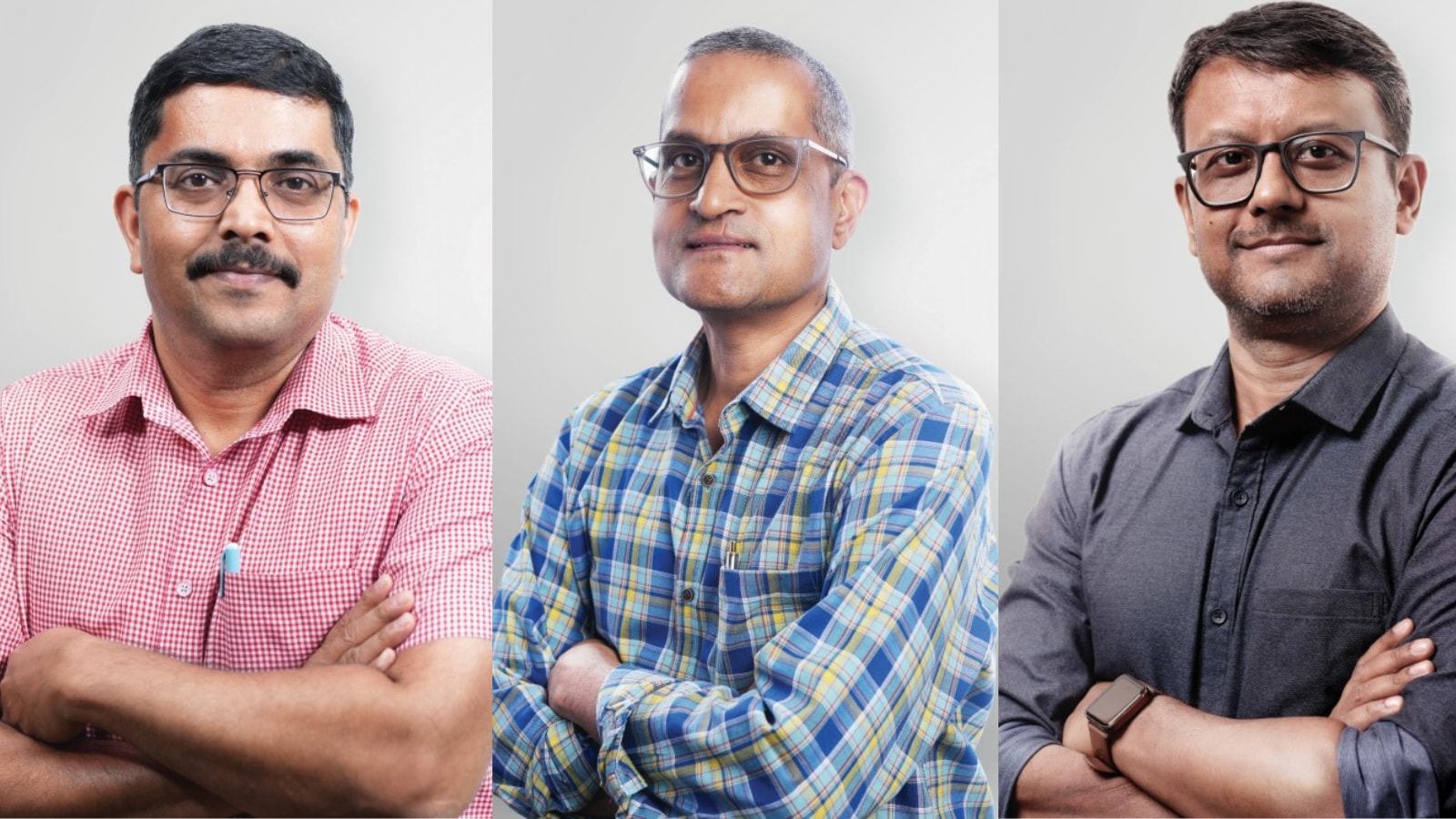
Three scientists from Bengaluru working on developing pest-independent rice varieties, cancer treatment, and green chemistry have bagged the Tata Transformation Prize 2025, announced in Mumbai on Tuesday.
The awards are presented across Food Security, Sustainability, and Healthcare categories and recognise research that contributes towards improving quality of life in India and abroad. Constituted in 2022 and presented jointly by the New York Academy of Sciences and Tata Sons, the winners will be presented with a cash prize worth Rs 2 crore.

The 2025 Tata Transformation winners spoke to The Indian Express:
1. P V Shivaprasad, National Centre for Biological Sciences (Category: Food Security)
P V Shivaprasad’s lab has used epigenetic engineering and performed small RNA–based modifications in rice to enhance stress tolerance and nutritional quality of the cereal. By precisely altering the expression of key genes, his work has shown the ability to surpass the conventional plant breeding limits. The lab-developed and engineered rice varieties promise to reduce fertiliser and pesticide dependence, lower production costs, and improve nutrition for millions.
“This prize recognised our decade-long research on the most important food crop in India, rice. Our pioneering studies uncovered an epigenetic basis for the mechanism underlying the domestication of rice, loss of its nutrients, and loss of stress tolerance among cultivated high-yielding rice lines. We are optimistic that bringing back some of the lost characters of rice can help us grow them even under climate stress. Plants generate several sets of chemicals to deal with stresses, and they are our nutrients,” Shivaprasad said.

On paddy cultivation in the backdrop of climate change and depleting groundwater tables, he said, ” Plants are very clever – they have a stress memory that can be passed on to the next generation. However, during our selection for high yield, we have stripped plants of this ability to adapt to stress conditions. Due to climate change, we might struggle to grow the current, high-yielding green revolution lines that need lots of inputs and are pampered with ideal conditions,” Shivaprasad said.
He said that it would become impossible to grow the crop unless greenhouse-like controlled conditions are provided, which are not practical. “We have to immediately generate a new set of rice lines that can cope with stresses. Policy makers must realise that there is a small window of opportunity to generate such climate-resilient rice lines, along with parallel methods that need to be implemented to preserve soil, use fresh water efficiently, and monitor controlled cultivation of suitable crops for a given area,” Shivaprasad said.
2. Balasubramanian Gopal, Indian Institute of Science (Category: Sustainability)
Story continues below this ad
Balasubramanian Gopal has developed a green chemistry platform that harnesses bioengineered E. coli bacteria to produce key chemicals used in pharmaceuticals, cosmetics, and agriculture. Integrating AI in experimental biology, his team at IISc is involved in designing efficient enzymes and optimising microbial strains for high yields, without antibiotics or harmful additives. This method is a sustainable technology and holds potential to replace traditional chemical manufacturing.
” The prize can be used to fine-tune the technology and test it out at a pre-commercial scale. We can now focus on the core aspect of the technology, knowing we are ‘covered’ for the next three years,” Gopal said.
He further said, “Our work on synthetic or engineered transcription initiation factors provides an avenue to engineer microbial strains that have a good chance of scaling something that standard recombinant strains often cannot. Though we readily admit that a vast number of such synthetic biology strategies have failed at the scale-up stage in the past, even as they looked very attractive at the laboratory scale. So, we have tried to address this problem by creating matched pairs- efficient enzymes in a microbe that isn’t too stressed to house them.”
3. Ambarish Ghosh, Indian Institute of Science (Category: Health)
Ambarish Ghosh’s lab is working to develop advanced cancer treatment using magnetic nanorobots – tiny, helical devices that can be used to guide through the body safely using magnetic fields. These nanorobots are designed to navigate complex biological environments, deliver drugs directly to tumors, and distinguish cancerous tissue from healthy cells.
Story continues below this ad
“It’s not just a pat on the back for our team’s hard work so far, but having experts from around the world validate our ideas signals that our research stands up globally. It opens a lot of doors, both for collaborations abroad and translating these ideas into practical outcomes in the international market,” he said.
On roles of AI in cancer imaging, Ghosh said, “Artificial Intelligence (AI) can allow us to get images of nanobots as they travel through diseased areas deep inside the body. It could also allow us to plan and steer swarms of these nanobots as they move, something that is both technically challenging and incredibly exciting. Scalability is crucial if one wants to impact real patients, not limiting to lab proof of concept experiments. In our technique, one can add a bunch of different functions to these nanobots, all in a way that scales up easily.”
