

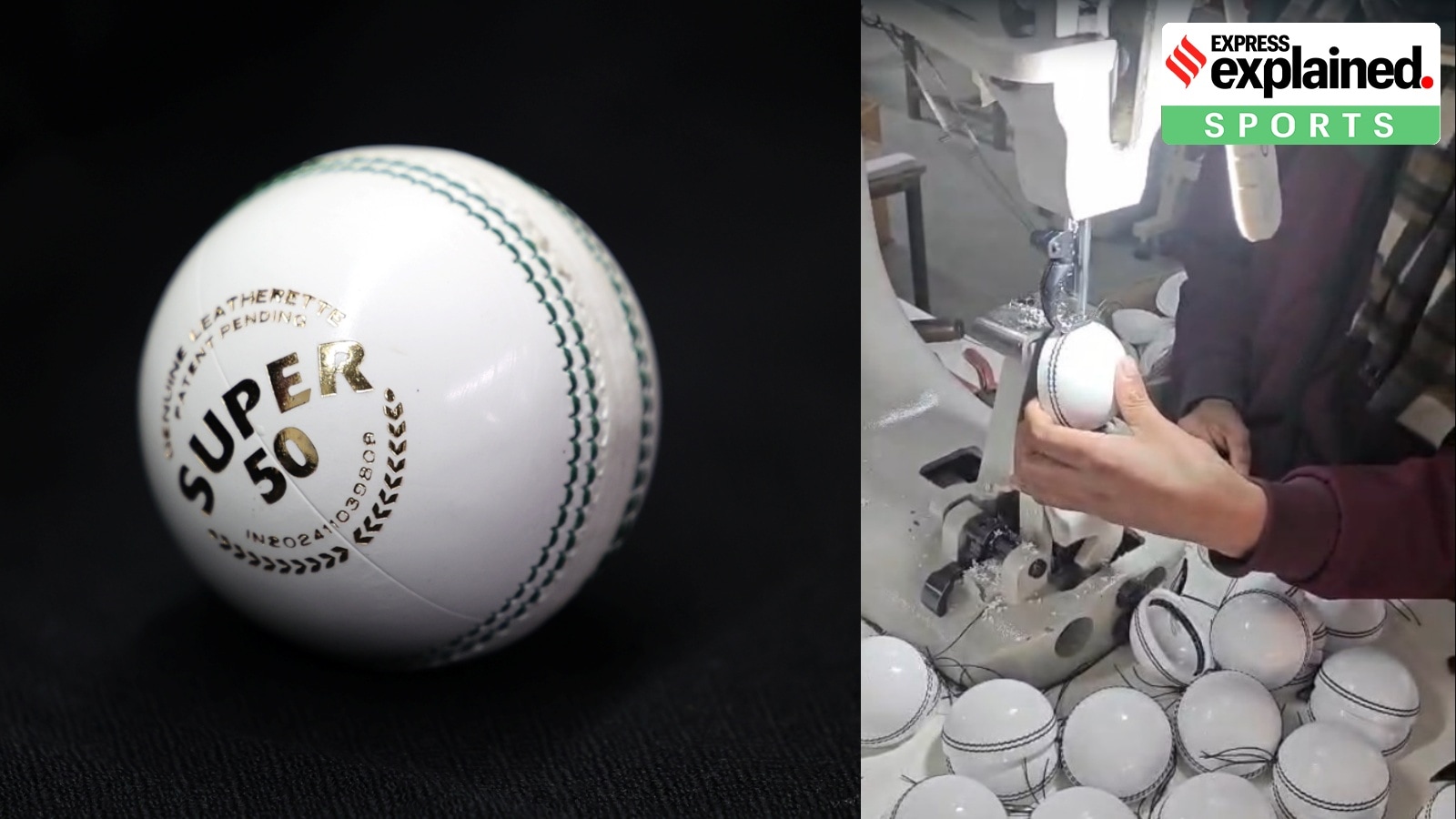
When the marketing team at Sanspareils Greenlands (SG) was discussing the sales pitch for a new cricket ball, an apt line from an iconic 1980s Surf detergent ad came up. “Aadha kilo Surf pure ek kilo saste powder ke barabar hota hai (half-a-kilo of Surf is equivalent to one kilo of cheaper detergent)”.
SG, the maker of the premium red leather Test ball in India, was then preparing to take a plunge into the five million balls-a-year budget market. The product was the ‘Super 50’, a leatherette ball aimed largely at the 15,000 cricket academies in the country as well as the corporate cricket circuit — both segments usually buy cheaper, less durable balls priced around Rs 250.

Super 50 promises these academies a longer lasting product that is priced at a slight premium. So, is it a game-changer for cricket academies that have an eye on their bottom-line?
Why a mass-market ball
The Meerut-based company has faced raw material supply issues since tanneries were shut down in Meerut in 2022 for causing pollution. At the same time, the company, which sells more than half-a-million leather balls annually, wanted to get a share of the cricket-academy market.
“If there was no raw material, how do we produce so many balls,” Paras Anand, the CEO of SG, said. “The academy consumption of leather balls annually is approximately four million balls in India and this is growing at a rate of 6% to 7%. The economics (of academies) only works if they pay about Rs 250 for a ball. We were not servicing that segment. We didn’t want to go down to the Rs 250-level. But if we priced it at about Rs 450 to Rs 470, we had to give a better product,” Anand said. The answer: A longer lasting ball that does not lose shape or get discoloured easily.
The patented Super 50 ball — available in both white and red — is guaranteed to last at least 50 overs, as the name suggests. It has received a non-leather vegan certification from PETA India and took two-and-a-half years to develop.
The manufacturing process
The early experiments in 2022 of importing polyurethane (PU) fabric — used to make foam, shoe soles etc — from China and Thailand failed because the material would fray on impact. “Phat jaati thi,” Anand said. After months of trial and error, the R&D team created a formulation for the outer surface of the ball using a mix of PUs sourced from India. The result was a eureka moment. In November, Super 50 was introduced in the market. Orders have touched 30,000 in the first month.
Story continues below this ad
The process is called thermoforming, which is used to make internal parts of cars. The construction of the ball is similar to the leather ball. Super 50 has a cork-wood core like the leather ball. The stitching is done using a machine, unlike leather balls which are hand-stitched. “The strength we have given this material is more than leather, the abrasion resistance is again more than leather. That’s why it lasts more than leather. Each ball is consistent unlike leather balls that can be different from batch to batch. We have got a patent for Super 50,” Anand said.
Rahul Dravid’s role
Dravid, the former India captain and Test batting great, has had a long association with SG. His feedback about the Super 50 prompted SG to return to the drawing board in March 2024.
“He said this looks plasticky. Then he bounced it and said it sounds plasticky. I will feel that it will break my hand and my bat. That was million-dollar advice,” Anand said. “So, we had to change the formulation (for the outer surface). We had a synthetic core because we wanted to keep the cost low. We replaced it with a cork wood core. The cost went up, but the final product is far superior.”
The latest version was tested by coaches at an academy in Bengaluru where Dravid’s sons train. “The reaction from the coaches was that this ball lasts longer. We had to convince coaches that if you were buying 24 balls, now you would need just 12 SG Super 50 balls. The Surf ad line was the sales pitch,” Anand said.
Story continues below this ad
The feedback from players
Academy coaches are happy about the long-lasting ball which saves them money. If it gets wet, the ball can be wiped dry which eliminates problems caused by dew.
Batsmen can prepare better for pace because the ball does not lose as much speed as the leather ball after pitching.
But an early assessment from bowlers is that batsmen are able to clear the ropes easily with the ball. Fast bowlers have complained that the Super 50 does not swing enough, while finger spinners have not been able to grip it. “The leggies won’t have a problem,” Anand said.
The SG CEO believes Super 50 is a disruptor. “At this stage, it is the perfect ball for training. They (academy coaches) had no one particular brand they could bank on. They were buying anything from the market from smaller manufacturers with limited supply. Now, academy coaches in the next 12 months will speak a different language.”
