

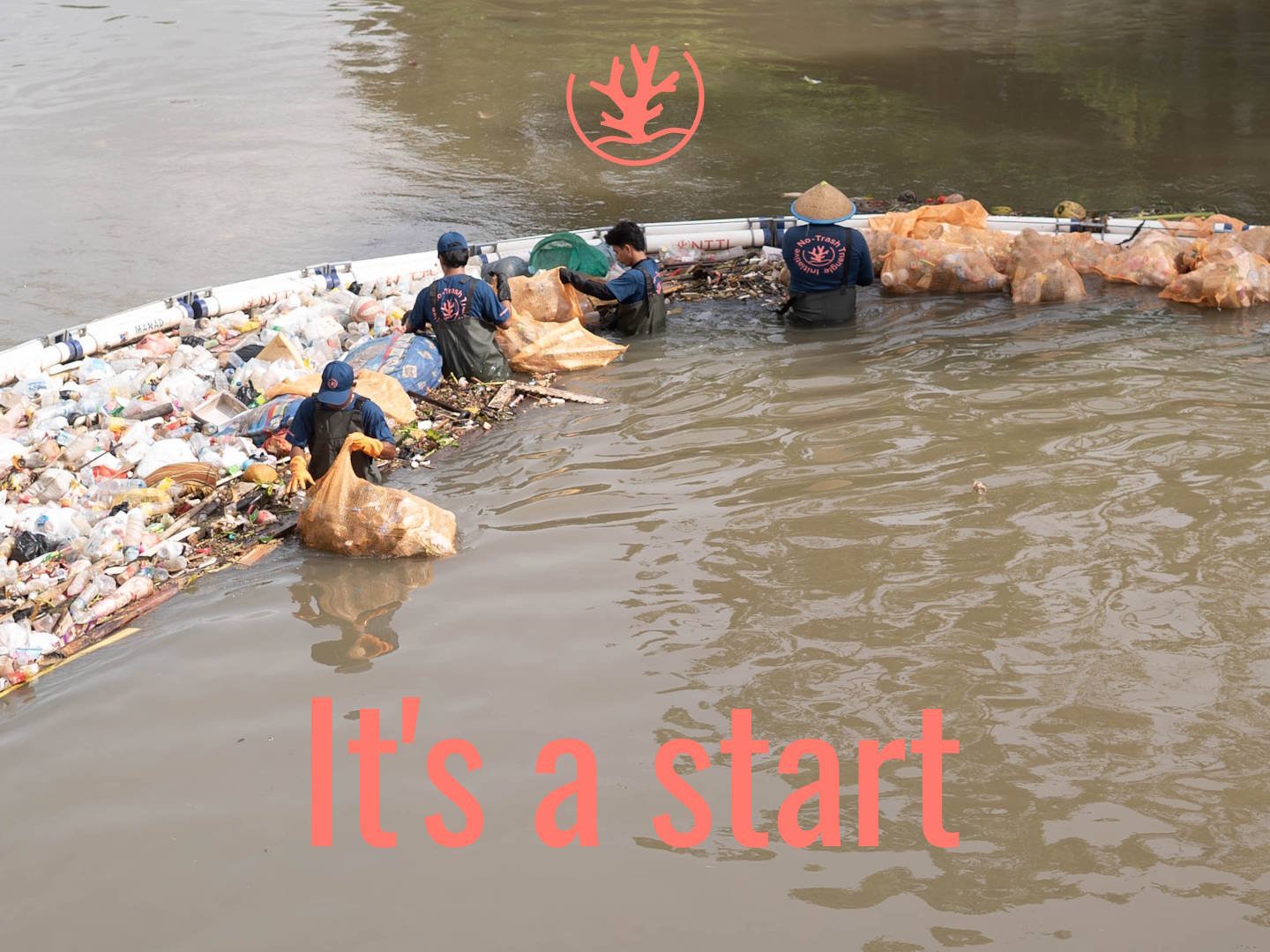
Perhaps 80% of the plastic in our oceans gets there via rivers. In Manado, Indonesia the grassroots No-Trash River project uses simple barriers to catch plastic waste, preventing it from reaching the Bunaken Marine Park and spoiling its dive tourism hotspots.
Learn more from Anna Clerici, co-founder of the No-Trash Triangle Initiative which is anEXO FoundationSustainability Award winner.
Uncomfortably tangible
At a bend in Manado’s Tikala River in Indonesia, a floating barrier stretches across the brown current like a tired smile. Plastic bottles, flip-flops, food wrappers, and orphaned toys drift like lazy fish, and gather against the low, metal structure put there to catch what it shouldn’t have to: ourwaste.
For decades, scientists have warned that rivers are the main arteries feeding plastic into the ocean. Depending on the study you read, anywhere from 8 to 20 million tons of plastic enter the sea each year, and up to 80% of it travels there via rivers.
But the thing about global statistics is that they always sound too big to touch. That is until you stand next to a river like this one, a tributary of the larger Tondano River in Manado, North Sulawesi, and the numbers become uncomfortably tangible.
They began where theycould
Back in 2017, a small team of marine biologists and resort managers decided to act, not because of the rivers, but because of theocean.
They lived and worked on Bangka Island. As ocean lovers, they wanted to protect the reefs that had given them so much, and they began where they could: organising beach clean-ups, building waste-sorting systems, and teaching local children about thesea.
They called their effort the No-Trash Triangle Initiative (NTTI); a nod to the Coral Triangle, the most biodiverse marine ecosystem on Earth, which begins just offshore from Bangka.
The initiative has grown step by step over the years, fuelled not by big funding but by the steady support of local diving resorts whose livelihoods depend on healthy coral reefs. These resorts became long-term partners, providing logistics, funding, and visibility. Their commitment helped NTTI expand its reach beyond the island, build relationships with local authorities, and turn what began as a community-driven effort into a structured programme with measurable environmental impact.
They step into the rivers
In 2024, the No-Trash Triangle Initiative launched the No-Trash River project in Manado thanks to a grant from 3RproMar; the Reduce, Reuse, Recycle to Protect the Marine Environment and Coral Reefs project implemented in Indonesia by GIZ on behalf of the German Federal Ministry for Economic Cooperation and Development (BMZ).
Today 20 river barriers snake across streams and canals in and around Manado city. The barriers are installed in shallow sections, so that NTTI team members can get towork.
NTTI employs former landfill workers, offering dignified jobs with fair salaries, stable contracts, and health insurance. They are the invisible custodians of Manado’s rivers, the ones who clean up what the city’s waste system can’tcatch.
Every day they literally step into the rivers. They lift, pull, and haul out what the barriers have trapped overnight. It’s tough, physical work under the tropical sun or rain. There’s no glamour in it, but sometimes there’s laughter; a joke shared midstream over the strange and unexpected things the river delivers: a wooden cross from the church upstream, 17 fridges, or a mattress that somehow made it thisfar.
The gathered waste is transported to NTTI’s sorting station, where it is weighed, separated, and prepared for recycling or proper disposal.
In just one year, the No-Trash River project in Manado has collected more than 100 tonnes of plastic; preventing it from reaching the ocean and the Bunaken Marine Park, one of Indonesia’s most famous diving destinations only a few miles offshore.
They stand between carelessness and consequence
But the No-Trash Triangle Initiative’s efforts don’t end with the river barriers. The initiative also runs education programmes in local schools, where children learn hands-on about the environment, the threats plastic pollution poses to marine life, and the importance of responsible consumption.
Is it enough? Of course not.
No one believes river barriers and outreach programmes alone will stop the tide of ocean plastic. The world’s consumption patterns are too vast, its waste infrastructure too fragile.
But there’s something quietly defiant about these barriers. They are not high-tech, yet they silently stand between carelessness and consequence. And they make a difference.
And maybe that’s the point. Change doesn’t always begin with grand gestures. Sometimes it begins with a few people on an island, a few rivers in a city, and a belief that the tide can indeed be held back if enough of us decide to stand in itsway.
To find out more and support NTTI’s work, visit no-trashtriangle.org.
About the author
Anna Clericiis one of the founders of theNo-Trash Triangle Initiative, a project dedicated to tackling plastic waste in the Coral Triangle.Based in Indonesia for nearly a decade, she has turned her love for the ocean into a mission to protectit.
Featured image (top ofpost)
“[A] floating barrier stretches across the brown current like a tired smile.” Photo by Ezra Kaunang for theNo-Trash Triangle Initiative (NTTI).
