

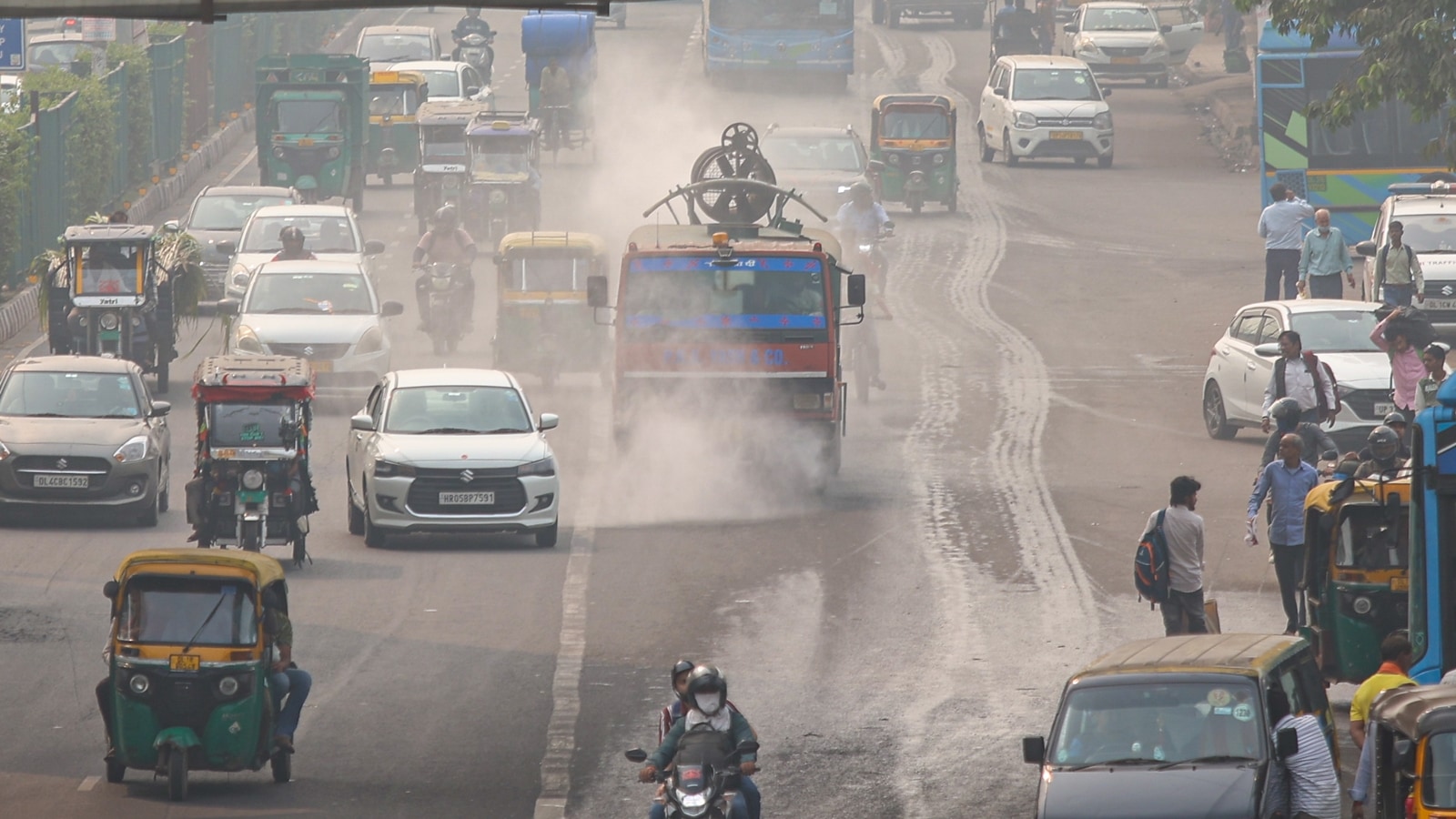
On an average, around 3,000 km of roads in Delhi are being mechanically swept every day with the help of water sprinklers to reduce loose dust in a bid to tackle dust pollution – considered to be one of the major contributors to air pollution in the Capital. However, this may not be enough.
According to a study conducted by Enviro Policy Research India (EPRI) in association with National Environmental Engineering Research Institute (NEERI), chemical dust suppressants, and not water, have shown higher effectiveness in reducing particulate matter. The study, commissioned by the Central Pollution Control Board (CPCB) in 2018, showed that the use of chemical dust suppressants had 50-60% higher efficacy than the use of water, which recorded an efficacy of 25-30%.

The CPCB, which spent around Rs 2.97 lakh on the study, had recently quoted this study while replying to an RTI filed by Noida-based social activist Amit Gupta.
However, experts flagged disadvantages that come with the use of chemical dust suppressants. While these can be used on road surfaces that see minimal disturbance, concerns have also been raised about the likely impact of chemicals on public health with poorly regulated application estimated to “trigger hazardous environmental consequences”.
In 2018, the CPCB had undertaken the pilot study to evaluate the performance of chemical suppressants at construction sites in the Capital. During the trials – conducted between October to December 2018 – salts of calcium or magnesium and bio additives were used.
According to the RTI reply, the trials were held at three dust-heavy locations — Sarai Kale Khan, a DDA construction site in Narela and the Dilshad Garden flyover stretch leading to the proposed Metro station. These sites were selected because of the presence of construction or road construction sites where spikes in PM10 and PM2.5 were routinely recorded.
“As per the study, dust levels dropped by roughly 30% and remained lower for nearly six hours following the use of chemical suppressants,” Gupta said. In contrast, the effectiveness of water sprinkling – the most widely used dust control measure in Delhi – was usually seen lasting only 10-15 minutes before the surface dried up.
Story continues below this ad
According to Council of Scientific and Industrial Research (CSIR)-NEERI experts, chemical-based dust suppressants are also not economical because they can be used just once in six hours, compared to multiple rounds of water sprinkling. For a 100 sq m area, both use 200 litres of water, but water costs Rs 90 per round, totalling around Rs 2,160 in six hours, while chemical suppressants cost only Rs 100.
Water sprinkling is one of the oldest dust control measures due to its ready availability and the fact that it can be sprayed directly onto road surfaces. It adds moisture to settle particles, but its effectiveness is short-lived due to rapid evaporation.
Despite being more effective, chemical suppressants are not used widely in Delhi. A senior scientist, working with the Commission for Air Quality Management (CAQM), explained why.
“Chemical-mixed dust suppressants are used only in limited pockets in Delhi because they form a thin layer on the surface that keeps dust down. But the moment there’s movement… vehicles, machinery or even heavy footfall – the layer breaks and the method stops being effective. That’s why water is used as the primary suppressant and chemicals are applied only where there is minimal disturbance.”
Story continues below this ad
Concerns have also been raised about the likely impact of the chemicals on public health with increased usage. Even as these agents are known to improve dust binding, excessive or repeated use can cause mild respiratory or skin irritation and lead to longer-term soil and water impacts if not carefully managed, experts said.
NEERI’s technical note on dust suppressants stressed that while these chemicals are effective, these cannot be treated as “harmless”. It said that an overuse or poorly regulated application “can trigger hazardous environmental consequences”.
As per experts, the most effective dust suppressants include chloride-based salts such as calcium chloride and magnesium chloride, along with lignin sulfonate, asphalt emulsions, and bio-additives, which were also used in the 2018 trials in Delhi. Salts, chlorides or additives can affect soil quality, groundwater and nearby vegetation if applied repeatedly or without monitoring. NEERI emphasised that the use must be “judicious,” site-specific and backed by regular checks.
In September 2019, then CPCB Member Secretary Dr Prashant Gargava had written to the Haryana State Pollution Control Board where he summarised the Delhi trials. He advised Haryana to consider the product for unpaved roads, busy traffic corridors and large construction projects during winter, while cautioning that it “should not cause any hazard to public health and environment”.
Story continues below this ad
According to Gupta, the results of the pilot study indicated that chemical suppressants may have a role in situations where dust cannot be removed immediately.
As per NEERI, the data collected during the pilot study indicated that suppressants can provide temporary relief in high-dust zones but cannot replace the need for proper containment of soil, debris and construction material.
Dr Anumita Roychowdhury, Executive Director (Research and Advocacy) at Centre for Science and Environment had earlier told The Indian Express that the long-term efficacy and the impact of dust suppressants need to be studied and no information is available on this as of now.
WATER vs CHEMICAL
Suppressants should be
- EFFECTIVE & soil/ environment friendly
- EASY to apply with standard equipment
- RESPONSIVE to routine maintenance
- SAFE, convenient for vehicles, humans
- COST-competitive
Water Effectiveness depends on
Story continues below this ad
- AMOUNT used per unit surface area
- TIME elapsed between applications
- TRAFFIC load between applications
Chemical Effectiveness depends on
- DILUTION of the mixture
- APPLICATION rate/ unit surface area
- TIME elapsed between applications
- TRAFFIC load between applications
- WEATHER conditions (rainy, humid, etc)
(Source: CSIR-NEERI recommendations)
