

In December, the middle school asked all 480 students to return the Chromebooks they had freely used in class and at home. Now the school keeps the laptops, which run on Google’s Chrome operating system, in carts parked in classrooms. Children take notes mostly by hand, and laptops are used sparingly, for specific activities assigned by teachers.
“We just felt we couldn’t have Chromebooks be that huge distraction,” said Esping, 43, Kansas’ 2025 middle school principal of the year. “This technology can be a tool. It is not the answer to education.”
McPherson Middle School, about an hour’s drive from Wichita, is at the forefront of a new tech backlash spreading in education: Chromebook remorse.
For years, giants like Apple, Google and Microsoft have fiercely competed to capture the classroom and train schoolchildren on their tech products in the hopes of hooking students as lifelong customers. For more than a decade, tech companies have urged schools to buy one laptop per child, arguing that the devices would democratize education and bolster learning. Now Google and Microsoft, along with newcomers like OpenAI, are vying to spread their artificial intelligence chatbots in schools.
But after tens of billions of dollars of school spending on Chromebooks, iPads and learning apps, studies have found that digital tools have generally not improved students’ academic results or graduation rates. Some researchers and organizations like UNESCO even warn that overreliance on technology can distract students and impede learning.
Schools in North Carolina, Virginia, Maryland and Michigan that once bought devices for each student are now reevaluating heavy classroom technology use. And Chromebooks, the laptops most popular with U.S. schools, have emerged as a focal point. School leaders, educators and parents described the laptop curbs as an effort to refocus schooling on skills like student collaboration and conversation.
“We’re not going back to stone tablets,” said Shiloh Vincent, the superintendent of McPherson Public Schools. “This is intentional tech use.”
Story continues below this ad
The classroom device pullback is the latest sign of a growing global reckoning over how tech giants and their products have upended childhood, adolescence and education.
In a landmark verdict last week, a jury found the social media company Meta and the Google-owned YouTube liable for hooking and harming a minor. More than 30 states have limited or banned student cellphone use at school. Last year, Australia began requiring social media companies to disable the accounts of children under 16, a move that other countries are considering.
Now children’s groups and educators concerned about screen time are turning their attention to school-issued laptops and learning apps. Parents are flocking to support efforts, like Schools Beyond Screens and the Distraction-Free Schools Policy Project, to vet and limit school tech.
At least 10 states, including Kansas, Vermont and Virginia, have recently introduced bills to restrict students’ screen time, require proof of safety and efficacy for school tech tools or allow parents to opt their child out of using digital devices for learning. And Utah recently passed a law that would require schools to provide monitoring systems for parents to see which websites their children had visited — and how much time they spent — on school devices.
Story continues below this ad
Some parents are particularly concerned about YouTube, saying the platform has steered children to inappropriate videos on school devices. Gov. Gavin Newsom of California, a Democrat, recently expressed concern that one of his school-age sons had watched YouTube videos of manosphere podcasters on his school laptop.
“It was his school device,” Newsom said during a podcast interview this month. “It was YouTube. It was the Chromebook and all these algorithms.”
Google said it provided tools for schools to lock students’ Chromebook screens, restrict the content they saw, manage their YouTube access and disable Chromebooks after school hours. The company said it also turned off YouTube by default for K-12 students with school-issued Google accounts.
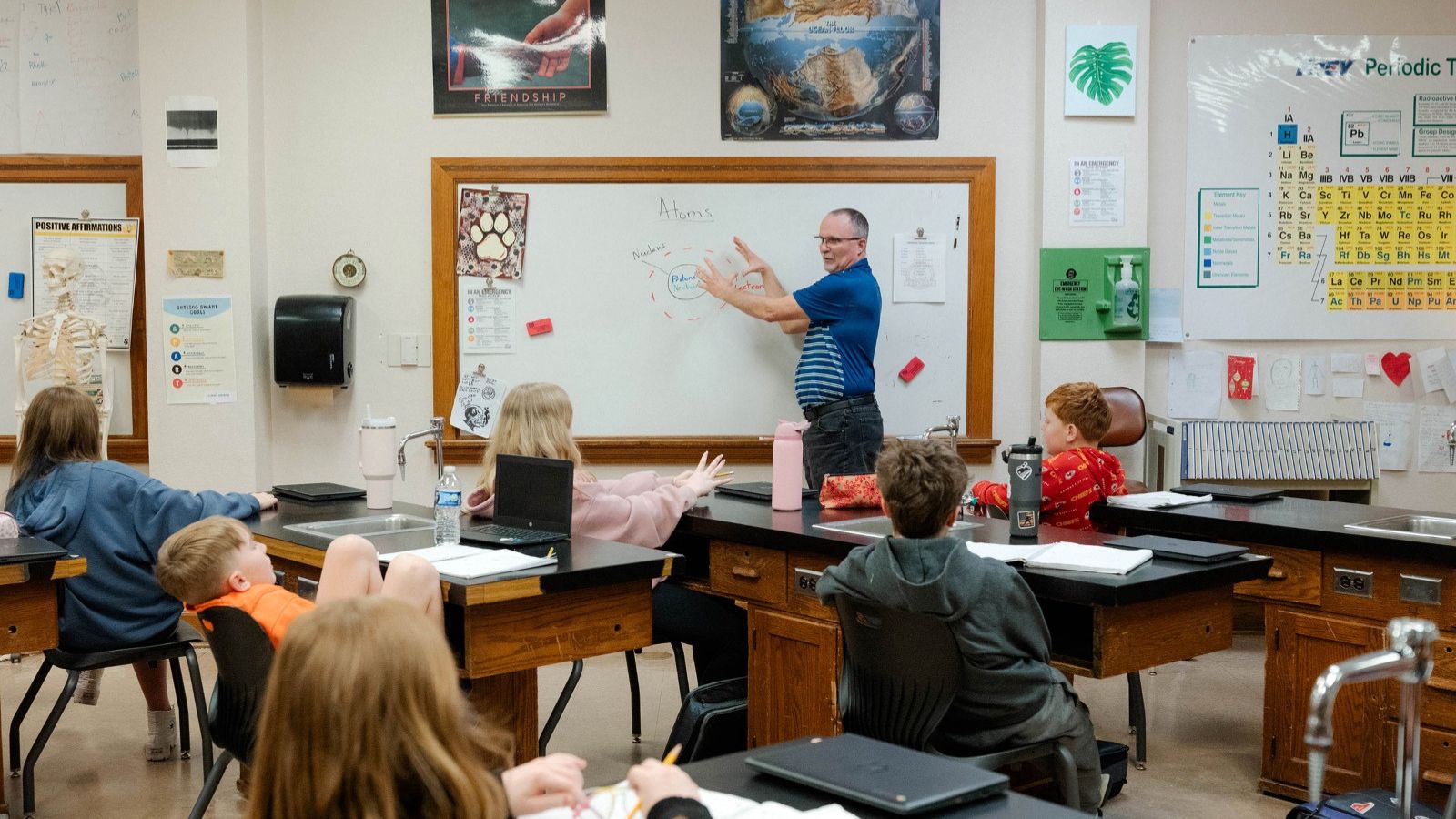
In a small town surrounded by wheat fields, McPherson Middle School serves sixth through eighth graders in a red brick schoolhouse built in 1938. In science class, eighth graders sit at vintage lab tables next to cabinets brimming with old microscopes. The school auditorium still has its original wooden seating.
Story continues below this ad
“We already have a little bit of an old-school vibe for sure,” said Esping, now in her fourth year as principal.
She is also revisiting years-old school tech decisions.
In 2016, as part of the national trend, administrators at McPherson decided to buy a $225 Chromebook for every middle schooler. Google had introduced the low-cost laptops five years earlier, with a pitch that the tech would help equalize learning opportunities and equip students with vital career skills.
“The individual use of Chromebooks is a way to empower students to maximize their full potential,” the middle school’s device policy explained in 2016.
School leaders were enthusiastic.
“The general idea was: Students are going to be more engaged because it’s online — and how exciting for them!” Esping recalled.
Story continues below this ad
To capitalize on the Chromebooks, the middle school invested in online textbooks and learning apps. But administrators, parents and students found that some of the platforms seemed too gamelike or did not work as advertised.
The coronavirus pandemic only increased school reliance on tech tools. In 2021, Chromebook shipments to schools more than doubled to nearly 16.8 million, compared with shipments in 2016, according to Futuresource Consulting, a market research firm.
When Esping took over as principal in 2022, she worried that rampant tech use was hindering learning. So the school banned student cellphones.
Online bullying and disciplinary incidents quickly decreased, she said. But online distractions continued.
Story continues below this ad
Some students became so hooked on playing video games on their Chromebooks that teachers had difficulty getting them to concentrate on their schoolwork, administrators and teachers said.
Students also sent mean Gmail messages or set up shared Google Docs to bully classmates with comments. Hundreds of children logged on to Zoom meetings where they made fun of their peers, teachers and students said.
The school blocked Spotify and YouTube on school laptops. Then administrators stopped students from messaging one another on school Gmail.
Even then, some educators said they were spending so much time policing student Chromebook use that it was detracting from teaching. Some parents complained their children were spending hours playing video games on their school-issued devices.
Story continues below this ad
Although the idea of taking back students’ Chromebooks seemed unorthodox, given U.S. schools’ deep reliance on Google’s sprawling education platform, the middle school went ahead. The changes took effect in January.
On one recent morning, school formally began with the Pledge of Allegiance, broadcast over school loudspeakers. Homeroom teachers then led group sessions on organizational and interpersonal skills to help children navigate life without their own laptops.
Homeroom topics have included tips for students on using paper planners for school assignments and doing homework during school hours. (Students who want to practice things like extra math problems online can borrow Chromebooks from the school library to take home.)
Teachers have also taught students how to play board and card games like Scattergories and Uno.
The new laptop minimalism has also changed core courses.
Story continues below this ad
During a recent English class on writing thesis statements, Jenny Vernon, the teacher, gave seventh graders a choice. They could answer questions by hand on bright salmon-colored paper or use a class Chromebook. Most students chose the paper.
In a sixth grade lesson on fractions, a teacher asked the class to convert three-twentieths into a percentage. Students each worked on the problem on small dry-erase boards. They balanced the boards on their heads to indicate they were ready to be called on.
Computer science classes promote purposeful tech use. In one recent lesson, students used Chromebooks to program sensors and LED lights.
“It’s coding the physical world,” said Courtney Klassen, the computing teacher. “It’s not just staring at the screen.”
Some students have welcomed the changes.
Jade LeGron, 13, said curtailing Chromebooks had been “super beneficial” because students had stopped fighting with teachers over video games and had less opportunity “to be mean to each other.”
Sarah Garcia, also 13, said spending less time online had prompted students to talk more. “Since we don’t have our Chromebooks in front of our face,” she said, “most people now interact with their, like, peers and stuff.”
The school is part of a trend. In Wichita, Marshall Middle School is trying “tech-free” Fridays. In January, the Kansas Senate introduced a school device bill that would prohibit laptops and tablets in kindergarten through fifth grade — while restricting device use for middle schoolers to just one hour during the school day.
Schools like McPherson say they are not just curbing Chromebooks to reduce children’s screen time. They are also aiming to refocus learning on child development, student-teacher interactions and old-fashioned fun.
“They’ve learned how to make darts again!” Esping exclaimed, pointing up at a student-made dart jutting out from a school hallway ceiling. “They are going back to the old ways of being ornery.”
