

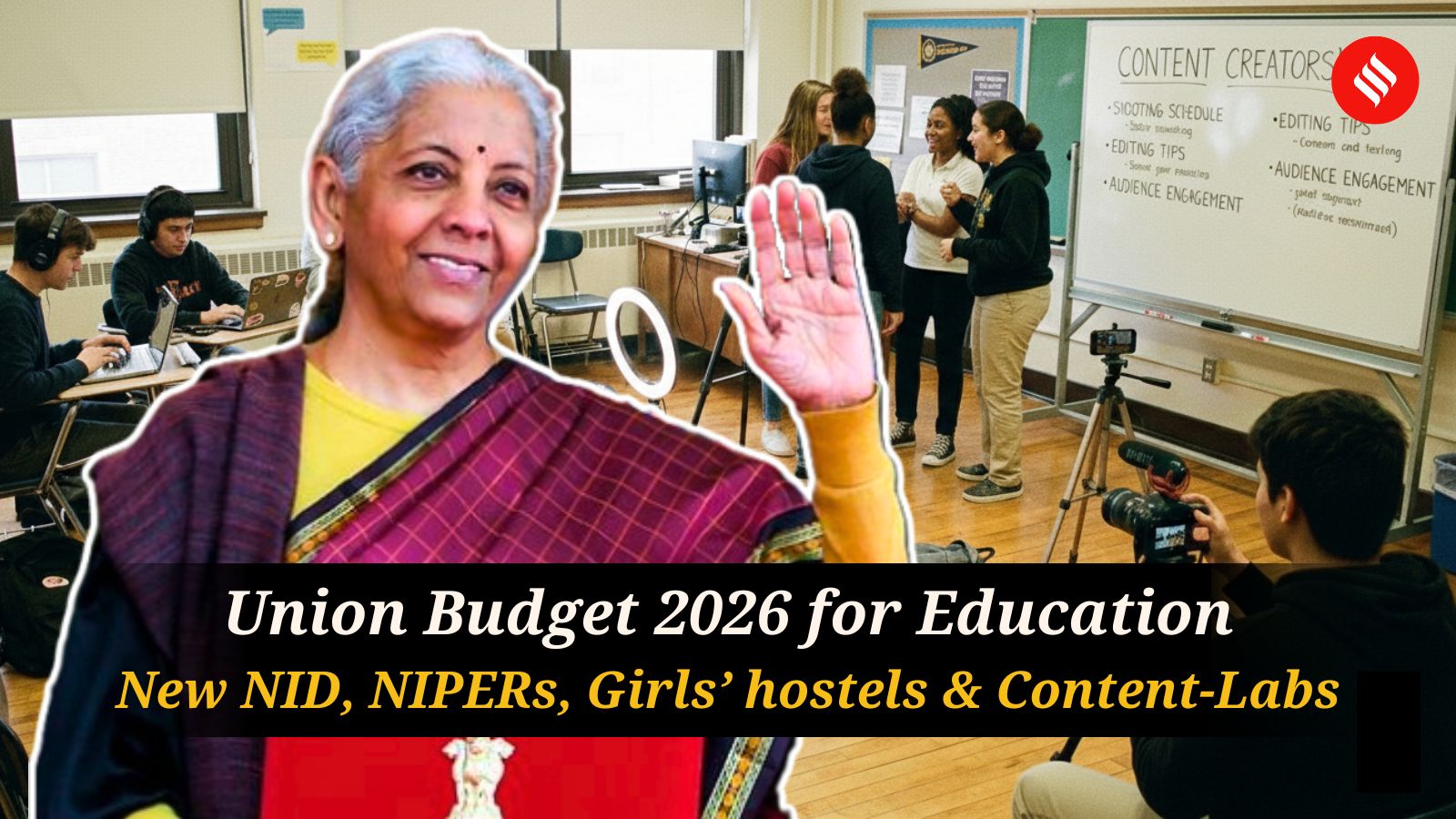
The Union Finance Minister on Sunday presented the Union Budget for 2026–27 with a clear focus on medical and health education. The announcements noted a major expansion of training capacity across pharmaceuticals, allied health professions, mental healthcare and traditional medicine. From new national-level institutes and upgraded campuses to large-scale skilling pipelines for caregivers and health professionals, the budget positions healthcare education as a central pillar of India’s services-led growth and employment strategy.
At the heart of the announcements is a ₹10,000-crore bio-pharma sectoral development outlay, aimed at strengthening pharmaceutical education, clinical training and research ecosystems. The government has proposed setting up three new National Institutes of Pharmaceutical Education and Research (NIPERs), taking the total number to 10, while seven existing NIPERs will be upgraded to enhance advanced training, research capacity and industry linkages. Additionally, a nationwide network of accredited clinical facilities is also planned, intended to address long-standing gaps in hands-on clinical exposure and translational research within medical and pharma education.

Beyond healthcare, the budget places strong emphasis on short-cycle, practical skilling, particularly for smaller cities. Professional bodies such as ICAI, ICSI and ICMAI will be tasked with designing short-term modular courses and practical toolkits to develop a new cadre of “corporate mitras”. These programmes are intended to support small businesses and enterprises, especially in tier-2 and tier-3 cities, by creating locally available professional support in accounting, compliance and corporate governance.
Research and employment linkages also feature prominently during the speech. The Finance Minister referred to the Anusandhan Research Fund, while claiming that nearly 25 crore people have moved out of poverty through various government interventions.
To sustain this momentum, a high-powered “education-to-employment and enterprise” standing committee will be constituted, with the services sector identified as the core driver of India’s next phase of growth. The committee will focus on employment generation, export of services and technologies, and the integration of AI-linked skills and job requirements, reflecting the government’s intent to align higher education with evolving labour market demands.
The Union Budget outlines a wide spectrum of structured career pathways, particularly in health and care services. In the healthcare sector, Allied Health Professional (AHP) education will be expanded across 10 selected disciplines, including optometry, anaesthesia technology, applied psychology and behavioural health. The government plans to train one-lakh AHPs over the next five years, addressing critical shortages in hospitals and community health systems.
Complementing this is a proposal to build a strong geriatric and long-term care ecosystem. Multi-skilled caregivers — including wellness and yoga practitioners — will be trained, with a target of 1.5 lakh caregivers over the coming years.
Story continues below this ad
Additionally, creation of five hubs for medical value tourism was announced — integrating healthcare delivery with education, diagnostics, rehabilitation and post-care services. These hubs are expected to open up diverse employment opportunities for doctors, allied health professionals and support staff.
Traditional systems of medicine and mental health education have also received attention. The government will set up three new All India Institutes of Ayurveda, aimed at producing a larger pool of skilled personnel. In mental healthcare, a second NIMHANS-like national institute will be established in north India, while the existing mental health institute in Ranchi will be upgraded.
Boost to Orange Economy: ‘Content-Labs’ in 15,000 Schools and New National Institute of Design (NID)
In the creative and design sectors, the budget proposes the upgradation of the Indian Institute of Creative Technology in Mumbai. Further, it proposed that the institute create ‘content-creation labs’ focusing on animation, visual effects, gaming, and comics (AVGC), across 15,000 schools and 500 colleges.
Acknowledging the rapid expansion of India’s design industry and the shortage of trained designers, the government has also proposed setting up a new National Institute of Design (NID) in eastern India.
Story continues below this ad
Higher education infrastructure will see a spatial re-imagining through a challenge-based model.
The Centre will support states in establishing five university townships located in industrial and logistics hubs. These townships are envisioned as integrated clusters hosting multiple universities and colleges, residential facilities and shared research infrastructure, aimed at improving regional access to quality higher education.
Girls’ hostel in every district; space-studies get boost
Equity-linked interventions also find mention. To address persistent access gaps, the government has proposed setting up one girls’ hostel in every district, particularly targeting regions with low female participation in STEM education.
Science outreach and research infrastructure will be strengthened through renewed focus on astrophysics and astronomy. The budget announces four major telescope facilities, including a large solar telescope, the Himalayan Chandra Telescope and the COSMOS-2 planetarium, aimed at boosting research, training and public engagement in space sciences.
Story continues below this ad
Tourism, hospitality and sports education have been folded into the broader skilling narrative. A National Institute of Hospitality will be set up, with the NCHM upgraded to better bridge academia and industry needs. As part of a pilot initiative, 10,000 tourist guides across 20 iconic sites will undergo 12-week training programmes, developed in collaboration with IIMs.
In sports, the Khelo India Mission will be extended with a 10-year integrated talent development pathway, spanning beginner, intermediate and elite training levels.
The budget also links education with agriculture and rural livelihoods. Under an ICAR-led package, AI-based decision-support systems will be deployed to improve farm productivity, incooorporating the role of technology-enabled training and advisory services for farmers.
