

The cryptocurrency sector finds new ways to surprise investors every year. While ‘finfluencers,” traders, and analysts use a range of unique tools and strategies to predict the performance of various crypto assets this year, we can track some ongoing trends and market catalysts in order to understand what developments the crypto industry might experience in 2026.
Let’s take a look.
Bitcoin price volatility after a year of record highs
Bitcoin entered 2026 on track to mark its first annual loss since 2022, as it began the year trading at under $90,000. While Bitcoin was once deemed a niche investment choice and a way to diversify one’s portfolio to hedge against risks, it is now a trending asset class that is greatly affected by macroeconomic developments and U.S. government announcements.
In 2025, Bitcoin remained the top cryptocurrency by market capitalisation. It crossed the $126,000-mark on October 7, but crashed afterwards. Analysts pointed out U.S. President Donald Trump’s scrutiny of tech exports to China and his tariff threats as possible triggers for this crash. Fear was the dominant emotion as investors worried about potential losses, sudden sell-offs, and panic-induced trading.

Many popular alt coins, or non-Bitcoin cryptocurrencies, are also starting the year in the red. But while these assets once echoed Bitcoin’s price trajectory, that may not be the case this year as savvy investors better discern between Bitcoin and more centralised crypto projects or meme tokens.
Volatility can also be expected in the crypto sector as the fiscal year comes to an end in the spring. However, this doesn’t necessarily always mean a collapse in price, though the last two months may have felt that way to many traders. Rather, it signals the possibility of rapid price fluctuations, keeping investors on their toes and glued to their trading apps.
Trump’s increased involvement with crypto in the U.S.
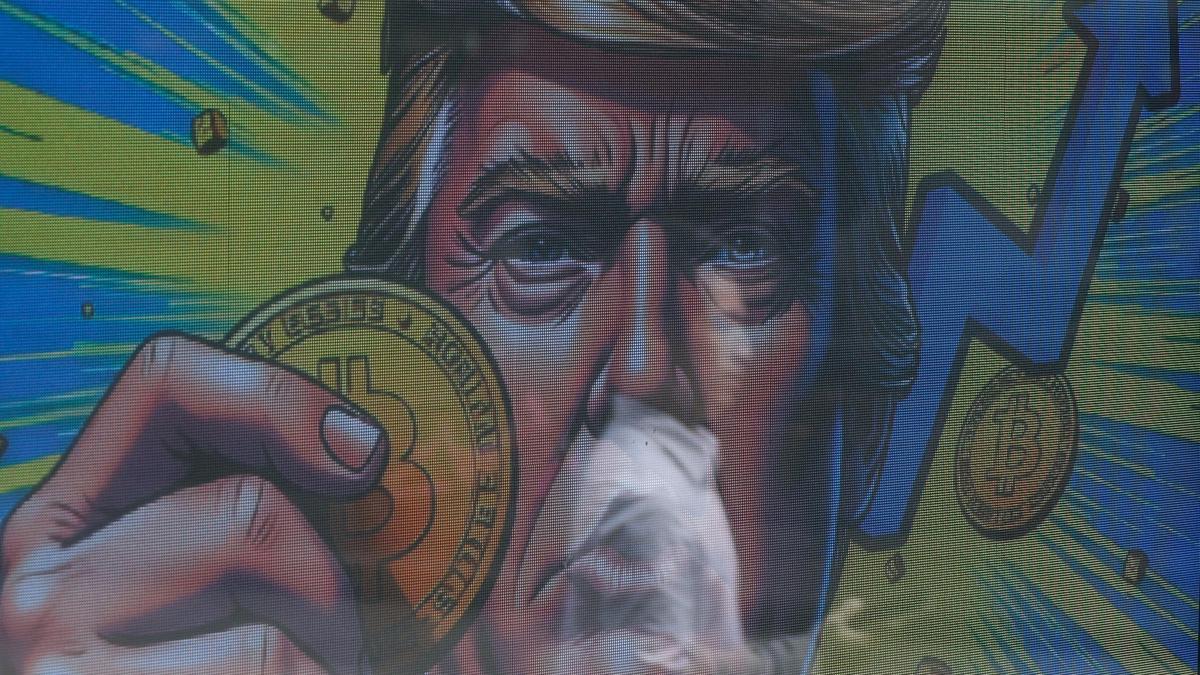
U.S. President Donald Trump branded himself as a pro-crypto presidential candidate during his campaign run in 2024, earning the support of both conservative and pro-crypto lobbies. On March 6, he signed an executive order to establish a Strategic Bitcoin Reserve and a U.S. Digital Asset Stockpile. He also launched the $TRUMP meme currency around the time of his inauguration early in 2025, though it crashed in value. As of December, Trump Media also planed to distribute digital currencies to shareholders

Legal experts have criticised the strong potential for ethical and financial conflict due to Trump’s involvement with the highly volatile and still partially regulated cryptocurrency market. While it can be argued that the President has some interest in keeping crypto prices high and overseeing the market in order to satisfy his voter base, his other actions—such as limiting tech exports to China and hitting even trading partners with tariffs—have worked to trigger crypto price crashes.
In essence, crypto trackers this year will be working double-time as Trump trackers.
Increased adoption of crypto in India
As per Chainalysis’ 2025 Global Adoption Index, India has topped grassroots crypto adoption more than once, even while more exchanges in the country encourage users to register for their services, citing compliance with Indian laws and its crypto tax regime. With increased insecurity over rupee depreciation, we can expect to see more Indians gravitating towards crypto investments, as they look for ways to hedge against risk.

This is not an entirely positive trend, though, as many new crypto investors in India lack knowledge about the volatility of crypto assets and do not understand the underlying blockchain technology. As shown by last year’s WazirX restructuring exercise, the lack of cohesive crypto regulation means that investors are often left in the lurch in case of hacks or legal conflicts. More disillusioned Indian investors seeking better control over their assets and keys will likely begin to explore more decentralised finance (DeFi) options notwithstanding the unique cybersecurity risks they pose as well.
More regulation of stablecoins across world governments
In July 2025, U.S. President Donald Trump signed the “Guiding and Establishing National Innovation for U.S. Stablecoins Act” or “GENIUS Act” into law. The law was designed to make issuers of stablecoins—cryptocurrencies that are pegged to the value of real-life assets such as dollars—disclose how their assets were backed with real world wealth. This action has spurred other countries to look at how their own currencies are being used to back stablecoins, and enact regulatory frameworks accordingly. Stablecoins are different from central bank digital currencies, as they are not issued or controlled by centralised authorities, but are crucial for conducting trades via crypto exchanges.

Spurred by the U.S. government’s GENIUS Act, we can expect more stablecoin regulations across the globe. In particular, keep an eye on South Korea, Japan, Hong Kong, and Singapore, as these regions have proactive financial authorities as well as tech-savvy populations that are familiar with investing in virtual assets.
New crypto hacks and scams, powered by AI
While experts warn that crypto hacks and security exploits tend to rise when asset prices increase, the launch of new Generative AI tools have made it easier for malicious actors to launch sophisticated scams and attacks across borders—even if they have no knowledge of coding. These attacks tend to make use of highly experimental models still in the early stages of development. North Korean hackers are an ever-present threat as they target not just crypto platforms, but also individual users as well as employees at crypto firms, according to Chainalysis.

In fact, AI chatbots as well as more autonomous AI agents have already been jailbroken to power cyber attacks. In addition to this, chatbots and agents enable faster and more effective social engineering attacks, where hackers directly manipulate the victims whose funds or credentials they hope to steal.
Dating apps are also likely to be misused to launch crypto scams and “pig-butchering schemes” as Valentine’s Day approaches this year.
Published – January 08, 2026 02:24 pm IST
