

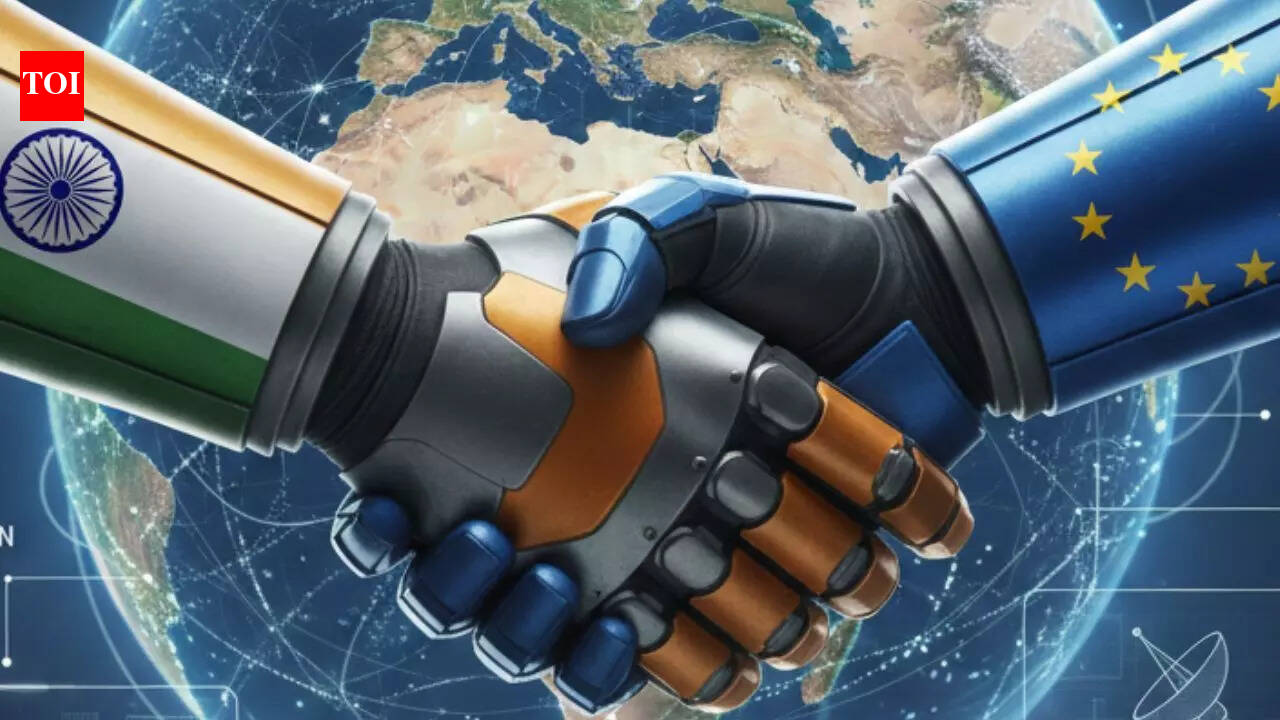

NEW DELHI: Apart from the political declaration announcing conclusion of the FTA talks, the signing of a security and defence partnership agreement along with the adoption of a joint comprehensive strategic agenda for the next 5 years at the India-EU summit marked what was, according to officials from both sides, the highest point in bilateral ties. Under the defence agreement, both sides announced the launch of negotiations for a security of information agreement for exchange of classified information demonstrating an increasing level of trust and reliability between them, despite the differences over the Russia-Ukraine war. European Commission President Ursula von der Leyen called the launch of the first ever security and defence partnership between the world’s two largest democracies and economies a landmark departure and a trust-based platform for cooperation on strategic issues that mattered most. “In so doing, we will help to build each other’s resilience…we have chosen to be reliable partners for one another,’’ said von der Leyen, who had in an interview to TOI last week described the new defence partnership as a likely game-changer but also cautioned that transfer of high-end technology will be subject to national competence. The partnership is meant to deepen cooperation in maritime security, defence industry and technology, cyber security and counterterrorism. PM Narendra Modi said the partnership will strengthen shared commitment to a rules-based international order, boost Indo-Pacific cooperation and allow defence companies to work together on co-development and co-production. To facilitate defence industrial collaboration, according to a joint statement, the 2 sides are looking to set up an industry-led India-EU Defence Industry Forum to bring together businesses from both sides, with official participation as observers and associating EU Member States, for further focused discussions on defence industry to explore opportunities. The statement said they will also explore, where there is mutual interest and alignment of security priorities, possibilities for India’s participation in relevant EU defence initiatives. Importantly for India, the leaders unequivocally condemned terrorism and violent extremism, in all its forms and manifestations including cross‑border terrorism. “They called for decisive and concerted international efforts to combat terrorism in a comprehensive and sustained manner and in accordance with international law,” said the joint statement, adding that they condemned in the strongest terms the terrorist attack in Pahalgam, Jammu and Kashmir on April 22, 2025 and the terror incident near Red Fort on November 10, 2025. The joint statement said geopolitical realities and growing cross‑regional security threats called for closer EU–India cooperation, adding the two sides will enhance preparedness across domains – from maritime security to hybrid threats, counterterrorism, space security, and transnational crime – while deepening mutually beneficial defence‑industry collaboration. According to both sides, the fresh strategic agenda covers key areas like prosperity and sustainability, technology and innovation, security and defence, connectivity and global issues. The “forward-looking action plan” seeks to build upon more than 20 years of strategic partnership, reflecting the commitment of both sides to work together in an “increasingly complex geopolitical environment as trusted, predictable and like-minded partners”. Under the agenda, both sides agreed to conclude an Investment Protection Agreement to provide high, predictable standards of protection for investors on both sides, and promote investment in high-growth and future-oriented sectors. The new agenda also stresses connectivity seeking to deepen strategic collaboration under the India-Middle East-Europe Economic Corridor (IMEC) to diversify trade routes, reduce strategic dependencies, promote regional integration, and future-proof supply chains, including support to infrastructure development, maritime, rail, digital, and energy. It called for advancing the EU-Africa-India Digital Corridor within the framework of IMEC including through the Blue Raman submarine cable system to provide ultra-high-speed, secure, and diversified data connectivity resilient to disruptions caused by natural disasters or acts of sabotage.
