

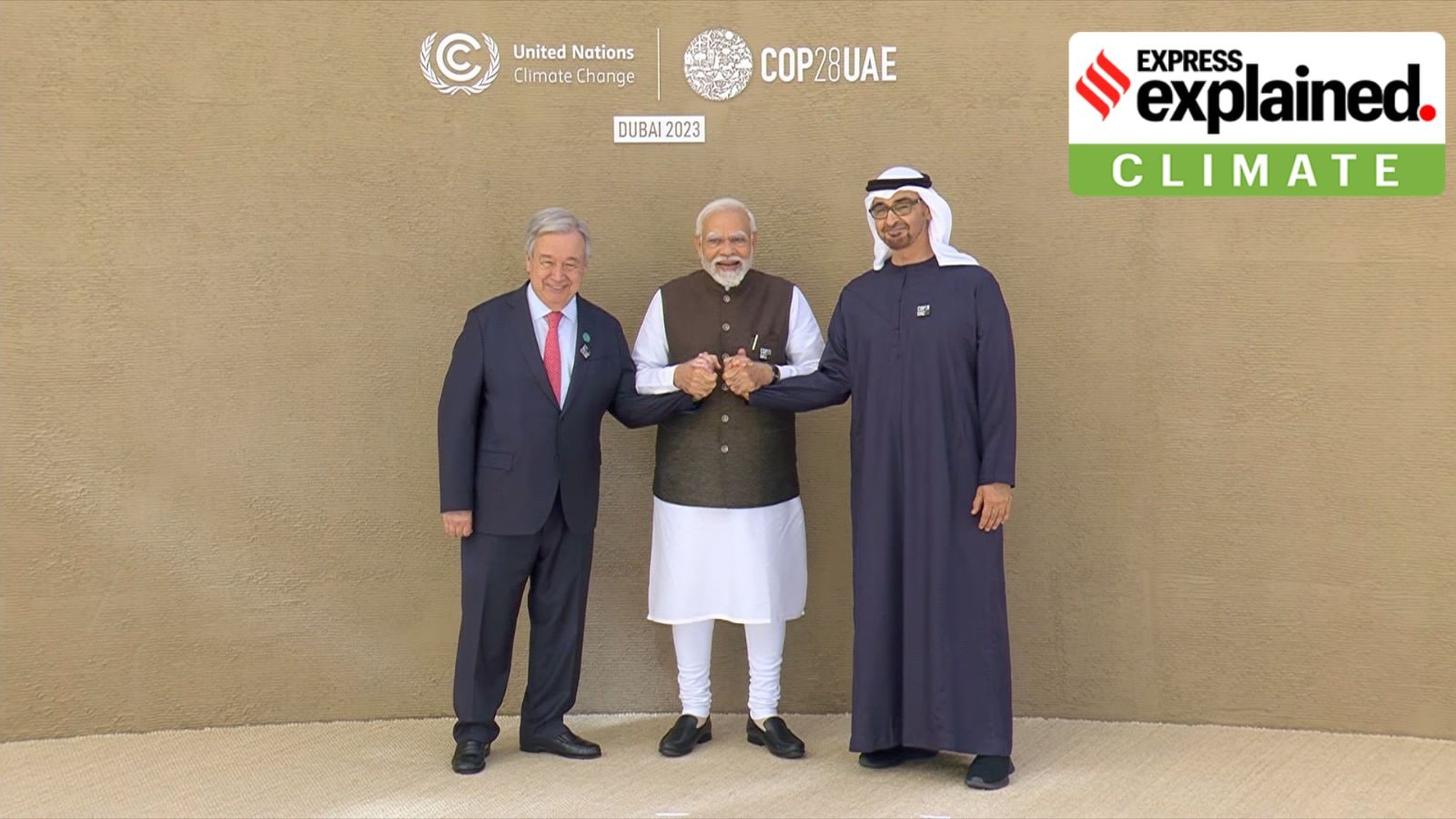
It was in December 2023, during the COP28 climate meeting in Dubai, that Prime Minister Narendra Modi offered to host the 2028 edition of this annual meeting in India. A public and explicit offer to host a COP meeting, five years in advance, and that too from a head of state, was extremely rare, and was a clear indication that India was looking to play a more active role in international climate affairs, and take a leadership role. The offer had come just a few months after a very successful G20 meeting in New Delhi whose final outcome had important decisions on climate. India was keen to build on that momentum.
But events of the last few years, on the climate front and elsewhere, prompted a rethink. India soon realised that the objectives it had in mind while offering to host the event could not be achieved in this changed situation. India’s own positions on climate related issues evolved significantly during this time, and it became increasingly evident that as host and president of a COP meeting, it would have to champion causes that could come in conflict with its own stated positions and national interest.

As a result, India has decided not to pursue this matter any further and not bid for COP33 when the time comes, later this year, to begin the process for picking up the host for 2028.
India’s sharpening positions
India has not spelt out the reasons for its change of mind, but the predicament it faced is not difficult to comprehend. In the last few years, India has been taking unusually strong positions on climate related matters.
This was prompted by the way global climate negotiations were evolving as well as an important recalibration of India’s own perspective on dealing with climate change. There has been growing acknowledgment of the fact that the international climate regime, represented by the Paris Agreement, continued to remain heavily stacked against developing countries, particularly a country like India which has a large emission footprint but a compelling need for more carbon space to ensure greater prosperity to its people.
Consequently, in matters of climate and energy policy, there has been a clear attempt by India in the last few years to prioritise long-term national interest over global climate concerns.
India even began questioning the very foundations of Paris Agreement, arguing that pursuing an arbitrarily-defined temperature goals (1.5 or 2 degree Celsius targets) was probably not the best way, and certainly not the only way, to deal with climate change. It also challenged the mitigation-centric approach of the Paris Agreement, insisting that, for a large number of developing countries, adaptation was equally, if not a greater, priority. India has been arguing that rapid development was probably the best insurance against climate change as that would bring in greater resilience to withstand climate impacts.
Story continues below this ad
This approach is at variance with the mainstream, ‘progressive’, position on climate change, that frames climate change as a global existential threat, and wants every country, regardless of their level of development, to prioritise climate action above almost everything else. India, on the other hand, had begun to argue for a development-first approach, hoping to get on a trajectory similar to that of China, which in the last three decades unabashedly prioritised growth and development to reach a position from where it can make meaningful contributions on climate without hampering its national interests. There is a reason why China, and for that matter United States, has never shown any interest in hosting climate meetings.
In the last few years, India has also been extremely vocal in articulating its recalibrated positions. It had reacted with uncharacteristic anger at the disappointing outcome on climate finance negotiations in Baku at COP29 in 2024. Thereafter, it has been pressing for the full implementation of Article 9.1 of the Paris Agreement, a largely overlooked finance provision that states that developed nations “shall provide”, not just ‘mobilise’, financial resources for developing countries. On India’s insistence, the COP30 meeting in Brazil last year was forced to establish a two-year work programme to discuss all pending matters on climate finance, including Article 9.1.
India’s position on some other contentious issues, like the proposal for an early transition away from fossil fuels, pushed mainly by the developed countries and considered progressive in the climate context, has also hardened.
Global concerns vs national interest
Having taken these positions, it would have been extremely difficult for India to steer the negotiations at COP33. The host and president of the COP meetings is expected to champion the effective implementation of the Paris Agreement, not question its core foundations. It is supposed to ensure that the COP discussions lead to outcomes that will speed up the rate of emission cuts, not raise doubts over their usefulness. India feared that taking on the role of host and president of COP33 would have required it to prioritise global climate concerns over its own national interests.
Story continues below this ad
This predicament would have been particularly pronounced in COP33 because that meeting is due to carry out the second Global Stocktake (GST) to assess the progress being made on Paris Agreement targets. GST is an important exercise set up under the Paris Agreement , to be carried out at five-year intervals, to ensure that the world does not lose sight of its goal and adjusts the ambition of its climate actions to achieve these. The first GST was held at COP28 in Dubai and the second one is due in 2028. Considering that the world is currently nowhere close to the pathway that will achieve the Paris Agreement targets, COP33 would need to deliver an outcome that would result in substantial increase in climate ambition, an unlikely scenario. As host and president, it would have been India’s responsibility to get such an outcome delivered. India’s own positions and actions would have come under greater scrutiny.
There was also a realisation that in the absence of the United States, which has withdrawn itself from the Paris Agreement, no amount of increased ambition from other countries was likely to make any meaningful dent in the climate crisis. But the host country would still be expected to make the effort, and as the third largest emitter, there could be pressure on India to lead by example.
It is also a fact that after the Baku meeting in 2024, the divisions between the developed and developing countries have widened, and mutual trust has declined. In such a scenario, it is getting increasingly difficult for the host country to forge consensus, and facilitate compromises. Brazil faced this issue at COP30 in Belem last year. In a GST year, this would have become an even more difficult job.
The IPCC AR7 angle
The under-preparation seventh assessment report (AR7) of the Intergovernmental Panel on Climate Change (IPCC) worsened India’s predicament. Work on AR7 began last year and it is due to be published in 2029. But there are demands from some countries to expedite the publication of the main report, and its summaries, by 2028 itself, so that it can feed into the GST process. The assessment reports are the most comprehensive scientific view of the current state of global climate and have served as the scientific basis for international climate negotiations from the start.
Story continues below this ad
It is not difficult to anticipate the findings of AR7 report. Global temperatures have been rising steadily, faster than earlier predictions, and climate actions have been unable to keep pace. AR7 is likely to present a grim picture of the state of global climate, and if published ahead of the GST exercise, could lead to renewed calls for raising of climate ambition by all countries.
India, along with some other countries including China, have been opposing an early publication of the IPCC AR7 report, arguing that many developing countries, with fewer resources, would have lesser time to review the report. As it is, IPCC is often accused of relying primarily on science produced by researchers from developed countries, and not offering adequate representation to scientists from the developing world.
India’s opposition to the early publication, however, appears motivated mainly by concerns that it will increase pressure on countries like itself to do more on climate. As host and president of the COP supervising the GST process, it would be difficult for India to oppose the early publication. It would be seen as an obstructionist approach.
India does not want to let its policy space get constrained with any fresh international commitment taken under pressure, particularly in an uncertain geopolitical environment in which energy security and supplies have come under threat. Hosting a COP that has to carry out GST would have made it difficult for India to ensure this.
Story continues below this ad
Because Prime Minister Modi himself had publicly made the offer, it was not easy for India to step aside, as this would likely be seen as a climbdown and shirking of responsibility. It would also be a missed opportunity for India to push forward the cause of Global South and buttress its leadership credentials among the developing countries. But weighed against the likely prospect of getting boxed into the corner on some important issues, India thought it prudent to opt out and decide against hosting COP33.
