

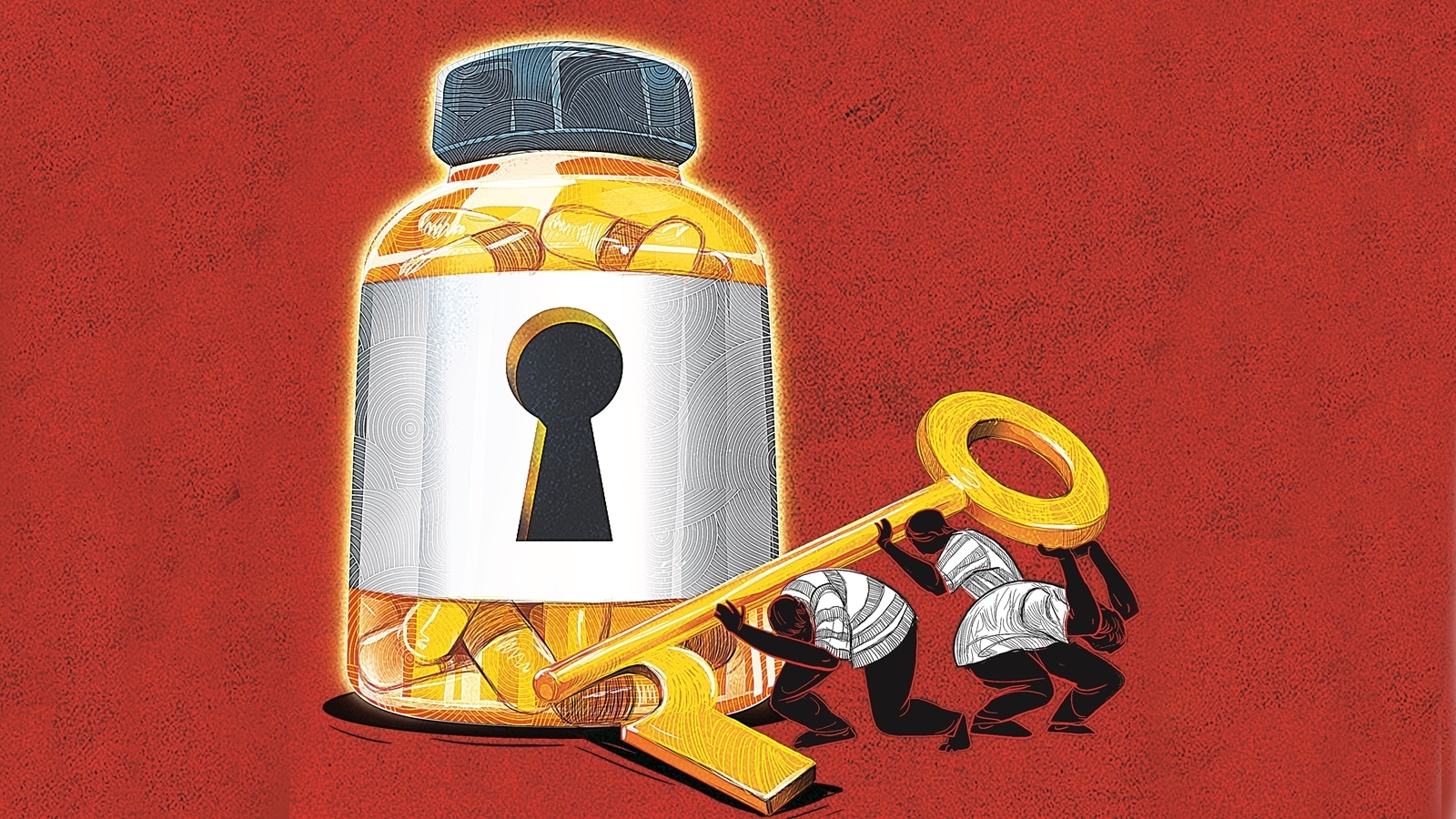
Sixty-seven-year old Meera Gupta received a life-changing diagnosis in November last year. After months of extreme weakness, persistent fevers and a battery of tests, she was confirmed to have stage four Acute Myeloid Leukaemia (AML). She started her chemotherapy with a regimen including the targeted oral drug called Venetoclax, which can cost as much as Rs 90,000 for 28 pills. The other drugs, injections and antimicrobials she needs as part of her treatment, push the cost close to Rs 3 lakh every month.
For her son Vivek, a Kanpur-resident who works in fish farming, life came to a standstill. “I haven’t worked for almost a year now and constantly need to visit Delhi for treatment. My only job is managing my mother’s treatment,” he says. But, it is not the hospitalisations that are the biggest expense, it’s the medicines. “Those prices don’t come down just because customs duty is removed,” he adds.

Venetoclax was one of the 17 medicines for which the basic custom duty was slashed — an announcement made by the Union Finance Minister Nirmala Sitharaman in her budget speech last week. These drugs are primarily anticancer agents used across a range of hematological malignancies and solid tumors, often as targeted therapies or immunotherapies.
The announcement is in line with the government’s push to make such targeted cancer therapies more accessible and affordable. Sitharaman had announced custom duty exemption for 37 medicines and 13 patient assistance programmes in the last budget as well. And, it was cut for three advanced cancer therapies in the interim budget prior to that. The GST Council in its 56th meeting last year also removed all taxes on 36 therapies for cancer and rare diseases.
Yet, these cuts in customs and taxes offer little comfort to families of cancer patients like Gupta. “Any saving is welcome, but don’t call it relief. Relief would be not having to worry every month whether you can afford to keep your mother alive. Even if customs duty is removed, the savings will be marginal. At best, Rs 20,000–Rs 25,000 a month. When your bill is Rs 3 lakh, that doesn’t change your reality,” says Vivek.
He said government schemes and relief funds, such as chief ministerial or prime ministerial relief funds, are slow, uncertain and time-consuming. “We applied in December and were told it could take three to six months. But cancer doesn’t wait. Till then, you pay from your pocket,” he says.
Limited insurance cover
When it comes to newer cancer immunotherapies and targeted therapies — many of which have shown survival benefits for certain cancers — the high costs make them unaffordable for most people. Even health insurance offers limited protection. Vivek and his family exhausted most of Meera’s health insurance cover within a few months. “Insurance sounds big on paper, but when treatment costs Rs 3 lakh a month, how long can Rs 10 lakh last? Three months? Four?”
Story continues below this ad
Only around 20 per cent of the country is covered by some social health scheme. And, another 50 per cent under Ayushman Bharat and its extension by states. Around 30 per cent have no cover at all. Dr Mohit Saxena, head of the department of medical oncology at Manipal Hospital-Gurugram, says cancer immunotherapy coverage in India is often limited by sub-limits, caps, or specific policy clauses rather than being fully covered up to the total sum insured. While modern, advanced treatments like immunotherapy are included in many policies, they may be capped at 50 per cent of the sum insured or a fixed amount like Rs 2 lakh, despite immunotherapy costing Rs 2–Rs 6 lakh per cycle.
Managing the cost burden
Dr Atul Sharma, chairman of medical oncology at Max Hospitals, says the reduction in price is likely to be around Rs 20,000–Rs 25,000 per month for many high-cost drugs. “While helpful, this reduction does not make the treatments cheap or easily affordable for most patients,” says Dr Sharma. But, it adds up. He explains that a patient taking Venetoclax for blood cancer may spend around Rs 90,000– Rs 1 lakh per month. Over a year, the duty removal could reduce costs by approximately Rs 1–Rs 1.2 lakh, and for patients on treatment for several years, the cumulative savings can be significant, he says. “In India, where 60–70 per cent of healthcare costs are out-of-pocket, this could improve treatment adherence, allow earlier access to life-saving therapies like CDK4/6 inhibitors or CAR-T, reduce financial stress on families, and potentially improve survival rates — without compromising care quality,” adds Dr MD Ray, professor of surgical oncology at AIIMS-New Delhi.
Dr Saxena, says that many of medicines for which the duties have been exempted continue to be under patent protection, with only one global manufacturer. The drugs are likely to become dramatically cheaper once the patent expires and generics manufacturers, including those from India, enter the market. When it comes to individual patients, he says the costs remain high for those requiring high-dose therapies. He explains that Venetoclax at a dose of 100 mg can cost around Rs 1 lakh per month, which may reduce to about Rs 75,000 per month after the duty cut. However, many patients require higher doses, such as 400 mg per day. The practical relief comes to those paying through insurance. “Lower drug prices mean their insurance coverage can stretch further, allowing them to receive treatment for longer durations,” he says.
