

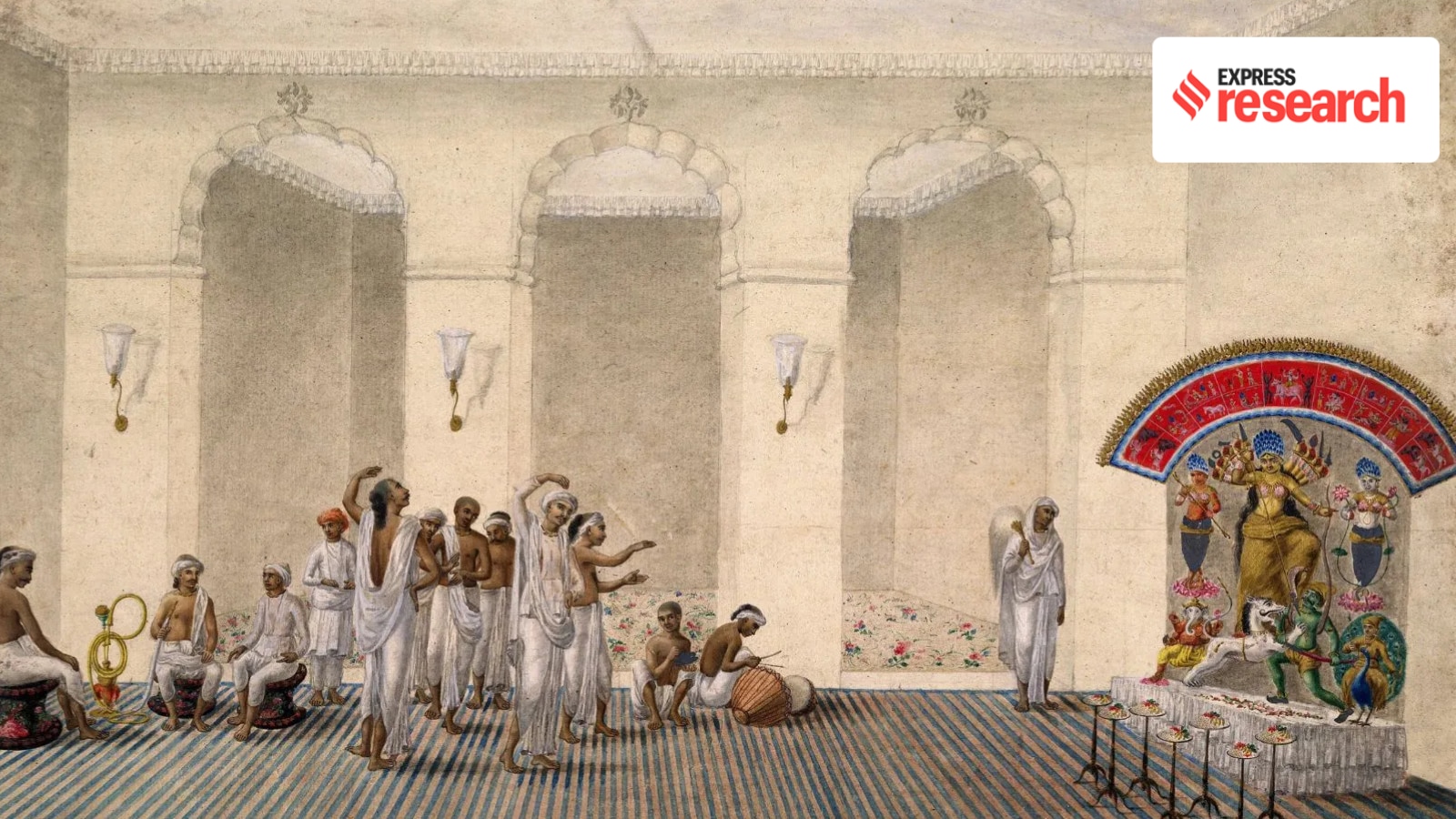
One evening in the village of Guptipara, in Nadia district of West Bengal, a group of Brahmin friends set out to join Durga Puja festivities at the home of a local landlord. What should have been a day of merriment soon turned grim. The men were turned away on the grounds of their low social standing.
Affronted, the twelve friends (or baro yaar) organised a celebration of their own — the Baroiyari Puja. In eighteenth-century Bengal, this act of quiet defiance sparked a social shift that reshaped the religious and ritual landscape of the region.

“The GuptiparaBaroiyari Pujawas a path-breaking event, being in a way instrumental in encouraging ‘public participation’, breaking the shackles of the Goddess confined to the precincts of rich households,” notesProfessor Mrinmoyee DebinThe Making of Goddess Durga in Bengal: Art, Heritage and the Public(2021). No longer would the houses of the ordinary remain dim, nor would the Goddess be the privilege of the elite.
An elite affair
While the exact origins of Durga Puja remain a subject of controversy, it is believed to have begun around the fifteenth century. Historians trace the celebration to the time of the Sultanate, when Raja Ganesh (1400-1421) assumed power from the Sultan of Bengal and proclaimed their association with the goddess by performing rituals and issuing coins bearing symbols associated with Durga. “During the late Sultanate and the initiation of Mughal rule, the alliance of the aspiring rajas of Bengal with the goddess became quite visible,” writes Deb. She argues that historical anecdotes, like that of Raja Ganesh, play a key role in legitimising the early connection between political authority and religious affirmation during the initial phase of Durga Puja in Bengal.
Later in the 18th century, Raja Krishnachandra of Krishnanagar, Nadia, began the worship of the Goddess with great pomp and show. Following his footsteps was Raja Nabakrishna Deb from Calcutta.
Historians argue that the earliest pujas became a platform to celebrate the victory of the British East India Company in the 1757 Battle of Plassey. “Clive… apparently advised both of themto celebrate the victory in a befitting manner,” note academics Samir Kumar Das and Bishnupriya Basak, inThe Making of Goddess Durga, adding, “So thepujawas celebrated in autumn in order to make it coincide with the occasion of victory and as the legend would have it they had spent over a lakh rupees each during those days”.
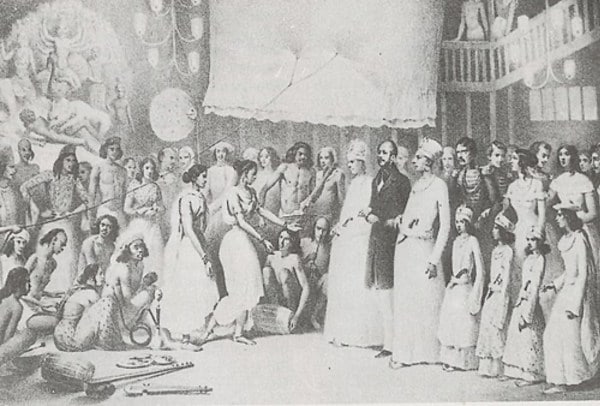 Durga Puja at Shovabazar Rajbari in the presence of Robert Clive (Wikipedia)
In an interview withindianexpress.com, Basak explains, “The political and cultural landscape of Bengal altered irreversibly post the Battle of Plassey, with the British East India Company exerting their suzerain rights over the land. Raja Nabakrishna Deb’s ostentatious celebration following the victory of Lord Clive initiated the first great Durga puja in Calcutta. This signified a political alliance with the Bengal zamindars”.
Story continues below this ad
In the following years, Calcutta was to become the seat of colonial power. The liaison of the landlords (zamindars) with the British helped the former amass a huge amount of wealth. This capital, however, was of little use since colonial policies heavily discriminated against Indian investors. The effect, according to Das and Basak, was that “the landlords were flush with disposable cash which they either had to spend lavishly on non-productive expenditures in the city of Calcutta or buy agricultural land and try their luck in the countryside”. A suitable alternative, discovered by thebabus, was the hosting of grand pujas. “Raja Rammohun Roy is a prototype of the potential Indian investors who had decided to migrate to Calcutta in order to make his fortune as a trader and capitalist,” Das and Basak write.
Some landlords also believed that the hosting of a puja would help strengthen ties with the British. Among them were Abhaycharan Mitra and Ramdulal Dey. Dey was perhaps the first trader to celebrate Durga Puja in 1770, write Das and Basak.
Noteworthy is that not all elite households organising Durga Puja belonged to landlords. “We were gold merchants, not zamindars,” cautions Santanu Mullick, the 8th generation of the iconic Mullick family in Malapara, Calcutta, that has been hosting its Durga Puja for the last 260 years. “Apart from gold, we were traders of salt and cotton fabric and dealt in forex in those days. Naturally, our forefathers were very pally with the East India Company,” says Mullick, adding that while he does not know the minute details of the festivity that took place 200 years ago, there is no doubt that the British had been invited to the pujas.
Story continues below this ad
Durga Puja thus became a medium through which power, status, and cultural dominance were expressed through ritual patronage. As the number of Bengali households hosting such pujas multiplied, Calcutta witnessed an influx of artists and clay modellers from neighbouring Shantipur, Krishnanagar, and Bikrampur in Dhaka (now Bangladesh). The grand celebration came to be denoted asBonedi Bari, or elite household, pujas.“The religious phenomenon of Durga Puja became synonymous with the ostentatious display of private treasures and wealth of theZamindars,” writes Deb.
Das and Basak describe a typicalbonedi barisetup “In thethakurdalans(the places in the house where the idol is made andpujasare held) of the newly rich landlords, traders, merchants and suppliers — better known asbabusandbhadraloks(gentlemen and members of the polite society) — the idol makers were commissioned for generations to give shape to the idols in situ while retaining the unique features of each household as per the instructions of the family elders…”
Twelve friends and a Durga Puja for all
But it was not too long before the affluence would erode, and the association of thebabuswith the British would end. What began as an act of defiance by twelve friends in Guptipara was soon to become a tradition across Bengal.
“The phenomenon of the Baroiyari puja represents a transformative moment in the history of Durga Puja, when it entered the domain of the public space, transcending the restricted premises of the wealthy Bonedi landlords. The point of inception of the Baroiyari is considered to have been a pujo begun by an assembly of twelve (baro) friends (yars) at Guptipara. This was a path-breaking moment, initiating public participation in the puja,” says Basak.
Story continues below this ad
 Goddess Durga (Wikipedia)
The common people of Bengal, long excluded from the grand celebrations held by the elite, gradually found inspiration to organise their own Durga Puja. By the late eighteenth century, the Guptipara Baroiyari Puja had inspired similar celebrations across neighbouring regions such as Chinsurah, Kachrapara, Santipur and Ulo.
Scholars, however, have attributed this shift not only to the influence of the Guptipara Puja but also to broader economic forces at play during the period. They argue that the growing reliance on community funding, particularly with the onset of the Great Depression of 1929, surged. The expenses incurred from hosting a Bonedi Bari Puja were huge and began to burden the aristocratic families. A report by the Bengal Chamber of Commerce, cited by Das and Basak, indicates that the Second World War, alongside the Bengal Famine (1943) and the economic depression, resulted in the disintegration of the old joint families and led to a visible decline in the number of Bonedi Bari Pujas.
The 1947 Partition of India further deteriorated the situation. A 1954 paper published inThe Economic Weekly, cited by Das and Basak, pointed out that a poor economy, floods in north Bengal, and drought in south Bengal together left the masses distraught, “withpujaexpenses being the barometer of the economy”.
Story continues below this ad
 Bengal famine (Wikipedia)
“Generally, the financial capacity, manpower, and time required to organise such grand Pujas have all decreased over time in most elite households,” says Mullick.
Deb notes, “With the initiation of Baroiyari Puja, the populace of Bengal in a way re-affirmed the disposition of Devi Purana that says, this is a ceremony that can be celebrated by Brahmanas, Kshatrias, Vaisyas, Sudras.” The trend had also struck Calcutta. By the nineteenth century, the city had several baroiyari pujas. Shibkrishna Dawn (1837-73) of Jorasanka, a historic neighbourhood in North Calcutta best known for the Tagore house, was among the first to host a Baroiyari Puja. Although a rich man, Dawn is said to have collected ‘subscriptions’ from the upper classes to organise a Puja, Deb notes.
Over the next few decades, theBaroiyari Durga Pujagained extreme popularity in Kolkata. Organised by the public and for the public,Baroiyari Pujas, as scholars note, ‘democratised’ theDevi. Academic Debdutta Gupta, inThe Making of Goddess Durga in Bengal(2021), notes: “The exclusiveBonedicelebrations slowly gave way to a more democratic observance ofDurga Pujain theBaroiyariandSarbojanin pujaformats.” Among such Pujas are the Ahiritolla Sarbojanin Durgotsav (1948), Shyambazar Street Sarbojanin Durgotsav and Hati Bagan Sarbojanin Durgotsav (both 1948), Jorasanko Sadharon Durgotsav (1948), and Deshbandhu Park Club Puja (1948).
“But the Sanskrit wordBaroiyari,” says Das in an interview withindianexpress.com, “doesn’t necessarily mean twelve friends. The Sanskrit word, in fact, denotes that it is ‘a puja for all.’ In Bengali, we call itSarbojanin puja.”
Story continues below this ad
Devi and nationalism
With the onset of the 20th century, Bengal became a hotbed of nationalist fervour. Even puja pandalsturned into spaces of resistance and rebellion against theRaj. “If slight and humiliation played a role in making the transition tobaroiyari pujapossible, the same kind of slight and humiliation suffered by the native Indians in the hands of the colonial authorities were also responsible for the gradual infusion of the ‘nationalist spirit’ in the celebration,” opine Das and Basak in their work.
From the 1940s, Das and Basak note, “a substratum of ‘desperate young men well-endowed with muscle power’ emerged from within the communities of the Hindus and the Muslims who would not be afraid at the sight of the policemen and soldiers…” The ideals of nationalists, such as Bipin Chandra Pal and Aurobindo Ghosh, motivated the youth to participate in various physical activities to strengthen the mind and body.
These pujas also became a platform to promote the Swadeshi Movement. Gupta writes, “TheBaroiyari puja samitieschannelised the patriotic sentiments, also providing the platform to several leaders of the Indian nationalist movement for addressing the public”. TheNebu Bagan Baroiyari Durga Puja, started in 1919, was a fitting example. “Daker Saj[ornaments] was compulsory for the idols here, and theKumartuli[an artisans’ colony in Calcutta] artisans added oriental design in the backdropchali. The oriental design in the chali became the new style established by the clay modellers,” notes Gupta.
In 1926, similarly, the Simla Byaam Samiti organised its Durga Puja. Gupta contextualises that the year was of particular significance due to the notorious policies of the British administration and the ensuing communal riots in Bengal. “The social equilibrium was completely devastated. It was during this time of crisis that SimlaByaam Samitisought to revive and restore the situation through various social and cultural acts,” he notes. The idol was draped in Khadicloth, known as ‘Swadeshi Thakur’.
Story continues below this ad
Another fascinating story was that of the 23 PallyDurgotsav, initiated in 1939. Gupta notes, “Here, theKumartuliidol makers showcased their creative freedom by adorning theMahisasuror the buffalo demon, with a British crown. It symbolised the evil power inherent in British imperialism.”
The Devi, once accessible to the elite alone, had now become a force of resistance and symbol of freedom for the Indian masses. “The emergence of the nation as ‘Mother’ became central to the formulation of the new visual form of Durga, where the Goddess stands triumphant and as a saviour of her children from the stranglehold of colonial rule. Abanindranath Tagore conceived the Bharat Mata, and possibly under this influence, a shift can be visualised in Durga’s representation,” says Basak.
A corporate congregation
Das, in his interview, directed attention to yet another category of puja. Calling it the puja of the new millennium, he said: “It is the Corporate Pujas.” Not restricted to any particular neighbourhood, these pujas span across the city. Basak adds, “Post-independence and partition, the ‘national spirit’ dissipated into a more fragmented, disintegrated para pride that shaped the puja”.
When asked what other than geography differentiated Baroiyari Pujas from corporate ones, Das explained, “The latter is usually a lavish, themed puja, brimming with advertisement billboards, awards and crowds of people”.
Story continues below this ad
Another aspect that makes corporate pujas different from neighbourhoodbaroiyari pujasis the increasing role of political parties. “Party-politics and puja have got increasingly entwined,” laments Basak.
Das concurs: “Parties compete to gain control of the pujas by entering their administrative committees. The greater the pomp and show, the greater the chance of winning votes.”
While agreeing with the mass employment such pujas generate, Das says: “I would say that the distinction between aBonedi Bari PujaandBaroiyari Pujais gone.” He explains that new aristocrats, the corporates, have now taken control of the neighbourhood pujas. “So the voluntary participation of ordinary people, in everypara, for instance, is absent now. You have only a select few who take control over the organisation of the pujas. This is a hierarchy which is absolutely opposed to the very spirit ofBaroiyari Puja.”
Perhaps, Durga Puja celebrations in Bengal have come full circle.
