

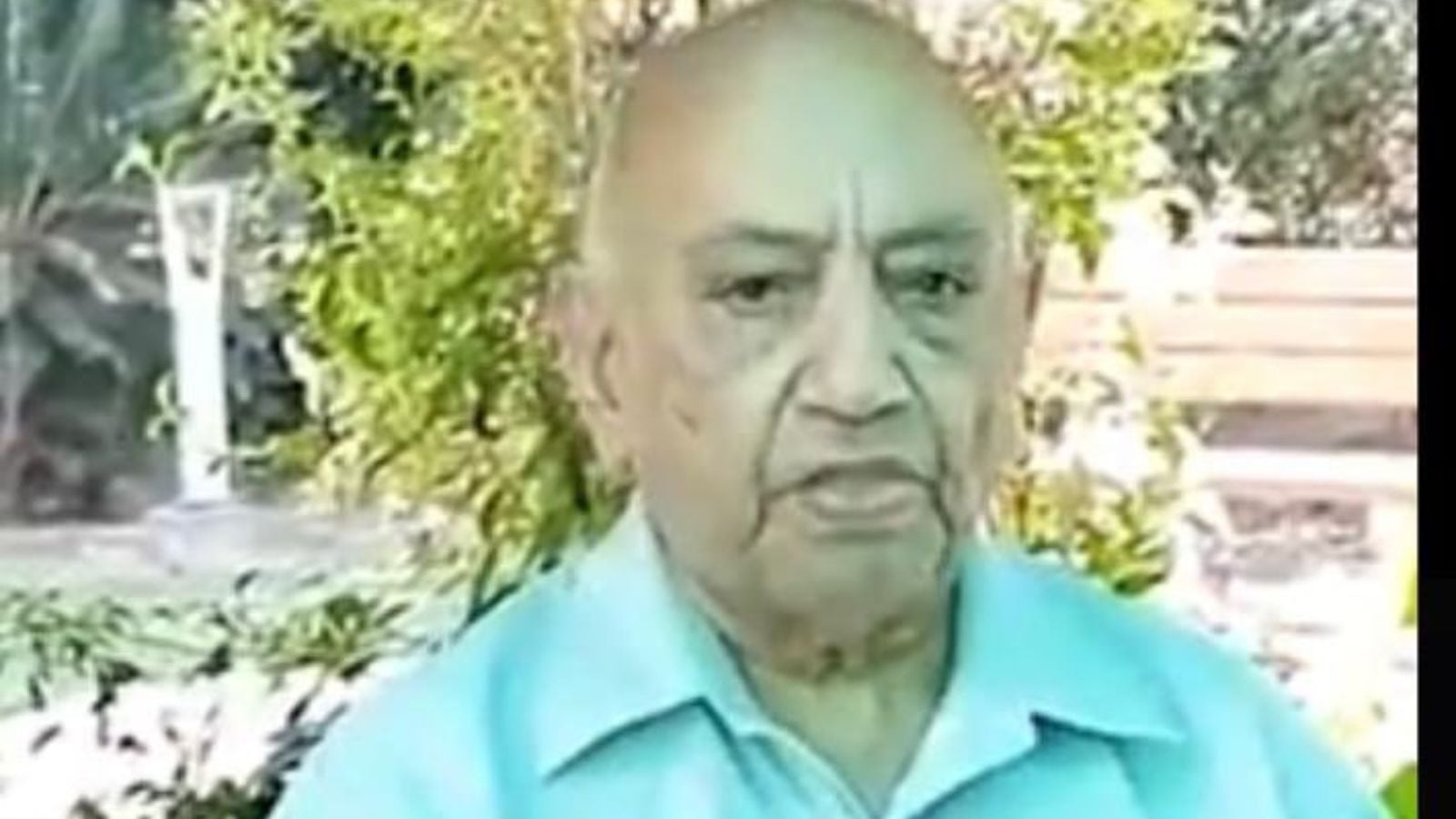
A mentor, a teacher, and a model of clinical excellence — this is how doctors who trained and worked under Padma Shri awardee Dr Jagdev Singh Guleria remember him.
A distinguished physician and cardiologist and former dean of the All India Institute of Medical Sciences (AIIMS), New Delhi, Dr Guleria died at his home in the Capital on January 22. He was 98.

He leaves behind a legacy of clinical brilliance and mentorship, according to his family, friends and former colleagues.
He is survived by his two sons, both doctors — Dr Randeep Guleria, presently the chairman of the Institute of Internal Medicine & Respiratory and Sleep Medicine and Director of Medanta Medical School and former AIIMS director; and Dr Sandeep Guleria, a transplant surgeon.
Dr Anoop Mishra, chairman of the Fortis CDOC Hospital for Diabetes, Delhi, recalls his association with Dr J S Guleria while working at AIIMS and marvels at his precision in diagnosis. “He could listen to half the symptoms and tell you the full diagnosis.”
Dr J S Guleria hailed from a village in Himachal Pradesh, and completed his Doctor of Medicine (MD) from Government Medical College in Amritsar and initially joined the civil medical services in Punjab, a permanent job that offered pension after retirement. But in 1958, when AIIMS was being established in Delhi, he chose to resign and join the institute.
At AIIMS, Dr J S Guleria was part of the first batch of DM cardiology students. At that time, AIIMS didn’t have its own wards, so they treated patients at Safdarjung Hospital. He admitted the first patient in AIIMS in December 1958 and later joined the faculty, eventually becoming the head of the Department of Medicine and then the dean.
Story continues below this ad
Dr S K Sharma, former professor and head of Department of Medicine, AIIMS, joined the institute in 1979 — this was the time when diagnostic imaging was sparsely unavailable. “There was no ultrasound, no CT scan, no MRI. Diagnosis depended on clinical examination. And in that art… Dr Guleria stood at the very top,” he shares.
Dr Sharma recalls Dr Guleria treating former prime minister Indira Gandhi’s cousin. “Dr Guleria entrusted me to look after her. He had such trust in his students… even in moments of high pressure,” he says.
After retiring from AIIMS in 1987, Dr Guleria was persuaded to not go into private practice immediately. Instead, he helped set up the Department of Medicine at University College of Medical Sciences (UCMS) in East Delhi, a completely new building and department. He worked there for several years, establishing the department and mentoring young doctors. Later, he started his private practice at Sitaram Bhartia Institute of Science and Research, where he served patients for over 30 years.
Dr A B Dey, former Head of Geriatric Medicine at AIIMS, also remembers working with Dr Guleria and how he treated the mountaineer Tenzing Norgay.
Story continues below this ad
“Even with such high-profile patients, he treated everyone with the same meticulous attention, clinical skill, and calm presence,” says Dr Dey.
Dr Mishra adds, “He gave advice that didn’t get lost in theory. It was always actionable, and it almost always helped the patient.”
Reflecting on his father’s childhood, Dr Randeep Guleria recollects, “My father came from a small village called Manjara in Himachal Pradesh. There was no electricity in the village until the late 1970s or early ’80s. He used to walk nearly 5 km every day to go to school, sometimes even crossing a river along the way.”
Even in his late 90s, Dr J S Guleria continued to see patients, according to his family, in a testimony of how he continued to do what he loved till he could.
