

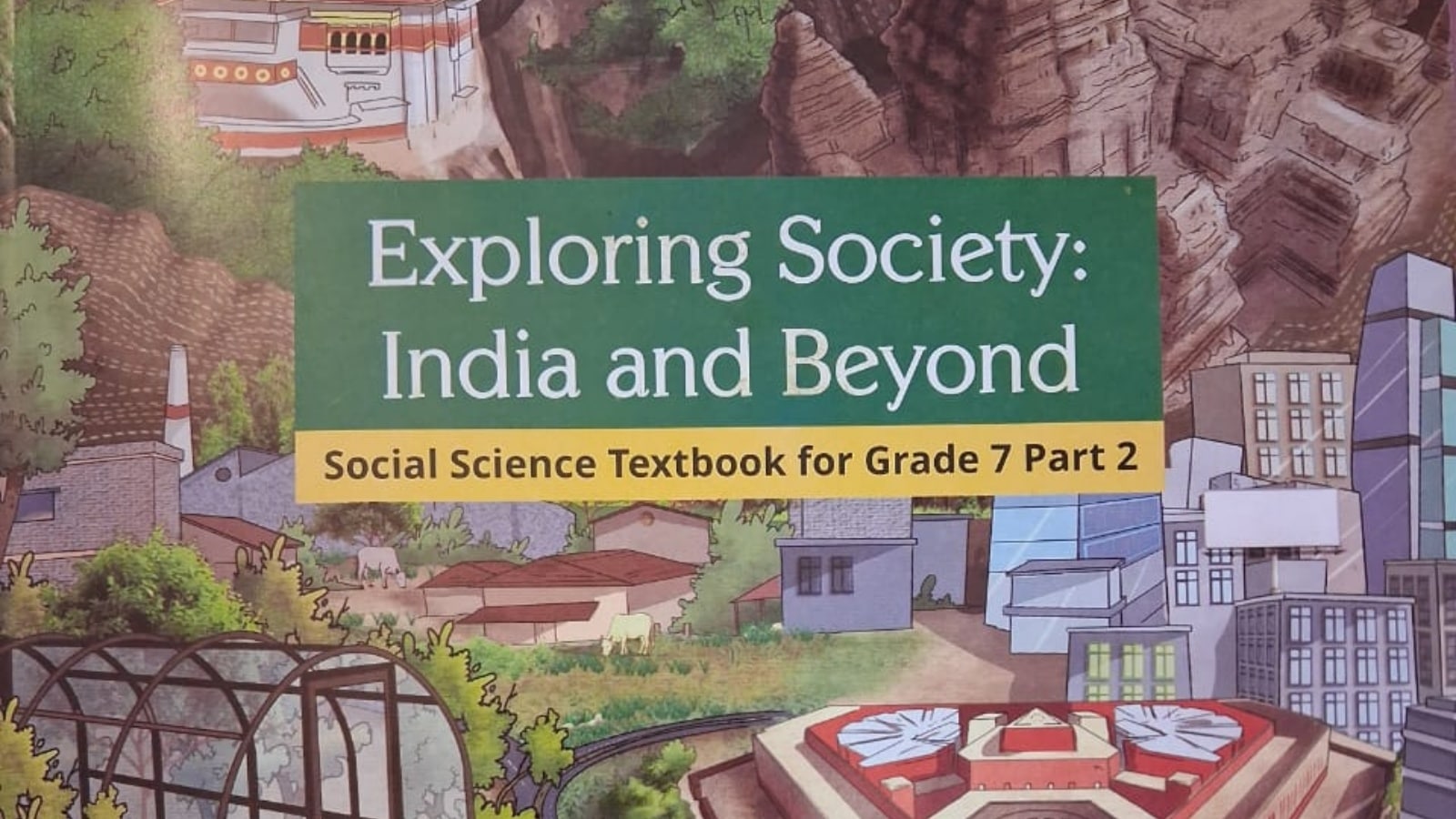
A NEW class 7 NCERT social science textbook released on Friday has a larger section on “Ghaznavid Invasions” — focusing on the Mahmud of Ghazni’s “destruction and plunder” and his eagerness to “spread his version of Islam to non-Muslim parts of the world” — compared to the previous edition.
The section on the Ghaznavid invasions is preceded by a box that contains “a word of caution”. The box is similar to the “note on history’s darker periods”, which was published in the class 8 textbook, placed before the chapter on the Delhi Sultanate. The box in the class 7 textbook refers to this note and states that it explains how history has recorded war, conquest and destruction more than peace, good governance or creativity, and how the world over historians have sometimes hesitated to draw attention to such darker periods.

“Our approach is that it is better to face them and analyse them so as to understand what made such developments possible and, hopefully, help avoid their recurrence in future. In addition, we should not forget that while past events cannot be erased or denied, it would be wrong to hold anyone responsible for them today,” it reads.
The new textbook is meant for use in the ongoing academic session. Part 1 of the textbook was released earlier this year.
The old NCERT class 7 history textbook had a paragraph on the Mahmud of Ghazni. It pointed out that rulers tried to demonstrate their power and resources by building large temples, and chose to target temples which were sometimes extremely rich when they attacked kingdoms. It referred to the Mahmud of Ghazni as having raided the subcontinent 17 times with a religious motive, targeting wealthy temples and taking away their wealth.
‘The Ghaznavid Invasions’ section has about six pages including boxes and pictures. It details Mahmud’s 17 campaigns in India, his plunder of a temple in Mathura, temples in Kannauj and the destruction of the Somanatha Shiva temple in Somnath, Gujarat. It tells students that the existing temple was built in 1950 and inaugurated the next year by the then President of India, Rajendra Prasad, before asking them why they think it was decided to fund the construction entirely from public donations.
The section also describes Mahmud’s campaigns as having involved the “slaughter of tens of thousands of Indian civilians and the capture of numerous prisoners, including children, who were taken to be sold on slave markets of Central Asia”. It adds that his biographers depict him as a powerful but cruel and ruthless general, “keen not only to slaughter or enslave ‘infidels’ (that is, Hindus or Buddhists or Jains), but also to kill believers from rival sects of Islam”.
Story continues below this ad
“But it is also true that Mahmud was keen to spread his version of Islam to non-Muslim parts of the world, as we find from contemporary evidence,” it reads. It quotes Mahmud’s court historian Al-Utbi as having noted that he killed infidels and carried away their children and cattle as booty, mastered several other territories, and “destroyed their temples, their sacred buildings, built mosques instead, making the light of Islam visible”.
It also quotes scholar Al-Biruni as having pointed to the origin of the Shivalinga worshipped at the Somnath temple and recorded that “the image was destroyed by Prince Mahmud. He ordered the upper part to be broken and the remainder to be transported to his residence, Ghazni. [A part of the image] lies before the door of the mosque of Ghazni, on which people rub their feet to clean them from dirt and wet.”
None of these details are in the old textbook.
The chapter – “Turning Tides: 11th and 12th centuries” – then refers to Muhammad Ghuri “who sought territorial conquest”. It points to his general Qutb-ud-din Aibak and Aibak’s army commander Bakhtiyar Khilji who conducted campaigns in eastern India from the end of the 12th century.
“On his way to Bengal, he destroyed large Buddhist monasteries and universities such as Nalanda and Vikramashila, collecting huge booty and slaughtering large numbers of monks. There is a consensus among historians of Buddhism that this destruction of its large centres of learning precipitated the decline of Buddhism in India, although a few other factors may have also played a role,” it adds, before detailing Khilji’s attack on Nalanda, where “the library is said to have burned for months”.
Story continues below this ad
Bakhtiyar Khilji, and the destruction of Nalanda and Vikramashila that the new textbook features, were not a part of the old class 7 history book.
The chapter concludes on the note that large parts of north India and all of south India remained outside of the hold of the Turkic invaders, and that on a few occasions, native rulers came together against them.
Asked for a comment, NCERT Director Dinesh Saklani said that the content is self-explanatory.
The chapter on the Ghaznavid invasions is preceded by one on empires and kingdoms in the 6th to 10th centuries. Covering the rulers of Kannauj, Kashmir, the Chalukyas, the Rashtrakutas, the Pallavas, and the Cholas, it concludes with a section on foreign invasions by the Hunas from Central Asia, and the Arabs.
Story continues below this ad
It points to the arrival of Muhammad bin Qasim who was sent by the governor of Iraq to Sindh. It quotes a 13th century Persian record as saying that bin Qasim considered it his bounden duty to carry out this religious war, in obedience of God who says in the Koran: “Wage war against the infidels”. It refers to the killing of King Dahar, a ruler in Sindh, and contains an explanation of the word “infidel”. “For medieval Islam, infidels were non-Muslims, especially Hindus, Buddhists or Jains,” the book explains.
It, however, states that the Arab conquest of Sindh had limited political and religious impact “compared to their conquests in other regions where Islam often replaced local institutions and led to mass conversions”.
The Arab invasion of Sindh and bin Qasim were not a part of the old class 7 history book.
NCERT has been bringing out new school textbooks in line with the National Education Policy (NEP) 2020 and the National Curriculum Framework for School Education 2023. New books for classes 1 to 8 are available so far. In earlier years, class 7 had three textbooks for social science, with one each for history, social and political life, and geography. With the new books, students in class 7 will use two textbooks, each of which covers all three themes.
Story continues below this ad
The old books were based on the National Curriculum Framework of 2005, and went through a round of rationalization to reduce content load in 2022-23 in the wake of Covid-19.
