

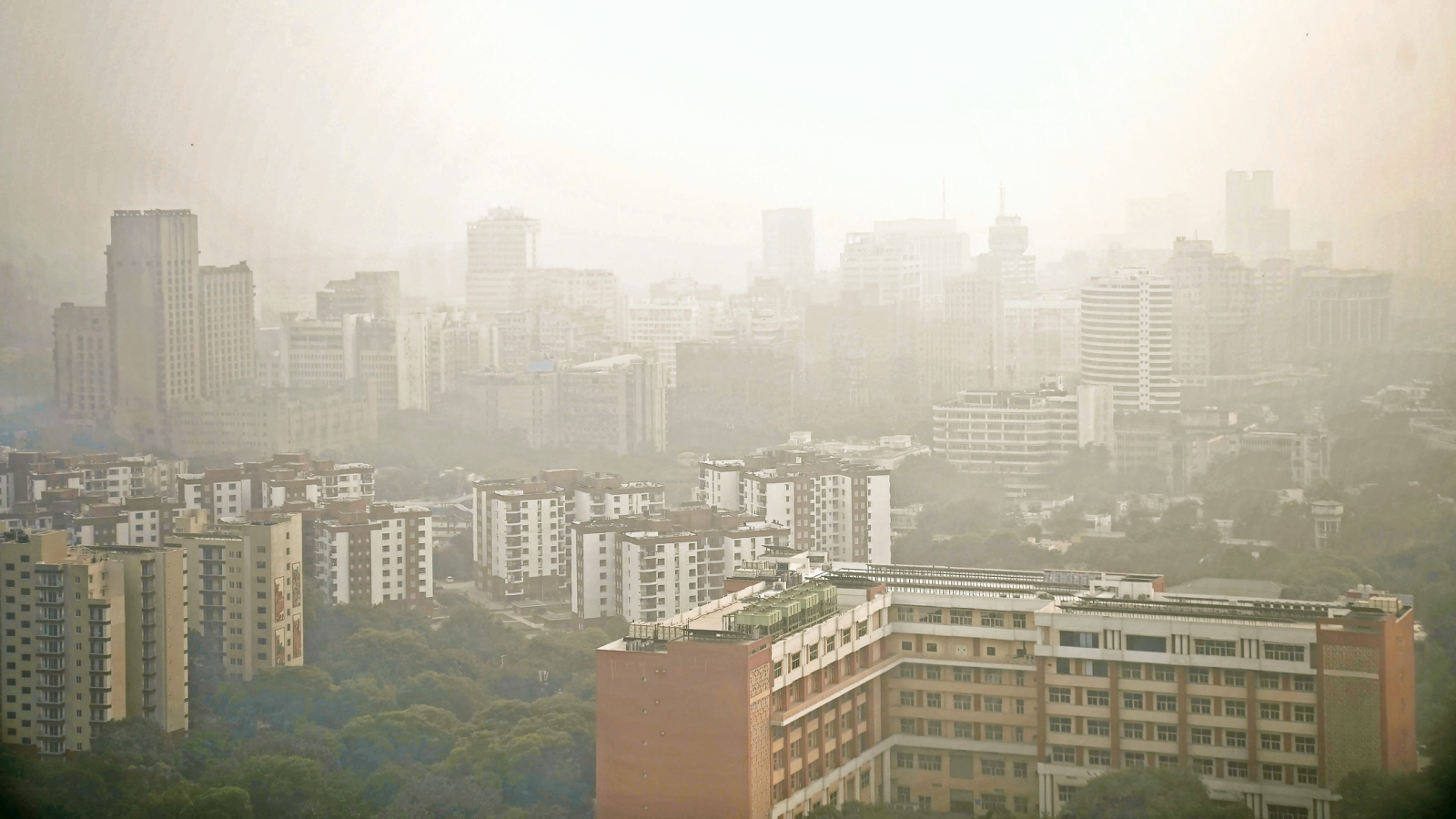
Even as the Centre has said the National Clean Air Programme (NCAP), launched in 2019 by the Ministry of Environment as a flagship initiative to tackle severe air pollution, has helped achieve positive outcomes in over 100 cities, a closer look at the data highlights concerning details.
Delhi has managed only a 16% drop in PM 10 levels against a target of 22%, leaving it trailing behind both its own benchmarks and nearby cities like Noida and Alwar. Nearly one-fifth of the identified 130 ‘non-attainment’ cities, urban areas that consistently fail to meet national air quality standards, have shown zero reduction in pollution levels since 2017.
The data is a part of a submission filed by the Union Environment Ministry on Monday in response to the National Green Tribunal’s (NGT) query on the status of the targets achieved under NCAP and the roadmap after the expiry of the initiative.
Despite the disparities, the Ministry maintained that “…the focused and coordinated actions undertaken by the 130 cities under NCAP have yielded positive outcomes.” It stated that 103 cities have shown some reduction compared to 2017-18 levels. Of these, 25 cities, roughly one in five, have achieved the ambitious target of a 40% reduction, it said.
Overall, 18 cities have met the National Ambient Air Quality Standards (NAAQS) for PM10 levels, keeping annual average concentrations below 60 micrograms per cubic meter. PM 10 refers to coarse airborne inhalable particles, less than 10 microns, that can induce adverse health effects.
However, 27 cities, as per the submission, have shown no reduction at all. These non-performing cities are concentrated primarily in Odisha, Maharashtra, Telangana, Chhattisgarh, Punjab, Andhra Pradesh, Bihar, and Assam.
NCR’s mixed report card
The data presents a stark contrast within the National Capital Region (NCR). While Delhi struggles to curb its coarse particle pollution (PM10), reducing levels from 241 µg/m³ in 2017-18 to 203 µg/m³ in 2024-25, its neighbours have fared significantly better.
Story continues below this ad
Noida has recorded a 35% reduction in PM 10 levels, comfortably exceeding its 30% target. Similarly, Alwar in Rajasthan has surpassed its 20% reduction goal, achieving a 31% drop. However, Khurja in Uttar Pradesh, another NCR city, has managed only an 18% reduction against a steep interim target of 44%.
Cities in Uttar Pradesh, often associated with high pollution loads, have emerged as some of the country’s top performers. Bareilly has recorded the highest gains nationally, slashing PM 10 levels by 77%, much higher than its 26% target. There is no NCR city among the top ten cities with the highest gains.
Other UP cities, including Firozabad (60%), Moradabad (57%), Raebareli (46%), and Jhansi (45%) have also posted improvements. The list of top performers also includes Dehradun in Uttarakhand (57%) and Tuticorin in Tamil Nadu (54%).
Nalgonda in Telangana recorded the worst performance with a 52% shortfall from its target, meaning pollution levels have surged. Jalgaon in Maharashtra missed its target by 49%.
Story continues below this ad
A cluster of industrial cities in Odisha, specifically Angul (-20% reduction), Rourkela (-12%), and Balasore (-11%), have also seen air quality deteriorate significantly compared to the 2017 baseline. Gorakhpur in Uttar Pradesh and Dera Bassi, a city in Punjab, are also among the most underperforming cities with 45% and 37% gap, respectively.
The PM 10 level reductions are met by focusing on emissions from road dust, vehicles, construction activities, open waste burning and industrial operations. The Centre has released funds to the tune of Rs 13,784 crore across 130 cities, including 82 non-attainment cities, under the programme.
