

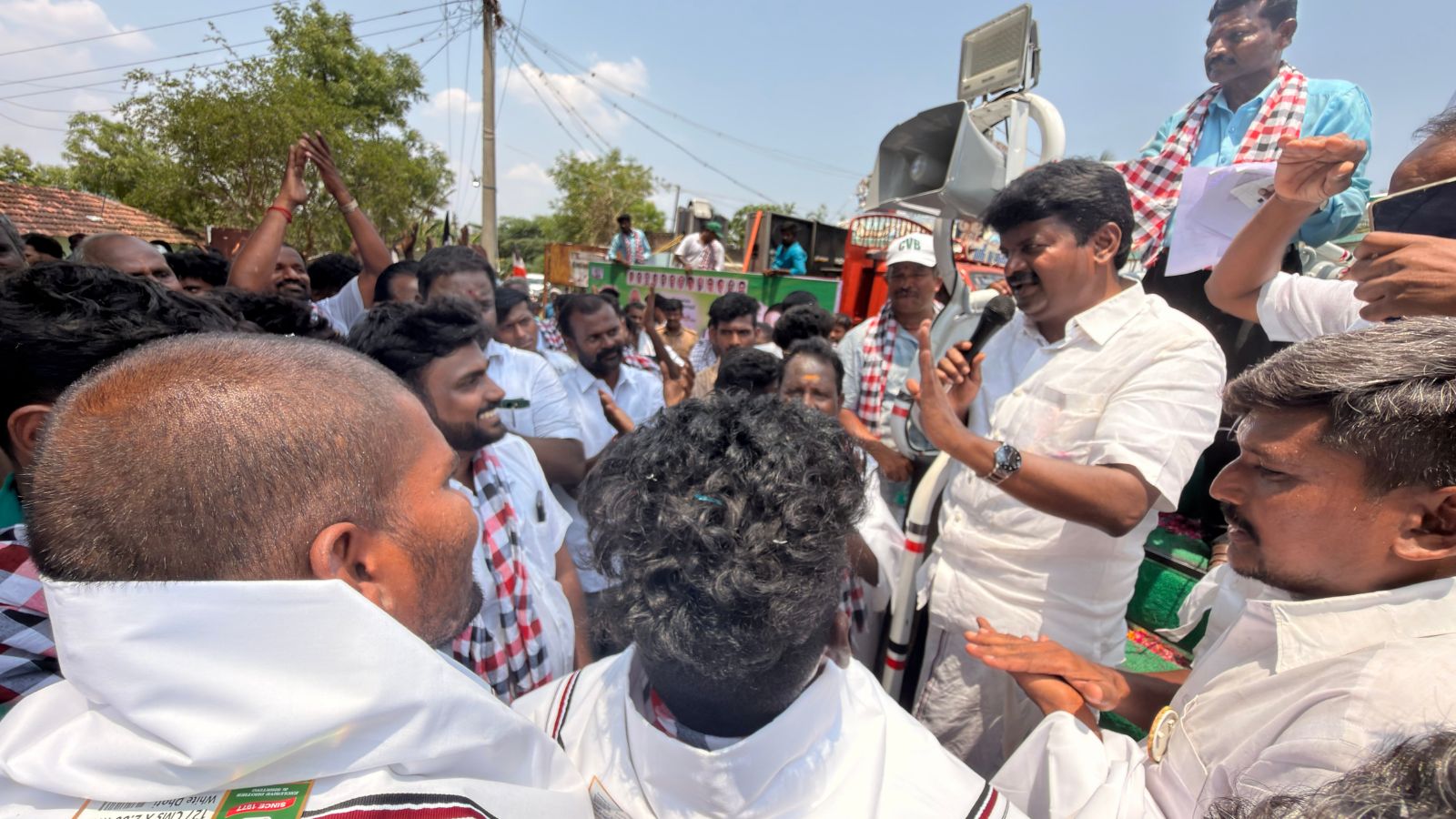
The sun is sharp in Valaipatti. On a dusty stretch, men in white veshtis and women in bright saris gather in a loose circle. Drums beat. A few boys dance, unplanned. At the centre stands C Vijayabaskar – doctor, politician, “our man.” “If you come to this side, it is sunny,” he calls them to the shades of a banyan tree. “Are we doing well under the leaf now?” He asks then. The crowd claps. It is not a response but a recognition for the “leaf” – the Two Leaves symbol of the AIADMK – and for the bond, built slowly, over the years.
He invokes the soil – Valaipatti as “a soil that has always held affection… a soil that has placed its very life upon us”. He invokes lineage, his father Chinnathambi Ayya, and then, more broadly, the emotional geography of loyalty: this is “the fortress of M G Ramachandran and J Jayalalithaa”.

In Tamil Nadu politics, such invocations are not mere nostalgia; they are claims of continuity. And Vijayabaskar, 51, has built his career on precisely that – continuity, proximity, and an almost studied ordinariness.
He has won Viralimalai three times — 2011, 2016, 2021 — and is now seeking a fourth term. He was also among the AIADMK ministers who came under scrutiny after Jayalalithaa’s death, facing Income Tax raids over alleged disproportionate assets. But even his opponents concede a point that has become something of a cliché in the district: he might win even if his party loses. “It is a constant journey with people,” he says later, seated in his SUV, on his way to visit a town secretary who suffered a cardiac arrest an hour ago. “Being there with them, literally. What do they like, I like. Whatever I like, people also like.” He pauses. “I like Jallikkattu, they like it.. I like kabbadi, people like kabbadi. Like they all like cricket, I like cricket. I like them, they like me.”
A statement that might sound simple but, in his telling, carries a kind of philosophy: “See! Being a very ordinary person is important I think.” In a state where politics often oscillates between charisma and calculation, Vijayabaskar presents himself as something else – a practitioner of presence. He speaks of late nights, of cycling through villages, of attending “all functions,” of being known not as an idea but as a habit. “There is no designed strategy or social media teams. We should manage people, not the media,” he says.
When asked why people should vote for him, he turns not to sentiment but to infrastructure. “For the development,” he says, and begins listing with the precision of someone who has repeated this inventory often. “This bypass road we are travelling on — I brought it. I brought the medical college in Pudukottai. A second dental college. The government agricultural college and IT college. All town panchayats have bus stands. All primary, high schools have been upgraded. Basic amenities.”
Then, almost as a summary line: “Rs 700-crore worth Cauvery drinking scheme I brought for the entire district. People know it.”
Development is not an abstraction but an accumulation of visible interventions. It is also, he suggests, the product of relationships, both political and personal. “If the animal husbandry minister is my friend, I will get an animal husbandry hospital here. If the highways minister is my friend, I should get four bridges from him,” he says. “Making use of everything, from party strength to personal friendship, for the constituency.”
This, he believes, is what turns a politician into something more durable: “My first priority is to fulfil all their needs.” The needs in a place like Viralimalai near Pudukottai, as he describes them, begin early in the day and rarely end. “The day starts with problems, demands, complaints,” he says. A temple festival donation. A request for medical help. A young athlete seeking support. Here, the doctor returns. “Because I have a lot of doctor friends, I will do the first consultation,” he says. “If there is no money at all, I will get them admitted to the right place… I will get them the best care.”
Vijayabaskar says politics is a series of small interventions – a chain of responses that, over time, builds a reputation less for ideology than for availability.
Welfare schemes, he says, are only as good as their monitoring. “Your job is not done with the announcement and rolling out a scheme,” he says. “You need to keep on monitoring it as there is always a chance of leakage. That is the major challenge.” It is a technocratic answer, almost administrative in tone, but it reflects the decade he spent as Health Minister under Jayalalithaa and Edappadi K Paklaniswami — years that, he argues, reshaped the state’s medical infrastructure.
“In the last five years of DMK, there has not been a single medical college in the state. I brought three medical colleges in this Pudukottai region alone,” he says. “Tamil Nadu has the highest number of medical colleges in India now.”
Still, the shadow of 2016 and the death of Jayalalithaa lingers. For many in the AIADMK, it marked not just a political rupture but a personal one. “Madam’s death is a great loss,” he says. “If madam was alive, there wouldn’t have been a split in the party… She gave me the opportunity to contest at the age of 26.”
He describes her not just as a leader but as a familial presence: “She solemnised my wedding, both my daughters were named by her. It is a loss in the family.”
In that loss lies the question of succession, of vacuum and, inevitably, of new entrants like Vijay. Here, Vijayabaskar’s assessment is measured, but firm.
“I am not denying that people have an affinity towards cinema,” he says. “But converting that into politics and sustaining it is tough.” Then, with a metaphor that folds generational difference into political continuity: “I like Ilayarajaa songs. My daughter likes Anirudh Ravichander songs. But both of us vote for ‘Two Leaves’. I like rice, my daughter likes pasta. But both of us will vote for ‘Two Leaves’.”
For him, cinema may shape imagination, but politics, he insists, is slower, rooted, almost organic. “Nobody can grow at rocket speed. It is like a growing plant,” he says. He does not dismiss Vijay entirely: “I would say that he is not a game changer but a game spoiler.” If that sounds dismissive, it is also revealing. For Vijayabaskar, politics is not an event but a condition – something that must be lived, repeatedly, in public.
“A party like AIADMK, it is there everywhere,” he says. “Even a village beyond the mud road also will have an AIADMK flag.” Outside, a dozen women of different ages stand by the road in a quiet village. The car slows. He lifts his hand to wave, but they are not there for that. They want to speak. He stops. He talks to them, one by one, calling each by name. He listens. He answers. There is no hurry in him. The sun is hard. This is how he works. Not as an idea placed on people, but as someone who lives among them, shaped by them, answerable to them. Or, as he says, plain and easy: “I like them, they like me.”
