

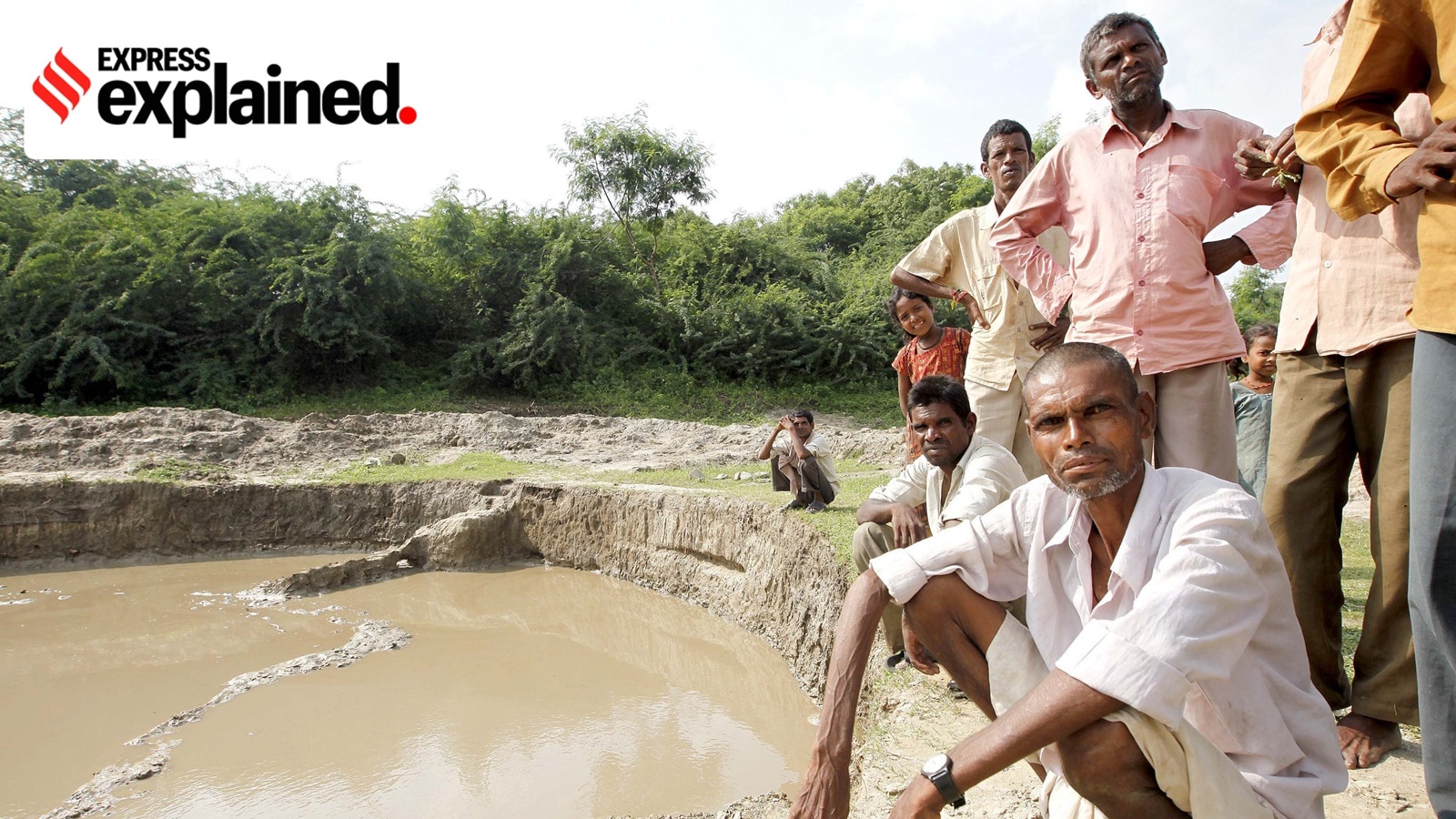
The Centre has amended Schedule-I of the Mahatma Gandhi National Rural Employment Guarantee Act (MG-NREGA), 2005, so that a minimum amount is spent on water conservation and harvesting works in rural blocks or subdivisions. The Ministry of Rural Development (MoRD) issued a notification to that effect on September 23.

What is the Schedule-I of the MG-NREGA?
As per the MG-NREGA provisions, every state government shall introduce a scheme to provide at least 100 days of guaranteed employment in a financial year to every rural household, based on demand.
The scheme’s minimum features are specified in Schedule-I of the Act, as well as a list of permissible public works that can be undertaken to provide work. While any amendment to the Act requires parliamentary approval, the government can make changes in the schedule through a notification. To date, the schedule has been amended about two dozen times.
What is the latest change?
The MoRD issued a notification to add a new proviso after sub-paragraph (2) under Paragraph 4. Sub-paragraph (2) states that the “order of priority of works” shall be determined by each Gram Panchayat in the Gram Sabha meetings, keeping in view the potential of the local area, its needs, and resources. Gram Sabhas are the local assemblies comprising all adults in a rural area.
“The District Programme Coordinator shall ensure that at least 60% of the works to be taken up in a district in terms of cost shall be for creation of productive assets directly linked to agriculture and allied activities through development of land, water and trees,” reads the proviso added by the NDA government in July 2024.
The Centre has now specified the proportion of money to be spent on water-related works. While the existing provision mandated spending on agriculture and allied activities assets at the district level, the new norms have specified minimum spending at the block level, based on their stage of groundwater extraction — “Over-exploited”, “Critical”, “Semi-critical” and “Safe”.
Story continues below this ad
According to the new norms, in rural blocks categorised as “over-exploited” and “critical” by the Central Ground Water Board (CGWB), a minimum of 65% of the MG-NREGS works (in terms of cost) shall be taken up for water conservation, water harvesting and other water-related works. For the “Semi-critical” and “safe” blocks, the minimum proportion has been fixed at 40% and 30%, respectively.
“Provided further that the assessment units (Blocks) classified as ‘Over-exploited’, ‘Critical’, ‘Semi-critical’ and ‘Safe’ in the available Dynamic Ground Water Resources Assessment Report, by the Central Ground Water Board (CGWB), shall be treated as priority areas for intervention,” the proviso states.
How are the blocks categorised?
The CGWB, under the Ministry of Jal Shakti, classifies blocks into four categories. ‘Over-exploited’ blocks are where the stage of groundwater extraction is over 100%, meaning that more groundwater is being drawn there than is being replenished.
Blocks with groundwater extraction between 90-100% are categorised as ‘critical’, those between 70% and 90% are classified as ‘semi-critical’, while the ‘safe’ blocks are those having the stage of groundwater extraction equal to or less than 70%.
Why has the ministry taken this decision?
Story continues below this ad
According to Union Rural Development Minister Shivraj Singh Chouhan, his ministry took the decision after Prime Minister Narendra Modi expressed his “expectations” in this regard.
“The Prime Minister expressed his expectation at the Council of Ministers meeting that we should spend a certain amount on water under MNREGA. Therefore, today, the Ministry of Rural Development has made a new provision for water conservation… a minimum expenditure on water-related works has been mandated,” Chouhan said, addressing an event on Thursday.
The overall allocation of the MG-NREG Scheme for the financial year 2025-26 is Rs 86,000 crore. How much of this amount will be available for water-related works is unclear. However, Union Jal Shakti Minister CR Patil said that the new norms will make available about Rs 35,000 crore for water-related works under the MG-NREGS.
Which states are expected to benefit most?
As per the CGWB’s National Compilation on Dynamic Ground Water Resources of India, 2024, of the total 6,746 blocks in the country, 751 (11.13%) were were assessed as ‘Over-exploited’, 206 blocks (3.05%) as ‘Critical’, 711 blocks (10.54%) as ‘Semi-critical’, and 4,951 blocks (73.39%) as ‘Safe’ in 2024. The remaining 127 blocks were assessed as having salinity.
Story continues below this ad
According to the new norms, the maximum proportion of amount has been fixed for ‘over-exploited’ blocks across 17 states and Union Territories. Most are in Rajasthan (214), Punjab (115), Tamil Nadu (106), Haryana (88) and Uttar Pradesh (59). The ‘Critical’ blocks are also concentrated in these states. So, these states will tap more funds for water-related works under the new norms.
