

6 min readNew DelhiUpdated: Mar 20, 2026 10:21 AM IST
Andhra Pradesh High Court news: Highlighting that even on the assumption that the wife is committing “adultery”, the husband cannot seek the DNA testing of the children, the Andhra Pradesh High Court dismissed the husband’s plea to subject his children to DNA testing to prove his wife’s alleged adultery.
While dealing with a plea of a husband, Justice Tarlada Rajasekhar Rao upheld a trial court’s decision to deny a DNA test plea filed during divorce proceedings.

“Even assuming that the wife is committing adultery, the petitioner cannot file an application to send the children for DNA testing, particularly when the children are not claiming any maintenance from the father and the adulterer, and the children are not parties to the lis,” the court observed on March 12.
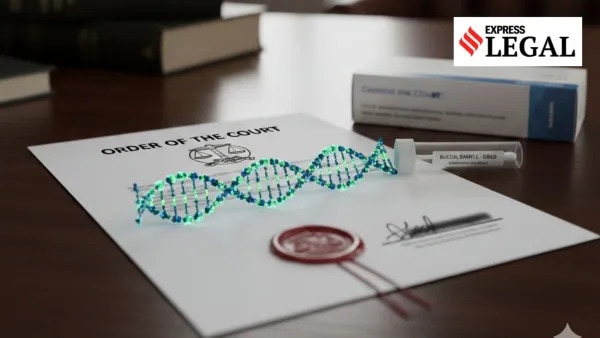
 Justice Tarlada Rajasekhar Rao said that to prove that his wife is in adultery, the petitioner has to adduce evidence in any other manner to that extent. (Image enhanced using AI)
Noting that to prove that his wife is in adultery, the petitioner has to adduce evidence in any other manner to that extent, the court said that for the purpose of proving the wife is adulterous, the petitioner cannot seek a DNA test of his children.
Case of separation
- The matter arose from a revision plea filed by a 59-year-old husband seeking to set aside an order by the senior civil judge at Vizianagaram.
- The petitioner had originally filed for divorce under Section 13(1)(ib) (desertion) of the Hindu Marriage Act, 1955, citing a continuous two-year period of desertion by his wife.
- During the proceedings, the husband filed an interlocutory application under Section 45 of the Indian Evidence Act, requesting DNA fingerprinting for two children to prove they were not born out of wedlock.
- The senior civil judge at Vizianagaram dismissed the plea in July 2024, prompting the husband to approach the high court.
- Appearing for the petitioner, advocate M M M Krishna Sanapala submitted that a DNA test was a “critical piece of evidence” and that his right to a fair trial necessitated the discovery of the truth regarding paternity.
- Wife’s counsel relied on the judgment of the Supreme Court in the case of R Rajendran v Kamar Nisha and others for the proposition that the use of a DNA test is an extremely delicate and sensitive aspect.
Right to privacy v right to fair trial
- The original application is filed to grant a divorce on the ground of desertion under Section 13(1)(ib) of the Hindu Marriage Act.
- The apex court also in the case of Goutam Kundu V State of West Bengal and another held that the courts should not order blood tests as a matter of course and the presumption under Section 112 of the Evidence Act that a child born during a valid marriage is legitimate is very strong and the court emphasised that ordering blood tests without strong reasons may harm the child’s reputation and social status.
- As the Supreme Court has categorically held that, unless a strong presumption under the Evidence Act, the child born during a valid marriage should not order blood test as a matter of course.
- The contention raised before the apex court was to find out the truth, and that every party to a litigation is entitled to produce the best evidence.
- Enabling the party to produce the best evidence is part and parcel of the right to a fair trial.
The refusal to subject the child to a DNA test would infringe upon the respondent’s right to a fair trial. - In support of the contention that the right to privacy of an individual must yield to the right to fair trial of another, reliance is placed upon the decision of this apex court in Sahara India Real Estate Corporation Limited and others V Securities and Exchange Board of India and another.
- The petitioner herein filed an application under Section 45 of the Indian Evidence Act to conduct a deoxyribonucleic acid test (DNA) of children to prove that his wife is adulterating.
Other court ruling
- The Madhya Pradesh High Court, in January, upheld a family court’s decision allowing the DNA test of a child in a divorce proceeding where the husband had alleged adultery.
- The order said that the divorce petition has been filed on the ground of adultery, and it is not the case where the husband wants to know the paternity of the child, or he wants to repudiate the liability to maintain the child, or for any other purpose.
- The court underlined that the child’s DNA test was sought only to prove the allegation of adultery against the wife.
- In this case, the petitioner was the wife who filed the plea against the family court order that had allowed the husband to conduct a DNA test to determine whether the child born to the estranged couple was the biological child of the man or not.
- In February, the Rajasthan High Courthas ordered aDNA testto determine maternity in connection with a property dispute after a 93-year-old woman denied that the plaintiff was her daughter.
- The court said that when a female counterpart is not disputing hermarriagewith a male, but she is denying the fact that a child is not her own, then it is not a case of testing thepaternity, but rather a case to decide thematernity of the child.
- The order stated that this court is astonished by the fact that a motherdenying a child to be hers is a “rarest of rare” case.


© IE Online Media Services Pvt Ltd
