

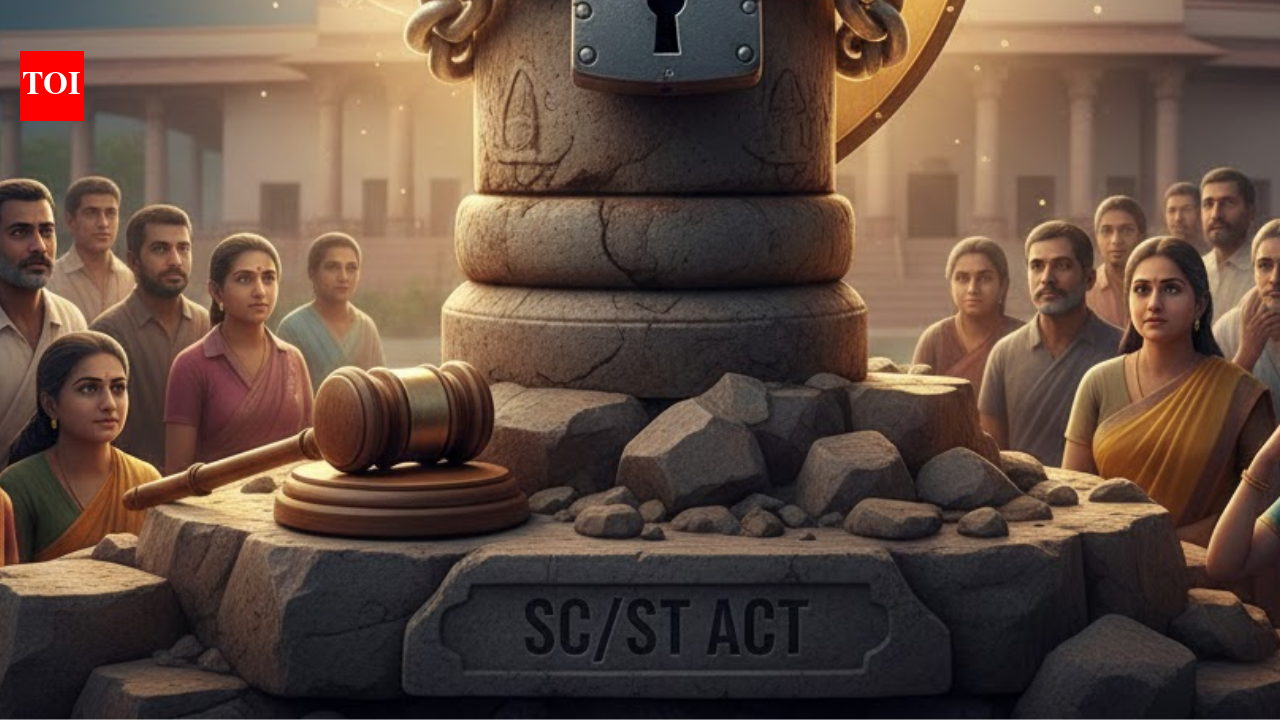

The Allahabad high court has ruled that a person’s caste, assigned at birth, does not change even if they convert to another religion or marry into a different community.The court made the observation while dismissing an appeal challenging an Aligarh special court’s order summoning nine accused to face trial under the Scheduled Castes and Scheduled Tribes (Prevention of Atrocities) Act.The case stems from a criminal complaint filed by a woman in an Aligarh SC/ST court, in which she alleged that the accused assaulted her and used casteist slurs during a dispute.After the special judge summoned all nine accused for offences under the SC/ST Act, they approached the Allahabad high court, arguing that the complainant could not invoke the act as she had married a man from a different caste. The appellants contended that her Scheduled Caste status had ceased to exist following her inter-caste marriage.Rejecting the argument, the judge held that marriage does not alter a person’s caste identity. The court noted that while a person may change religion, caste remains unchanged despite conversion or marriage.The judgment was delivered by Justice Anil Kumar-X in Criminal Appeal No. 6081 of 2022, arising from proceedings before the Special Judge, SC/ST Act, Aligarh.Background of the caseThe appeal was filed under Section 14-A(1) of the SC/ST Act against an order dated July 27, 2022, passed by the Special Judge, SC/ST Act, Aligarh . The appellants, Dinesh and eight others, were summoned to face trial in Complaint Case No. 02 of 2022. The charges included offences under Sections 323 (voluntarily causing hurt), 506 (criminal intimidation), 452 (house-trespass after preparation for hurt, assault or wrongful restraint), and 354 (assault or criminal force to woman with intent to outrage her modesty) of the Indian Penal Code, along with Section 3(1)(R) of the SC/ST Act .The complaint alleged that the informant was assaulted and abused by the appellants, and that casteist slurs were used during the altercation. The complainant and two others reportedly sustained injuries .The appellants’ argumentsCounsel for the appellants advanced two primary arguments before the High Court.First, they contended that the complaint was a retaliatory measure. According to them, an earlier First Information Report (FIR) had been lodged by the appellants against the informant and her family members in Case Crime No. 442 of 2021 under Sections 147, 323, 308, 504, and 506 of the IPC at Police Station Khair, District Aligarh . This FIR was filed on September 7, 2021, and the appellants claimed that members of their family had also sustained injuries, with injury reports on record . They argued that the present complaint was filed as a “counterblast” to this earlier FIR.Second, the appellants challenged the applicability of the SC/ST Act itself. They asserted that the informant was originally a resident of West Bengal and belonged to the SC/ST community there. However, she had married a person belonging to the Jat community. According to the appellants, by marrying outside her caste, she had lost her original caste status and could no longer claim protection under the SC/ST Act .They argued that a woman, upon marrying a man from another caste, adopts the caste of her husband and thereby loses the caste she held by birth. On this basis, they claimed that the summoning order for offences under the SC/ST Act was legally unsustainable .The state’s responseThe State, represented by the learned Additional Government Advocate, and counsel for the informant opposed the appeal. They submitted that the alleged incidents described in the complaint and the earlier FIR occurred on the same date and were essentially part of a single episode .The informant’s complaint alleged that she was assaulted and subjected to caste-based abuse during the altercation. The fact that three individuals, including the informant, were injured in the incident was also placed before the Court . In light of these circumstances, the State argued that the mere existence of a cross-case did not render the complaint false or malicious.Accordingly, the respondents maintained that the appeal lacked merit and deserved dismissal .The high court’s analysisAfter hearing both sides and perusing the material on record, the High Court addressed the two central issues: the effect of a cross-case and the question of caste identity after marriage.Cross-case and rival versionsThe court observed that the Trial Court had summoned the appellants after considering the statements of the informant and her witnesses, as well as the injury reports . The High Court held that the existence of a cross-case does not, by itself, justify discarding a complaint filed by the opposite party on a rival version of events .In criminal law, cross-cases arising from the same incident are not uncommon. They often reflect competing narratives of a single altercation. The Court emphasized that such circumstances must be evaluated through trial, not dismissed at the threshold merely because a counter-complaint exists.Therefore, the high court found no illegality in the trial court’s decision to summon the appellants for the alleged offences .Marriage and caste identityOn the second issue—the alleged loss of caste upon marriage—the Court delivered a clear and categorical ruling. It rejected the appellants’ contention as having “no force” .The Court reasoned that although a person may change religion, caste remains the same despite conversion to another religion . By extension, marriage does not change a person’s caste. Thus, the argument that the informant had lost her SC/ST status by marrying a man from the Jat community was legally untenable.This interpretation underscores a fundamental principle: caste, as understood in Indian law, is determined by birth and does not automatically shift due to marriage. Consequently, the informant retained her caste identity for the purposes of invoking protections under the SC/ST Act.Legal significanceThe ruling reinforces two important principles in criminal and constitutional jurisprudence.First, it affirms that courts must not prematurely reject complaints simply because they are filed in the context of cross-litigation. Where there are rival versions of an incident, it is the function of the trial process to evaluate evidence and determine credibility.Second, and more significantly, the judgment clarifies the legal position regarding caste identity after marriage. By holding that marriage does not alter caste status, the Court ensures that protections under the SC/ST Act cannot be circumvented by invoking marital status.The SC/ST Act is designed to prevent atrocities and caste-based discrimination against members of Scheduled Castes and Scheduled Tribes. Allowing caste identity to be nullified by marriage could create a loophole, undermining the protective framework of the statute.The final orderHaving found no merit in the appellants’ arguments, the High Court dismissed the appeal . The summoning order passed by the Special Judge, SC/ST Act, Aligarh, therefore remains in force, and the appellants will face trial on the charges framed against them.The judgment was delivered on February 10, 2026 .The high court’s decision provides a clear affirmation of two doctrinal points: the independence of cross-cases in criminal proceedings and the continuity of caste identity despite inter-caste marriage.For graduate students studying constitutional law, criminal procedure, or social justice legislation, the ruling offers a concise but instructive example of how courts interpret protective statutes such as the SC/ST Act. It illustrates the judiciary’s role in balancing procedural fairness with the enforcement of anti-discrimination laws.By rejecting the argument that caste can be extinguished through marriage, the Court has reinforced the statutory protections available to historically marginalized communities, ensuring that legal safeguards remain tied to birth-based identity rather than marital affiliation.
Key takeaways
Marriage does not change caste identityThe Court clearly held that a woman does not lose her caste status upon marrying a person from another caste. Caste, for legal purposes, is determined by birth and does not automatically shift due to marriage.SC/ST Act protections continue after inter-caste marriageBecause caste identity remains intact, individuals from Scheduled Castes or Scheduled Tribes retain protection under the SC/ST (Prevention of Atrocities) Act even if they marry outside their caste.Cross-cases do not nullify complaintsThe existence of a prior FIR or cross-case does not invalidate a subsequent complaint based on a rival version of the same incident. Courts must assess both cases on their own merits during trial.Summoning orders require prima facie satisfaction, not final proofThe High Court upheld the Trial Court’s summoning order, emphasizing that at the preliminary stage, courts only need to be satisfied that there is sufficient material (such as statements and injury reports) to proceed to trial.Protective legislation cannot be circumvented by technical argumentsThe judgment reinforces that the purpose of the SC/ST Act—to prevent caste-based abuse and discrimination—cannot be defeated by arguments that attempt to redefine caste identity through marital status.
Why this matters
Clarifies the legal status of caste after marriageThe ruling settles a recurring legal question: whether inter-caste marriage alters caste identity for the purposes of statutory protections. By affirming that caste is determined by birth and does not change upon marriage, the Court provides doctrinal clarity that prevents ambiguity in future litigation under the SC/ST Act.Strengthens the integrity of the SC/ST ActThe Scheduled Castes and Scheduled Tribes (Prevention of Atrocities) Act is designed as a protective statute addressing historical discrimination and caste-based violence. If caste identity could be altered or “lost” through marriage, it would create a loophole capable of weakening the Act’s enforcement. The judgment closes that interpretive gap.Prevents strategic dilution of atrocity chargesThe decision signals that accused persons cannot avoid prosecution under the SC/ST Act by arguing that a complainant’s marital status negates her caste identity. This reduces the possibility of technical defenses being used to bypass substantive allegations of caste-based abuse.Reaffirms trial as the proper forum for rival narrativesBy holding that the existence of a cross-case does not automatically invalidate a complaint, the Court underscores a core principle of criminal procedure: factual disputes must be tested at trial. This reinforces procedural fairness and discourages premature dismissal of complaints.Implications for gender and social identityThe ruling carries broader sociological implications. It implicitly rejects the notion that a woman’s identity is subsumed by her husband’s caste upon marriage. In doing so, it aligns with constitutional values of individual identity and equality, rather than patriarchal assumptions embedded in customary practices.Academic and policy relevanceFor graduate students studying constitutional law, criminal law, or social justice policy, the case offers a compact illustration of how courts interpret identity-based protections within a statutory framework. It demonstrates how judicial reasoning can shape the operational scope of anti-discrimination legislation without expanding beyond the statute’s text.
