

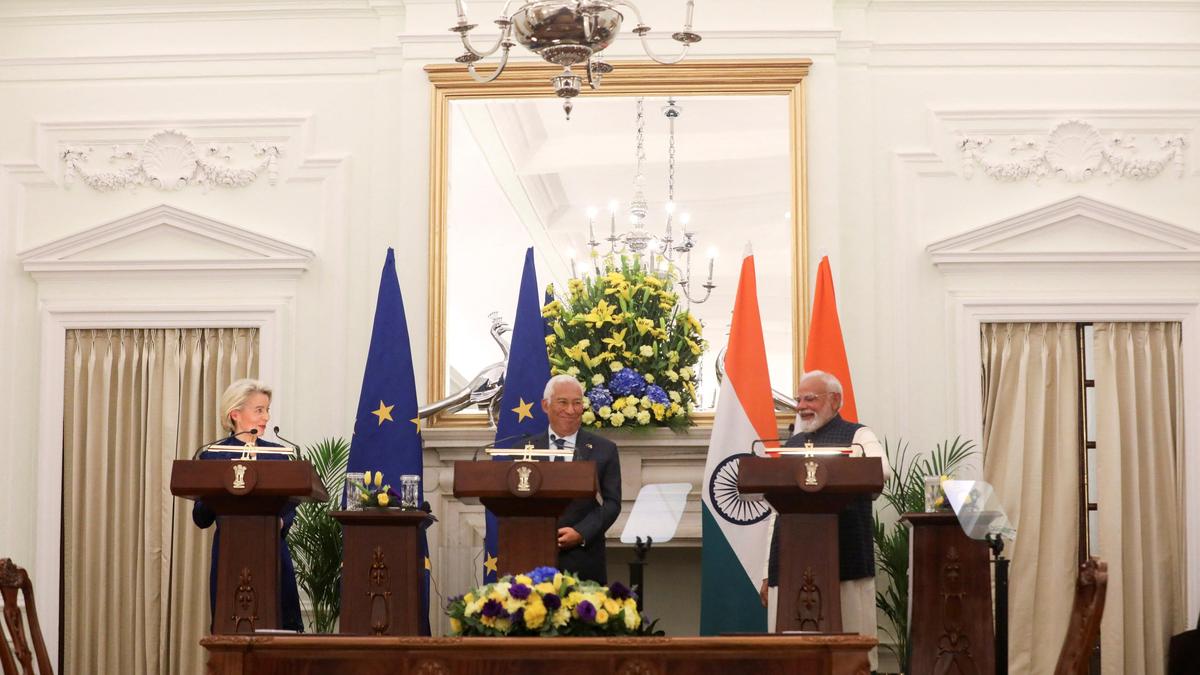
The free trade agreement (FTA) between India and the European Union (EU) has been termed “mother of all deals”.
According to a Commerce Ministry official, this is one of the largest bilateral trade deals that has happened across the world.
The China-ASEAN trade deal is also amongst the largest, but ASEAN is a grouping of 10 different countries (Southeast Asian nations). They are not a customs union like the EU.
ASEAN members are Brunei, Cambodia, Indonesia, Laos, Malaysia, Myanmar, the Philippines, Singapore, Thailand, and Vietnam. India also has a free trade agreement in goods with this grouping.
“So it’s a huge deal in that sense,” the official said.
The talks for the pact were concluded on Friday (January 23), and it was approved by the Union Cabinet on Saturday (January 24).
The scale of the pact is reflected in the following numbers:
The deal touches approximately 1.9 billion people (1.4 billion in India and about 500 million in the EU).
India and the EU account for 25% of the global economy.
They make up 30% of the world’s population.
The EU’s total imports of goods are $6.9 trillion in 2024. The EU’s services imports were $2.9 trillion.
India’s total goods imports were around $750 billion in 2024.
Together, they account for 11 to 12% of global trade.
Out of the total global trade of $33 trillion, India and the EU account for $11 trillion.
Bilateral trade
It is a cornerstone of the India-EU relationship, with total trade surpassing $190 billion in FY 2025. India exported $75.85 billion in goods and $30 billion in services to the EU, while the EU exported $60.68 billion in goods and $23 billion in services to India.
India has a trade surplus of $15.17 billion in 2024-25.

The EU market accounts for about 17% of India’s total exports, and the bloc’s exports to India constitute 9% of its total overseas shipments.
The 27-nation bloc is a major global trade player, exporting about $2.9 trillion and importing more than $2.6 trillion in goods annually.
India exported $437 billion in goods and $387.5 billion in services. It imported goods worth $720 billion and services worth $195 billion in 2024-25.
India’s major goods exports to EU in FY2025 included petroleum products (USD 15 billion); electronics ($11.3 billion – smartphone $4.3 billion); textiles ($1.6 billion – garments $4.5 billion); machinery, computer ($5 billion); organic chemicals ($5.1 billion); iron and steel ($4.9 billion), gems and Jewellery ($2.5 billion); pharma ($3 billion); auto parts ($1.6 billion); footwear ($809 million); and coffee ($775 million).

The main imports included machinery, computer ($13.0 billion); electronics ($9.4 billion – mobile phone parts-$3.7 billion, ICs $890.5 million); aircraft ($6.3 billion); medical devices, scientific instruments ($3.8 billion); gems and jewellery ($3 billion – rough diamonds $1.7 billion); organic chemicals ($2.3 billion); plastics ($2.3 billion).
India’s key services exports to the EU were other business services, telecommunication and IT, and transportation services. Imports included intellectual property services, telecommunication and IT.
Investment
The EU is also a major investor in India. India’s cumulative FDI inflows from the EU from April 2000 to September 2024 totalled $117.4 billion, and 6,000 EU firms are present in India. FDI from the EU accounted for over 16.5% of cumulative FDI equity inflows from all countries.
India’s FDI outflows to the EU totalled about $40.04 billion from April 2000 to March 2024.
This trade pact would be India’s largest FTA in both economic size and regulatory scope.
As the EU is a customs union, the agreement would give India preferential access to all 27 EU countries under a single framework.
The EU includes France, Germany, Spain, Italy, Austria, Belgium, Bulgaria, Finland, Hungary, Ireland, the Netherlands, Portugal, Poland, Denmark, and Sweden.
“So if you look at the magnitude of this trade, it is high,” the official added.
Published – January 27, 2026 02:26 pm IST
