



It’s always a best bet to have that one place in the list that won’t disappoint any kind of traveller in any case. With chill hitting your spine, apple orchards blanketed in white, and cafes serving sizzling momos beside roaring bonfires, are something that will sum up your experience when here. It’s in short India’s quintessential winter escape, where taking a dip in the hot springs at Vashisht, or just sipping thukpa while watching snow pile up on pine roofs, can be your favourite pastime. And if you’re feeling extra adventurous, the road to Rohtang (if open) offers jaw-dropping views.
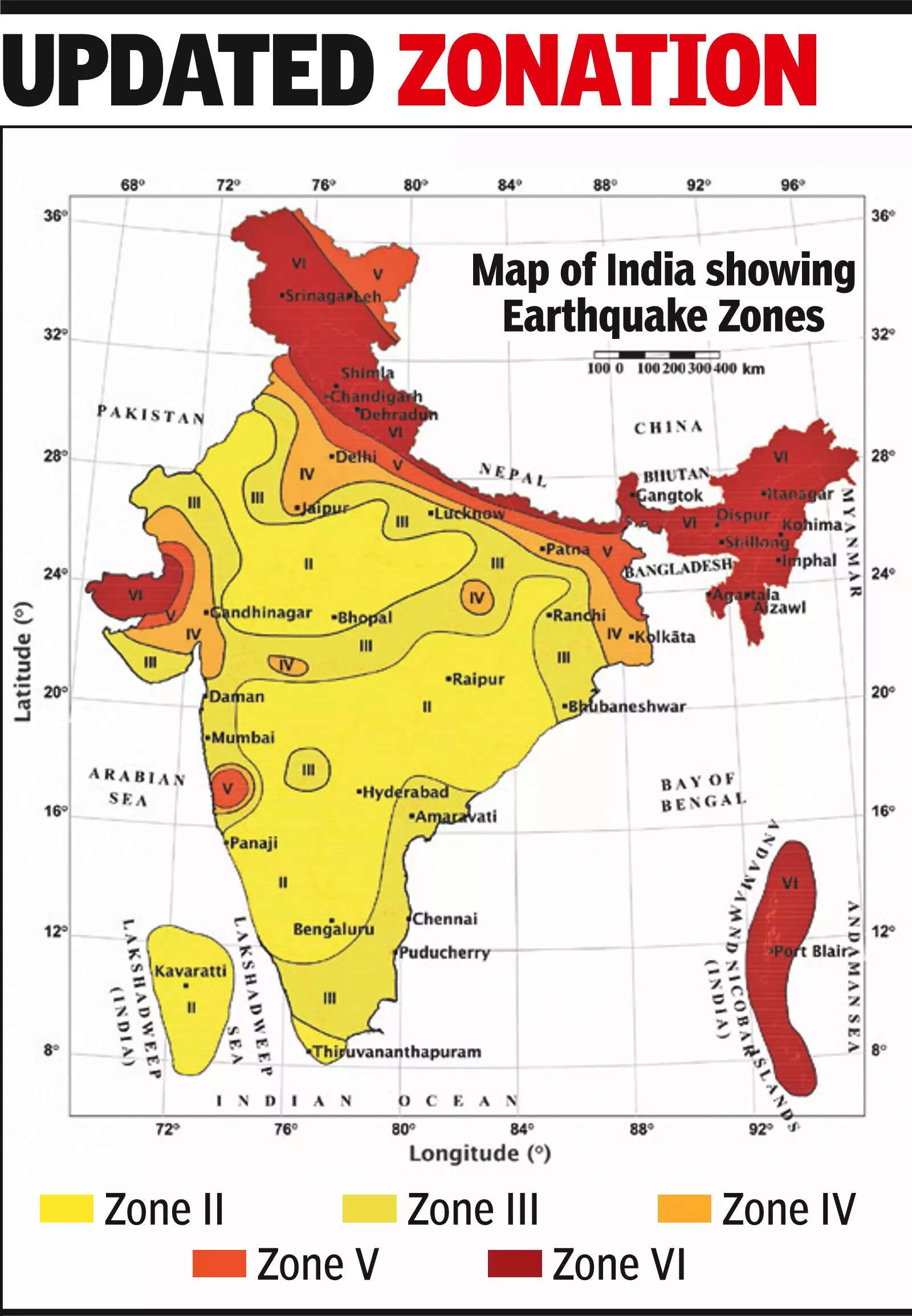
DEHRADUN: India has released a radically updated seismic zonation map under the new Earthquake Design Code, placing the entire Himalayan arc in a newly introduced highest-risk Zone VI for the first time, and reshaping the country’s understanding of earthquake exposure by showing that 61% of India now lies in moderate to high hazard zones, a shift that redefines how buildings, infrastructure and urban expansion must respond to the persistent tectonic stresses beneath some of the most densely populated regions in the subcontinent.Vineet Gahalaut, director of the Wadia Institute of Himalayan Geology and former director of the National Centre for Seismology, said the updated map finally brought much-needed uniformity to the Himalayan belt, which earlier remained split across Zones IV and V despite sharing the same underlying tectonic threat. He said previous versions underestimated the risks posed by long-unruptured fault segments, especially the central Himalayan stretch that has not produced a major surface-rupturing event in almost two centuries. “The earlier zonation did not fully account for the behaviour of these locked segments, which continue to accumulate stress,” he said, adding that the new framework adopted a more scientific, data-driven approach to seismic classification across the region.
The revision marks one of the most significant shifts in India’s seismic hazard assessment in decades because it reclassifies the outer Himalaya as a zone where rupture is likely to propagate southwards until it intersects the Himalayan Frontal Thrust, which in Dehradun region begins near Mohand, a shift that senior scientists told TOI has brought consistency to the entire Himalayan corridor, particularly in areas that earlier saw abrupt changes in hazard levels due to administrative boundaries rather than geological realities. Under the new map, towns situated along any boundary separating two categories will now automatically be placed in the higher-risk zone to ensure that planners and engineers do not rely on outdated assumptions about local hazard.Bureau of Indian Standards, which released the updated zonation as part of the revised Earthquake Design Code, said the map had been built using internationally accepted probabilistic seismic hazard assessment (PSHA) methods that incorporate detailed data on active faults, the maximum potential magnitude on each fault, the manner in which ground shaking diminishes with distance, the tectonic regime of each region and the lithology underlying various terrains. These inputs replace the earlier approach, which relied heavily on known epicentres and magnitudes of past earthquakes, broad geological features, soil classifications and historical damage surveys, and which often led to zone adjustments around industrial townships or large cities without fully accounting for fault-specific seismic potential.
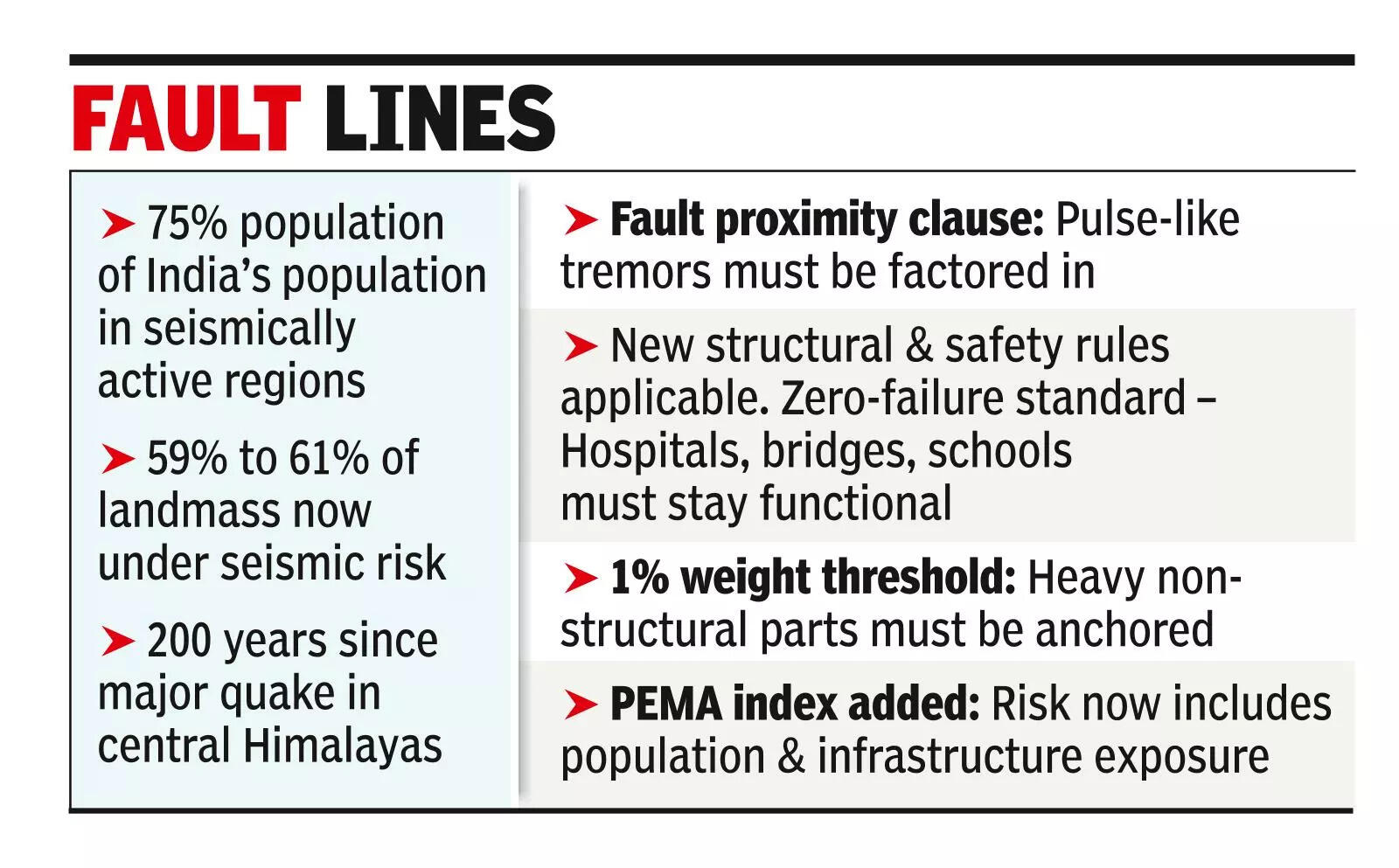
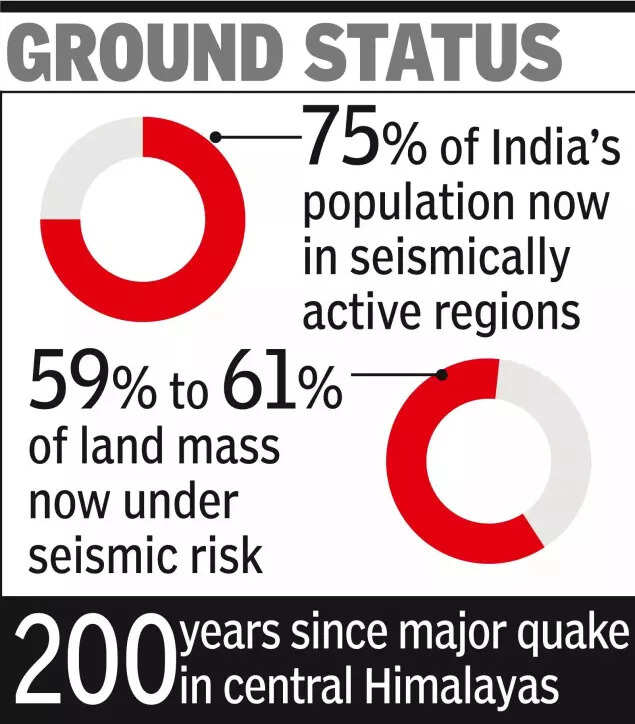
BIS said the new zonation provides a clearer understanding of the peak ground accelerations that can be expected during future earthquakes and urged that all new structures and infrastructure projects adopt the 2025 version instead of the 2016 map so that safety standards reflect the current assessment of seismic activity. The shift assumes particular importance because nearly three-fourths of India’s population now lives in seismically active areas, and the overall proportion of land falling under moderate to high hazard categories has increased from 59% to 61%.The revised design code introduces sweeping safety requirements for both structural and non-structural elements, with the latter receiving focused attention for the first time because components such as parapets, ceilings, overhead tanks, façade panels, electrical lines, lifts and suspended fixtures frequently fail during earthquakes even when the main structural frame survives. Under the new norms, all heavy non-structural components exceeding 1% of a building’s total weight must be securely anchored and braced to prevent internal collapses that endanger occupants, a requirement that engineers said would significantly reduce avoidable injuries during moderate earthquakes.
For buildings located close to active faults, the code mandates that structural design must consider severe pulse-like ground motions characteristic of near-fault earthquakes, and introduces updated limits relating to displacement, ductility and energy dissipation to prevent catastrophic failures. It also includes new provisions to address liquefaction risks, soil flexibility and site-specific response spectra, ensuring that structural performance reflects the actual behaviour of the ground beneath each development rather than generic assumptions applied across entire districts.The updated norms also tighten performance expectations for critical infrastructure such as hospitals, schools, bridges, pipelines and major public buildings, which must remain functional after a major earthquake to support emergency response and continuity of essential services. Engineers said this requirement aligns India with global best practices that prioritise resilience in essential facilities rather than mere survival of the structural frame.Another major addition to the 2025 map is the introduction of an “exposure window” that accounts for population density, infrastructure concentration and socioeconomic vulnerability using the probabilistic exposure and multi-hazard assessment (PEMA) method. This ensures that seismic zoning captures not just the physical hazard but also the degree of potential impact on communities, especially in urbanising regions where even moderate shaking can trigger widespread disruption due to high occupancy and dense construction.While the Himalayan region witnessed sweeping reclassification under the new map, the southern peninsula saw only minor scientific refinements, with its overall hazard profile remaining broadly unchanged because the tectonic regime there has shown relatively stable behaviour compared with the northern arc.
