

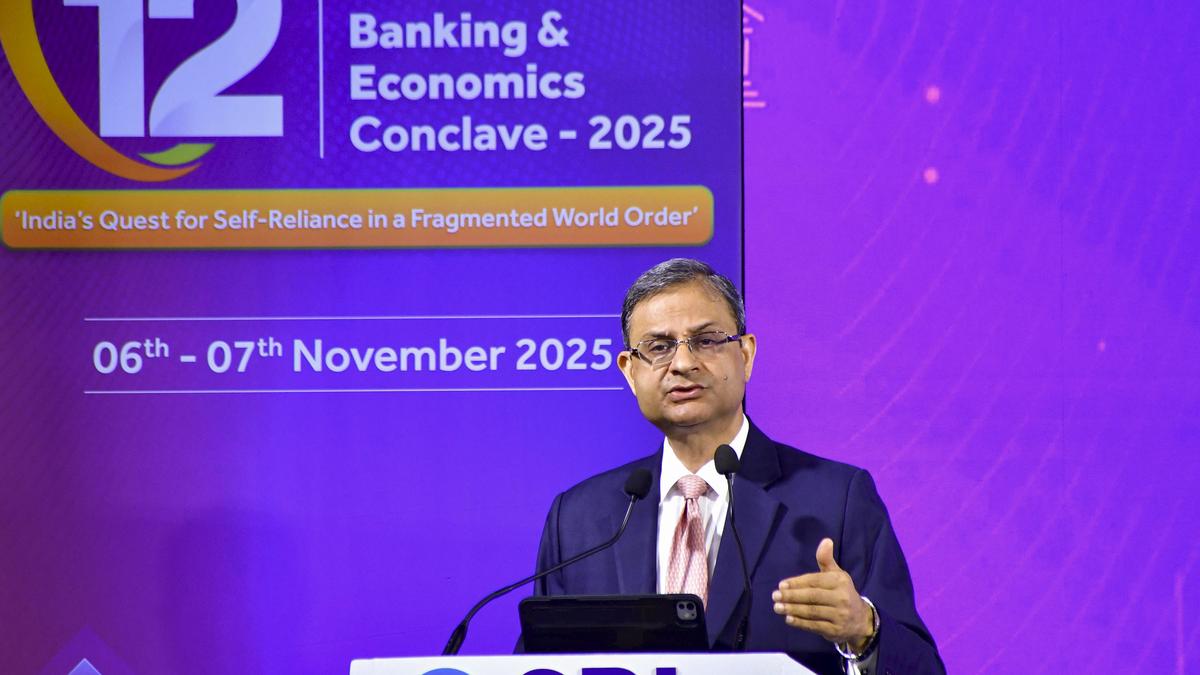
Reserve Bank of India (RBI) Governor Sanjay Malhotra addresses a gathering during the SBI Banking and Economics Conclave 2025, in Mumbai, Friday, Nov. 7, 2025.
’Owing to a series of regulatory measures aimed at ‘recognition, resolution and recapitalisation’ of the banking system, Indian banks today are far more mature than they were a decade ago, Reserve Bank of India (RBI) Governor Sanjay Malhotra said on Friday.
He said today credit and deposits have expanded almost three times. Capital buffers have strengthened too – CRAR rosefrom 13.5% ason March 31, 2015 to 17.5% as on March 31, 2025 with CET-1 increasingfrom 10.43% to 14.73% during the same period.
“Asset quality has also improved. GNPA and NNPA have reduced to 2.3% and 0.5% in March 2025 after rising to highs of 11.2% and 5.96% respectively in March 2018. Profitability of banks has enhanced significantly,” the Governor said while speaking at the SBI Banking & Economics Conclave.
“Between FYs 2017-18 and 2024-25, Return on Assets increased from -0.24% to 1.37%, and Return on Equity jumped from -2% to 14%. Regulation cannot ignore this performance, these changed realities,” he emphasized.
“This evolution implies that prudential rulebooks too should evolve in a calibrated manner as banks are now stronger and supervision more alert even as alternative risk-bearing pillars have deepened and market-based risk transfer mechanisms have become more effective,” he said.
Mr. Malhotra said regulatory measures such as Asset Quality Review (AQR) initiated in 2015,Prompt Corrective Action (PCA) framework, consolidation of 27 public sector banks into 12 by 2020, introduction of Insolvency & Bankruptcy Code (IBC in 2016, Project Finance Directionsregulatory measuressuch asCapital Market Exposure (CME), Market Mechanism for Large Borrowers,Reduction in Risk Weights for Infrastructure exposures of NBFCs and External Commercial Borrowing (ECB) framework had been balanced and appropriate.
These were built on the bedrock of a banking system that has been systematically fortified over the last decade, with financial stability remaining the unwavering cornerstone of RBI’s policy architecture, he said.
He emphasised that the RBI’s approach was calibrated: granting banks greater commercial leeway for growth, innovation and ease of doing business, while ensuring that risks were minimised and financial stability was maintained.
“We have set ourselves an ambitious goal of becoming an advanced economy by 2047. The financial sector has a large role to play in it. RBI remains steadfastly committed to this goal. We will ensure that our financial system evolves responsibly to support innovation, growth, and long-term economic resilience,” he concluded.
Published – November 07, 2025 07:49 pm IST
