

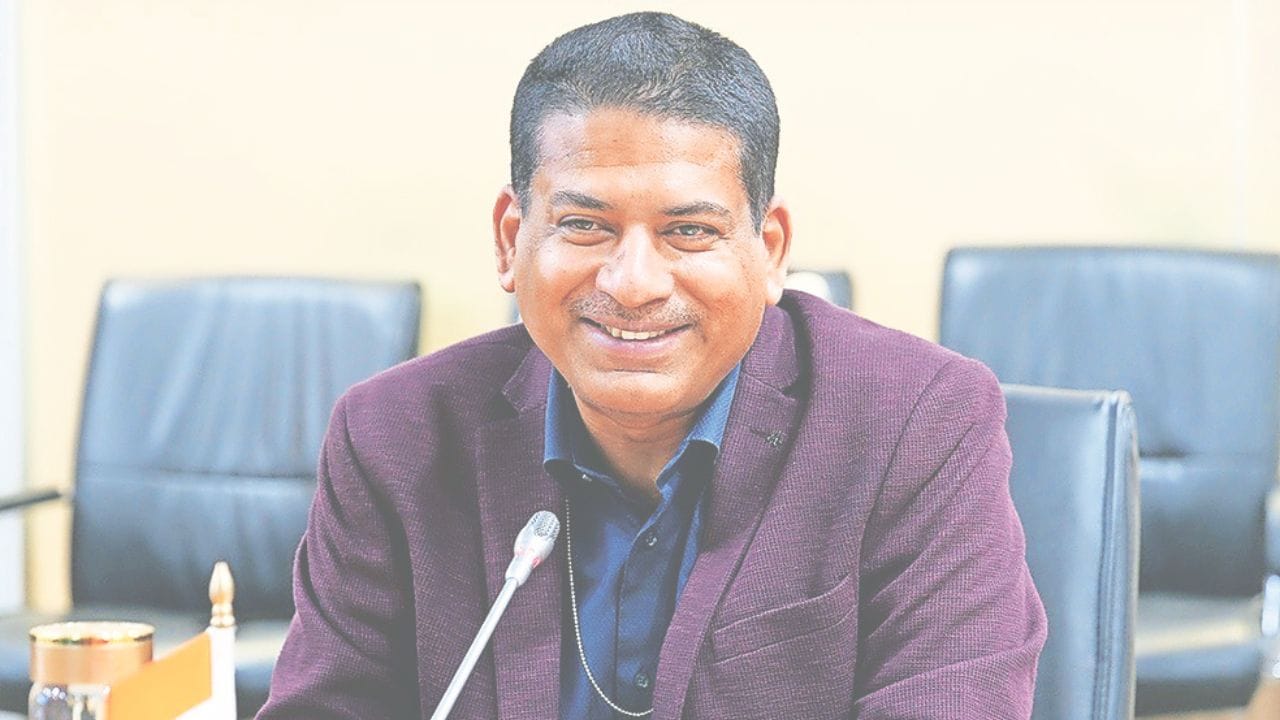
Even as the US has announced its decision to withdraw from the India-France-led International Solar Alliance (ISA), SANTOSH KUMAR SARANGI, Secretary, Ministry of New and Renewable Energy (MNRE), said the alliance’s future is bright irrespective of who is part of it. In an interview with The Indian Express, Sarangi said India and other like-minded countries will continue efforts to expand footprint in countries where solar deployment remains limited. Edited excerpts:
The upcoming data center boom is expected to increase the power demand. How much of this additional requirement would be met by renewable energy (RE) sources?
Most of them want RE sources. But probably they will use a combination of conventional power and RE till they get their full requirement from RE. To begin with, they will use a combination. For data centers, there is no mandatory requirement to use RE. They can run with conventional power entirely. But from a cost-economic perspective as well as decarbonisation perspective, they want to source more and more RE power. The Central Electricity Authority (CEA) estimates that by 2030, about 12 GW will be demanded by data centers. But that will actually depend on how many data centers are coming and what is the kind of power they are looking at. So, this is only a rough projection.
Amid the US withdrawal from the International Solar Alliance, how does the government view its future?
The future of the ISA is bright because the Solar Alliance targets countries that receive maximum sunshine. In this zone, the entire Middle East and Africa fall within this category. Therefore, India’s cooperation and engagement with Middle Eastern countries and Africa continue to remain strong. In terms of footprint, the ISA is also seeking to increase its interventions in regions where solar power has not been able to scale — largely in Africa. Therefore, irrespective of who is part of the ISA, India and other like-minded countries will continue their efforts to expand their footprint in countries where solar deployment remains limited.
China’s chokehold on rare earth elements is a global concern. RE projects need them. Are there plans to resolve these concerns?
If you are looking at some very core critical minerals which are used in advanced technology, advanced manufacturing including permanent magnets, then, renewable energy is not exactly dependent on those kinds of elements. Crystalline polysilicon is something that is available in other parts of the world also. Maybe at a slightly higher cost, but it is available. So, that way, that chokehold is not something that will impede the growth of manufacturing within the country.
Story continues below this ad
What is India’s roadmap as the West starts imposing carbon tax?
Decarbonisation initiative, not only for the European market, but for our own sake also, is required. You have seen the Emission Trading System (ETS) regulation, which has come up in the recent past, where they have added a few more sectors into the ET mechanism within our country. So, the decarbonisation initiative is something which most of the hard-to-abate sectors will have to initiate.
The pathway can vary from one industry to another. For example, if they do it through an electric arc furnace, the emission there is much lower and probably will come within the EU norms. But if somebody is using a blast furnace or a Direct Reduced Iron (DRI), then currently we are doing a pilot with a few steel industries to see if green hydrogen could also be utilised in their processes so that it decarbonizes.
JSW, for example, is putting up a 7,200 tonnes per annum hydrogen manufacturing capacity beside their Vijayanagara steel plant. And the effort is to decarbonise by directly using hydrogen in their processes. So, that’s one pathway. Similarly, aluminum industries are trying to source more and more RE power because they are highly electricity intensive. So, if they source more and more RE power, then in a way they are trying to decarbonise their aluminum manufacturing. Whether it is cement, steel, aluminum, they are adopting different paths of decarbonisation.
Story continues below this ad
Some are trying out carbon capture and storage mechanisms. But through different mechanisms, if they are able to fulfill the norm which is required by the EU, then I don’t think export will be an issue.
Power-intensive industries require uninterrupted supply. RE intermittency is a key challenge in the transition to green production. How does India plan to ensure reliable clean power for such industries?
The RE sector is no longer restricted to limited hours and is now capable of supplying round-the-clock (RTC) power through a combination of solar, wind and battery energy storage systems. With battery prices declining sharply over the last one to one-and-a-half years, RE-based RTC power is increasingly becoming cheaper than coal-based generation. If you look at the bids done by SECI, it discovered a tariff of Rs 3.12 per unit for solar power bundled with six hours of storage, while Indian Railways awarded a 1 GW RE-RTC tender at Rs 4.35 per unit, inclusive of battery storage. Several SECI RE-RTC bids have since been discovered in the Rs 5.06–5.30 range, compared to Rs 6.50–7 per unit for new coal-based power plants.
In addition, pumped storage projects (PSPs) are gaining traction, using surplus solar power during the day to pump water to upper reservoirs and generate electricity during peak evening hours. So, a combination of PSPs, solar, wind and base should be able to address their concerns. India’s battery storage capacity remains limited, emerging as a key bottleneck in integrating large volumes of renewable energy But recently, the Ministry of Power has come up with a VGF scheme, where they have tendered it out for 43 gigawatts. So, there is going to be a very rapid deployment of battery energy storage in our country.
Story continues below this ad
India achieved its target of sourcing 50% of cumulative installed power capacity from non-fossil fuels in June 2025 — five years ahead of its global commitment — and now has 266 GW of RE capacity. But thermal power still accounts for over 70% of generation. How can India meaningfully increase the share of renewables in actual power generation?
In several recorded months, RE has accounted for over 30 per cent of total electricity generation. While variable renewables such as solar and wind alone contribute around 14 per cent, their share rises to nearly 30 per cent when hydro and other non-fossil sources are included. On average, non-fossil fuel sources — covering solar, wind, large hydro and around 8 GW of nuclear capacity — currently meet about 25-26 per cent of India’s power generation, with the remainder coming largely from coal-based plants.
However, deeper integration of RE requires addressing its inherent variability and intermittency. This necessitates a significant scale-up of battery energy storage systems (BESS), pumped storage projects (PSPs), and grid-supporting technologies such as grid-forming inverters, synchronous condensers and
STATCOMs, which help manage reactive power, grid inertia and stability.
Story continues below this ad
The transition is already underway, with the Ministry of Power floating tenders for 43 GWh of battery energy storage capacity. As storage deployment expands and advanced grid technologies are adopted at scale, the grid’s ability to absorb higher shares of RE will improve. So, we are hopeful that by 2030, our grid will also be ready to absorb more and more RE.
There has been discussion, including in a recent staff paper, on making signed PPAs a precondition for granting transmission connectivity to renewable projects.
What is MNRE’s view on this proposal, and do you see it benefiting the sector or creating challenges for project developers?
There are pros and cons. If you have a prior PPA, then that gives you certainty that off-take is there. And therefore, this transmission line will be done. But even if there is no PPA, the people who are applying through bank guarantee (BG) or land route, they are giving a bank guarantee. And in case of their default, they will be penalised. And that penalty is quite heavy. It’s about 10 lakhs per MW which they are collecting as BG. So, I don’t think any non-serious player will just take connectivity by giving this kind of BG with the risk of foregoing and forfeiting that BG.
