

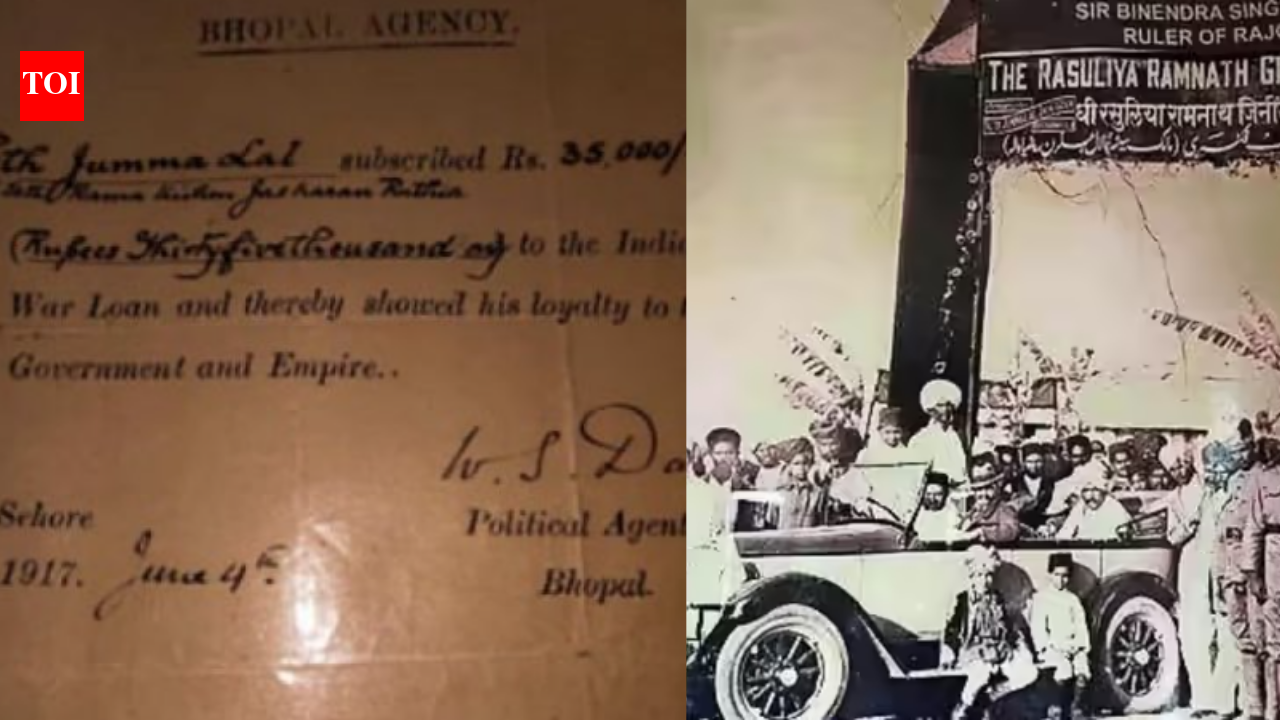
BHOPAL: While most families argue over ancestral land and jewellery, a Sehore family is dusting off a 109-year-old ledger – and preparing to ask the United Kingdom to clear what they call a pending bill from 1917. Vivek Ruthia, 63, claims that his grandfather, Seth Jumma Lal Ruthia, a prominent businessman of Sehore, advanced Rs 35,000 in 1917 to W S Dawis, then the political agent in Bhopal under British rule. According to the Ruthia family, the amount was given to assist in administrative management in the Bhopal State. More than a century later, Ruthia says the money was never repaid. He is now consulting lawyers to understand the scope of international law and whether a sovereign government can be held accountable for financial liabilities incurred during the colonial era. While no legal notice has yet been served, Ruthia says he is consulting lawyers to examine whether such a colonial-era financial claim can be pursued against the present-day United Kingdom. According to a certificate preserved by the family, dated June 4, 1917, Seth Jumma Lal, of the firm Seth Rama Kishan Jaskaran Ruthia, “subscribed Rs 35,000 to the Indian War Loan and thereby showed his loyalty to the Government and Empire.” The document bears the signature of W S Davis as Political Agent in Bhopal.
These officers managed relations with local rulers, supervised governance matters and ensured alignment with British authority. Historians also note that W S Davis, who had signed the bond certificate, had literary associations in Bhopal. He apparently had translated Hayat-i-Qudsi: Life of the Nawab Gauhar Begum, a biography written by Sultan Jahan Begum and published in 1918. Ruthia said he recently found the certificate while searching for other family documents. “My grandfather was into charity. This was a loan given to the British government during the war and it was never returned. My father never pursued it, but I am exploring legal options now. I will move to recover the money with interest as per statues of present-day law,” he said. Seth Jumma Lal Ruthia passed away in 1937, nearly two decades after the subscription. The British left India in 1947. The family claims that no repayment or settlement was ever made. Family feels if calculated at 5.5% annual compound interest for 109 years (1917-2026), the amount would rise to crores and if indexed to gold prices, which have increased more than 3,000 times since 1917, the equivalent value today could exceed Rs 10 crore. Legal experts however point out that any such claim would face complex hurdles, including limitation laws, sovereign immunity and cross-border jurisdiction. For now, the 1917 certificate remains a historical document in family custody. TNN
