

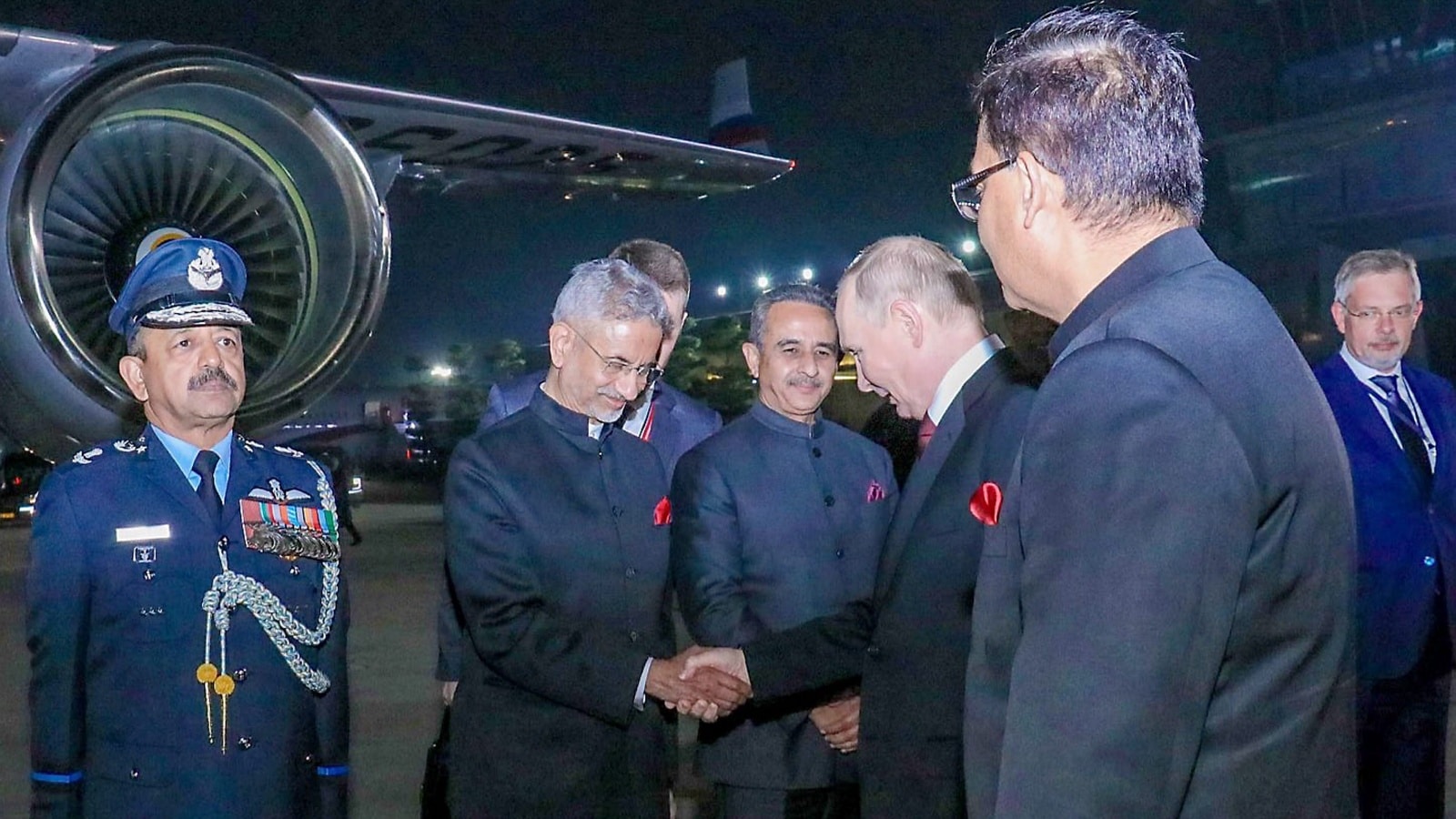
Underlining India’s “freedom of choice” in its relationships, External Affairs Minister S Jaishankar on Saturday said Russian President Vladimir Putin’s two-day visit won’t complicate India’s ties with the United States. Defining India’s ties with Russia as “among the steadiest big relationships” in the world, he said Putin’s visit was about “re-imagining” the ties with a focus on economic engagement.
Emphasising “strategic autonomy”, Jaishankar, during an interactive session at the HT Leadership Summit in New Delhi, said, “Everybody knows that India has relations with all the major countries of the world. And for any country to expect to have a veto on how we develop our relationships with others, is not fair.” He was responding to a question on Putin’s visit amid trade tensions with the US, after the Donald Trump administration imposed an additional 25% penalty tariff on India for importing Russian oil.

“I think we have always made it very clear that we have multiple relationships. We have a freedom of choice,” Jaishankar said. “We talk about what is called strategic autonomy and that continues… I cannot imagine why anybody would have reason to expect the contrary,” he said.
While he said the Trump administration’s functioning was “radically different”, he expressed confidence that a balanced Bilateral Trade Agreement (BTA) could be achieved. Without specifying any time frame, Jaishankar said the potential trade deal could happen “soon”, even as he reiterated India’s red lines on negotiations “in order to safeguard the interests of farmers, workers, and small businesses”.
“Every government and every American President has their own way of approaching the world. I can grant you that in the case of President Trump, it’s radically different from how his predecessor did it,” Jaishankar said.
On the ongoing negotiations on the BTA, he said: “We have right now a set of issues because of which the relationship is crippled… What you try to do is engage and walk through the issue. We believe there can be a landing point for our respective trade interests, which will be negotiated hard — because at the end of the day, the interests of the workers, farmers, small businesses and middle-class matter.”
He said India and the US are currently holding negotiations to close the first tranche of the deal. “When we look at a trade agreement with a country like the US, you have to be extremely judicious about your position, about what you put on the table,” he said.
Story continues below this ad
On the sticky issues between India and the US, he said: ”I think clearly right now, trade is the most important issue there… it’s clearly very central to the thinking in Washington, much more than it was to earlier administrations, which is something we have recognised and are prepared to meet.”
“But we are prepared to meet it on reasonable terms… for those of you who think that diplomacy is about pleasing somebody else. I’m sorry, that’s not my view of diplomacy. To me, it is about defending our national interests,” he said, responding to a question on whether South Block could have handled Trump’s repeated claims of brokering a ceasefire between India and Pakistan differently.
Talking about India-Russia ties a day after Putin’s visit, Jaishankar said for a “big and rising” country like India, it is important to maintain good cooperation with as many important players as possible in the world, in line with the freedom of choice. “If you look at India-Russia, the world has seen a lot of ups and downs in the last 70-80 years. I’ve said this before and I’ll say it again, India, Russia have actually been among the steadiest big relationships, big power or big country relationships in the world,” he said.
“Even Russia’s own relationship with China or US or Europe has had its ups and downs. Our relationships with many of these countries have had it too,” he said.
Story continues below this ad
Jaishankar said Putin’s visit was about “re-imagining” India-Russia ties, with a focus on economic engagement. “In the case of Russia, they visualised the West and China as their primary economic partners. We visualised perhaps the same… So the economic side of the relationship had somehow not kept pace,” he said.
Jaishankar also spoke about the recent reset in India-China ties. “Prime Minister Modi and President Xi (Jinping) met in October 2024. Since then, by and large, border areas have remained stable… Peace and tranquility in border areas is a key requisite to good relationships,” he said.
“But it’s not like that was the only issue in the relationship. There were many other issues, some of which predated Galwan (clashes of 2020). So there are issues about trade, investment, competition, subsidies, fairness, transparency,” he said. “These are real issues as well. We are trying to work our way through some of these. Some of it is easier, some of it is harder,” he said.
Asked if former Bangladesh Prime Minister Sheikh Hasina — who faces a death sentence in her country — would continue to stay in India, he said: “She came here in a certain circumstance and that clearly sort of is a factor in what happens to her. But again, that is something which she has to make up her mind on.”
