

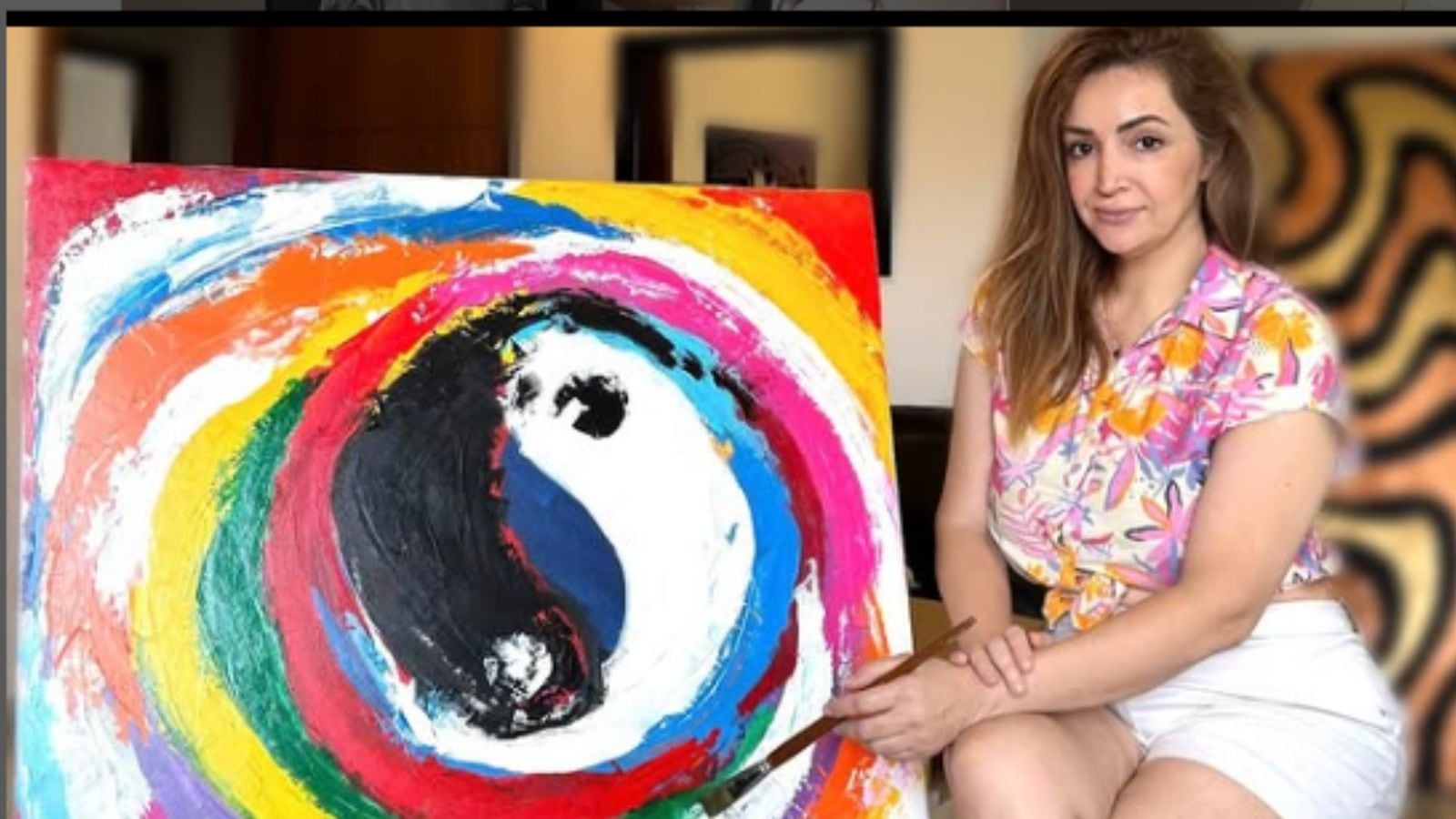
She didn’t know it until a few years ago, but Hasti Rajabi’s early life in conservative Iran was preparing her to become an artist advocating the right of women to express themselves freely. “From childhood, I enjoyed art and was always sketching and painting. I was a shy girl and found an outlet for my emotions on paper. I was painting, sketching, and painting for myself,” she says.
Her school understood her talent and encouraged it.

She married early and started a family. “I continued to make handicrafts and different kinds of art through it all,” she says. Rajabi is concerned about the status of women in her home country, which has strict rules for women. Last year, 22-year-old Mahsa Amini died in police custody after she was arrested for not wearing the hijab properly.
In 2011, when Rajabi’s friend who was studying dentistry in India asked her to come over, the artist bought a plane ticket that would change her life. “I didn’t know anything about India except Bollywood, dances, and the festivals that I watched on TV. But I decided on a night. I came to India. I had to learn English as my mother tongue is Farsi, and we never spoke English,” says Rajabi.
She calls India a magic country, but it was also a blank slate. She studied at Symbiosis for a year but decided to pursue painting instead. “This is where I began to find myself and express my feelings through art,” she says. She never exhibited her art in a gallery before.
A deeply personal exploration
A collection of her works is on display, Rajabi’s first solo show, at Pune’s Vesavar Art Gallery till November 11. Fittingly, the show is called Becoming. “The exhibition is a deeply personal exploration of transformation, emotion, and evolving identity, where each artwork reflects the process of inner growth, healing, and rediscovery,” says Rajabi, who lives in Pune now.
For a long time, art was a way for Rajabi to express a silent language. Even during the terrifying days of the pandemic, she was painting. Then she made a leap. Rajabi started to show my art with the purpose of inspiring and empowering women to express themselves freely and fearlessly. “A difficult situation in a woman’s life, such as a divorce, can bring them down. They feel no control and fear that they are weak. Through my art, I began to send out a message that they are enough,” she says.
Her style is modern and emotional. She works with mixed media, layers, and texture because emotions are never flat. “I love calligraphy as well as the abstract form,” she says. One of the most powerful pieces is The Universe in Her Step. It has a number of women holding hands and dancing. The piece is a celebration of feminine energy and unity. Each figure moves in harmony with the cosmos. Each colour in the work is symbolic; red is for desire and love, green is for renewal and nature, while yellow recalls the glowing sun, marking a beginning.
Story continues below this ad
Another piece, The Anatomy of Hasti, is a direct reflection of her inner world and journey. The covered eyes in the work speak of moments when she walked through life not knowing what lay ahead. “My message to viewers is that every scar creates a story. This is mine, painted for anyone who has ever turned darkness into light,” she says.
In Iran, meanwhile, Goli Kouhkan, 25, who had been a child bride, is facing execution for killing her abusive husband unless she raises an exorbitant amount by December to pay his family.
“I would like to be a representative of Iranian women, who are suffering in my country,” says Rajabi.
